
Antebellum Era
Slavery, commerce, and the road to war
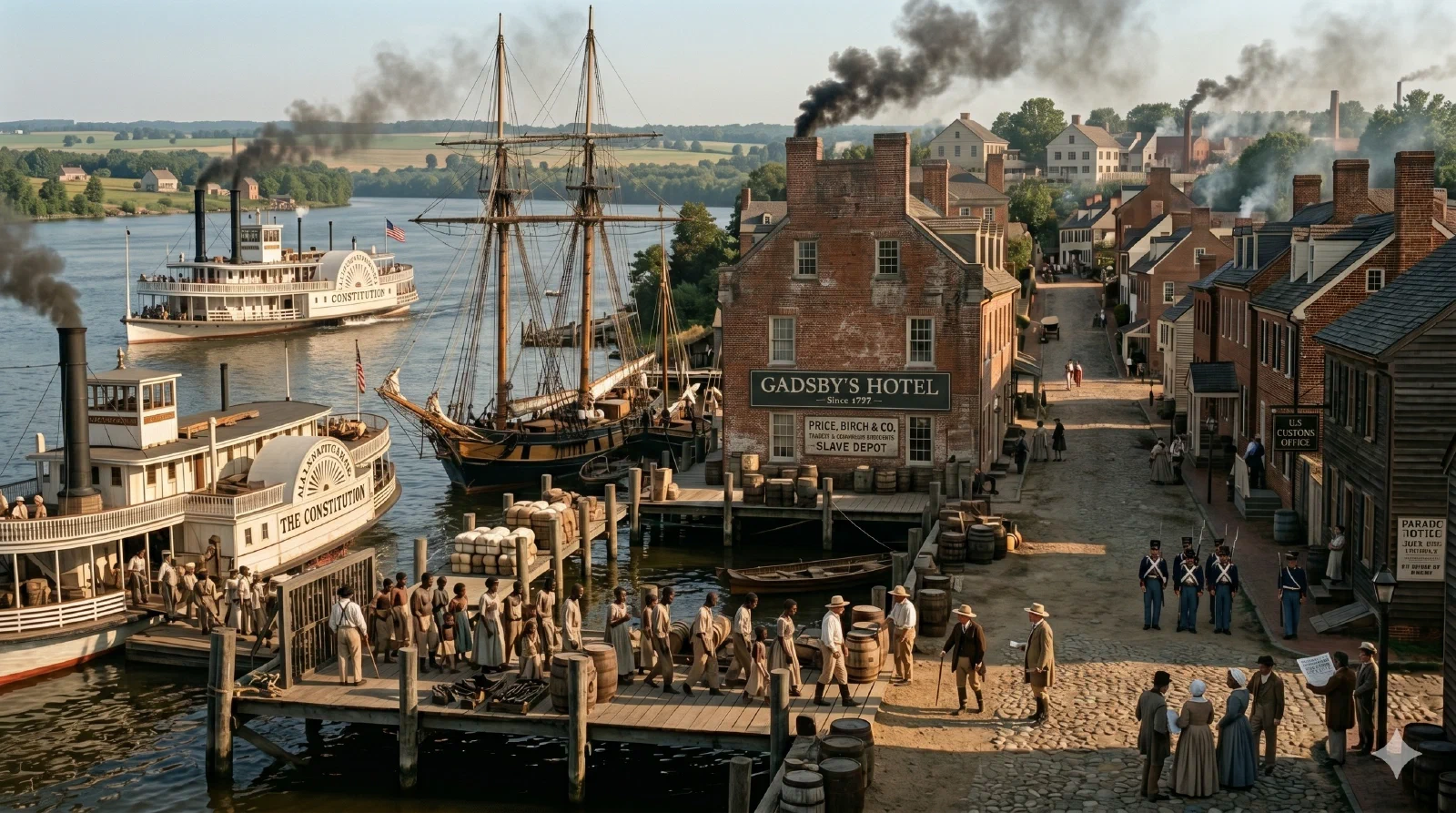
For three decades between Andrew Jackson and Fort Sumter, Alexandria is the United States’ largest domestic slave-trade clearinghouse — a port-town economy organized around the buying, holding, and shipping south of human beings sold off the played-out tobacco plantations of the upper South. The trade is centered at 1315 Duke Street 1315 Duke Street Federal-style brick house at 1315 Duke Street built in the 1810s by Brigadier General Robert Young of the DC Militia; from 1828 to 1837 the headquarters of Franklin & Armfield, the … , the brick Federal compound at 1315 Duke Street that John Armfield John Armfield b. 1797 · d. 1871 North Carolina–born slave trader who managed the Alexandria operations of Franklin & Armfield from 1828 to 1836, directing the collection and forced transport of thousands of … and Isaac Franklin Isaac Franklin b. 1789 · d. 1846 Tennessee-born slave trader who, with partner John Armfield, operated the largest domestic slave trading firm in the United States during the 1830s. Franklin managed the firm's New … purchase in 1828. Their firm — Franklin & Armfield — runs more enslaved people through the New Orleans market in the 1830s than any other American trafficking firm. A few blocks south, 1707 Duke Street 1707 Duke Street Antebellum jail compound operated by slave trader Joseph Bruin from the 1840s through emancipation. NRHP-listed 2000. operates Joseph Bruin’s competing operation through the 1850s.
The Black Alexandria of this era resists. The Mary and Emily Edmonson attempt the famous Pearl schooner escape in 1848 along with seventy-five other Alexandria and Washington-area enslaved people; captured and sold to Bruin, they are eventually freed by abolitionist fundraising. Harriet Jacobs Harriet Jacobs b. 1813 · d. 1897 Formerly enslaved author of Incidents in the Life of a Slave Girl (1861) who, with her daughter Louisa, worked among formerly enslaved people living in and around Union-occupied … , who as a child hid in the attic crawl-space of her free grandmother’s home in nearby Edenton, North Carolina, will publish Incidents in the Life of a Slave Girl in 1861, the most widely circulated firsthand account of the slave-trade economy that Alexandria’s port served.
Black church-founding
The same decades produce the foundation of Alexandria’s surviving Black religious institutions. 313 South Alfred Street 313 South Alfred Street One of the oldest African-American Baptist congregations in the United States, founded in 1803; present sanctuary erected 1855. NRHP-listed 2004. is gathered in 1803 and grows substantially across the 1830s and 1840s; it remains one of the oldest continuously active Black Baptist congregations in the United States. 606 South Washington Street 606 South Washington Street Mid-19th-century chapel, part of Alexandria's antebellum African Methodist Episcopal congregation. NRHP-listed 2004. and a network of small Methodist meeting houses serve the free Black community. After the Civil War 320 South Washington Street 320 South Washington Street Founded in 1863 by formerly enslaved Black congregants; one of the earliest independent Black Baptist churches in the South. NRHP-listed 2004. will be founded in 1863 from the camp of formerly enslaved contrabands gathering inside Union lines — but the Black religious geography of the post-war city traces directly to the antebellum churches.
A Greek Revival commercial center
The white-Alexandrian wealth being generated by the slave trade and the wheat-shipping economy goes into civic and commercial architecture. 201 Prince Street 201 Prince Street Greek Revival temple-front building completed 1851 at 201 Prince Street as the Bank of the Old Dominion. Used during the Civil War as a Union commissary, later a church, and since … opens at 201 Prince Street in 1851 as the Bank of the Old Dominion — Greek Revival temple-front, four-column Doric portico, the architectural vocabulary of antebellum American institutional respectability. The 811 Prince Street 811 Prince Street Italianate residence built 1854 by merchant John Bayne; later occupied by the Fowle family of shipbuilders. NRHP-listed 1986. (1854) is built in the emerging Italianate vocabulary that will define late-antebellum townhouse construction. The 614 Wolfe Street 614 Wolfe Street Two-story brick schoolhouse built 1786 on Wolfe Street. was a founding trustee and bequeathed funds for free education of poor children. Later home to a free school for Black … continues teaching boys; alexandria-historic-district alexandria-historic-district Old and Historic Alexandria District, the colonial-through-antebellum core of the city, listed on the National Register in 1966. acquires its essentially complete antebellum form during this era.
Schools, churches, and the seminary
In 1839 the future Episcopal bishop William Meade William Meade b. 1789 · d. 1862 Second Bishop of Virginia (consecrated 1841; assistant bishop 1829–1841) and the founder of Episcopal High School in Alexandria in 1839 — the first high school in Virginia. A … founds 1200 North Quaker Lane 1200 North Quaker Lane The first high school in Virginia, founded 1839 by Bishop William Meade of the Episcopal Diocese on a 100-acre campus west of Old Town. First principal William Nelson Pendleton … on the high ground west of the city, the first high school in Virginia. The 3737 Seminary Road 3737 Seminary Road Episcopal theological seminary founded in Alexandria in 1823 and relocated to its present hilltop campus in 1827. Occupied by Union forces during the Civil War and used as a … has been training Episcopal clergy on the same Quaker Lane corridor since 1823; Aspinwall Hall, the seminary’s central building, is completed in 1859, the same year a young Phillips Brooks Phillips Brooks b. 1835 · d. 1893 Episcopal Bishop of Massachusetts (1891–93), preacher of national reputation, and lyricist of the Christmas carol "O Little Town of Bethlehem" (1868). 1859 graduate of the . graduates and rides off toward a Philadelphia rectorship that will eventually produce “O Little Town of Bethlehem.”
The road to war
Alexandria votes to secede on May 23, 1861. The next morning, Union troops cross the Potomac and begin the longest occupation of any major Southern city in the war. The antebellum era closes at sunrise on May 24. the Marshall House, an inn at King and Pitt, will be the first military fatality of the war’s ground campaign within hours of dawn — a Union colonel shot descending the staircase with a Confederate flag he had taken from the inn’s roof, and the innkeeper killed in turn.