
Civil War and Occupation
Union occupation of Alexandria
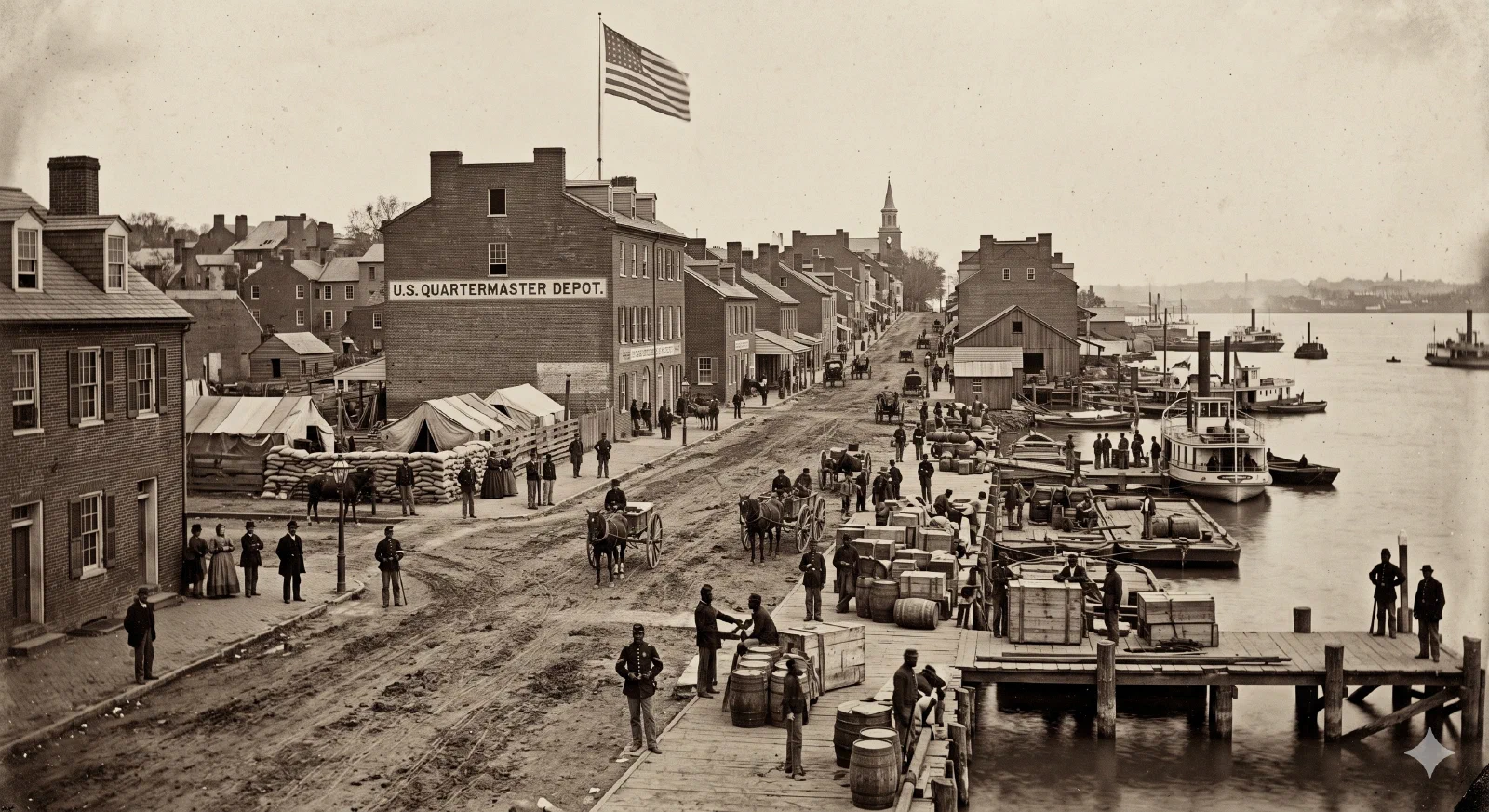
Alexandria spends almost the entire Civil War under Union occupation — 1,438 days, from the dawn of May 24, 1861 through the end of the war in April 1865. The longest continuous federal occupation of any major Southern city in the war reorganizes the town entirely: its commerce stops, its plantations are seized, its churches are requisitioned as hospitals and commissaries, and its enslaved population becomes the legal nucleus of the Department of the Potomac’s contraband and freedmen’s organization.
The first occupation morning
The day after Virginia votes to secede, the Lincoln administration sends troops across the Long Bridge. Colonel Elmer Ellsworth’s 11th New York Volunteers (the Fire Zouaves) march up King Street. At the Marshall House, an inn at King and Pitt, Ellsworth climbs to the roof, removes a Confederate flag visible from the White House, and is shot dead descending the stairs by the innkeeper James Jackson — who is in turn killed by Ellsworth’s sergeant. The first ground-combat fatality of the war on either side dies at the Marshall House on the morning of May 24, 1861. Both men become martyrs in their respective sectional presses.
The fortified ring
The Union army quickly raises a ring of earthwork fortifications along the high ground west of the city. 4301 West Braddock Road 4301 West Braddock Road Earthwork fort raised in 1861 as part of the ring of Union fortifications around Washington; the fifth-largest of the Civil War defenses of the capital. After the war the fort's … on Seminary Hill is the largest of the Alexandria forts — five-bastion earthwork, mounted with thirty-six guns, garrisoned through the war. Seminary Hill (off Seminary Road, near St. Stephens Road) Seminary Hill (off Seminary Road, near St. Stephens Road) Layered Seminary Hill site that was the country estate "Muckross" of Burke & Herbert Bank co-founder Arthur Herbert, the Civil War earthwork Fort Worth (1861-1865), and finally the … is built on the same Seminary Ridge corridor; the broader Defenses of Washington ring the capital’s southern flank. Most of the forts are dismantled at the war’s end; Fort Ward is preserved today as the most-restored of the Civil War-era earthworks.
Hospitals, cemeteries, and the contrabands
Alexandria becomes the Union’s largest hospital city. Civilian buildings across Old Town are converted into wards; 3737 Seminary Road 3737 Seminary Road Episcopal theological seminary founded in Alexandria in 1823 and relocated to its present hilltop campus in 1827. Occupied by Union forces during the Civil War and used as a … ’s buildings serve as hospital space; 201 Prince Street 201 Prince Street Greek Revival temple-front building completed 1851 at 201 Prince Street as the Bank of the Old Dominion. Used during the Civil War as a Union commissary, later a church, and since … becomes a U.S. Army commissary depot; 1200 North Quaker Lane 1200 North Quaker Lane The first high school in Virginia, founded 1839 by Bishop William Meade of the Episcopal Diocese on a 100-acre campus west of Old Town. First principal William Nelson Pendleton … ’s buildings are converted to ward use. 219 South Payne Street 219 South Payne Street Union Army hospital established in February 1864 for U.S. Colored Troops and Black civilian refugees in occupied Alexandria. Named for Toussaint Louverture, the Haitian … is established in February 1864 specifically for the United States Colored Troops — Black Union soldiers who could not be admitted to the white-only military hospitals. It is the only such USCT facility of its scale in the eastern theater.
The 1450 Wilkes Street 1450 Wilkes Street One of the original fourteen national cemeteries established in 1862, interring Union dead from the Civil War, including United States Colored Troops reinterred from L'Ouverture … is one of the fourteen original national cemeteries established by Lincoln’s 1862 National Cemetery Act. The 1001 South Washington Street 1001 South Washington Street Burial ground established in 1864 by the Union military government on the southern edge of Federally-occupied Alexandria for self-emancipated Black people — "contrabands" in … on South Washington Street, established in 1864, holds the remains of approximately 1,800 Black Alexandrians — escaped enslaved people who reached Union lines and the freedmen who followed them. The cemetery was paved over for an Esso gas station in the 1960s; its rediscovery in the 1980s and re-consecration in 2014 close one of the longest open civil-rights wounds in the city’s modern history.
The contraband camp and church-founding
The contraband population — Freedmen of the Contrabands Camp Freedmen of the Contrabands Camp founded 1861 Collective entity representing the several thousand formerly enslaved people who fled to Union-occupied Alexandria during the Civil War, settling in camps at Shuter's Hill, around … — gathers in temporary encampments north of Old Town. Out of those camps the founding generation of Black Alexandria’s post-war institutions emerges. 320 South Washington Street 320 South Washington Street Founded in 1863 by formerly enslaved Black congregants; one of the earliest independent Black Baptist churches in the South. NRHP-listed 2004. is gathered in 1863 by formerly enslaved congregants — the oldest of Alexandria’s post-emancipation Black congregations. 313 South Alfred Street 313 South Alfred Street One of the oldest African-American Baptist congregations in the United States, founded in 1803; present sanctuary erected 1855. NRHP-listed 2004. , already established before the war, becomes a hub for the contraband community. The Black religious geography of post-war Alexandria takes shape inside the four-year occupation.
The orange-and-alexandria railroad
The Jamieson Avenue at Hooff's Run Jamieson Avenue at Hooff's Run 1851 stone arch railroad bridge, in continuous use since the eve of the Civil War. NRHP-listed 2003. — 1851 stone arch over the future Potomac Yard site — is one of the heavily guarded transportation arteries the Union army keeps open through the war. The rail yard’s wartime role establishes the infrastructure that will transform west-end Alexandria into the late-19th-century industrial corridor.
When Lee surrenders at Appomattox on April 9, 1865, Alexandria has been under federal occupation for nearly four years. The Union army withdraws over the next year. The civilian government returns. The slave-trade complex at 1315 Duke Street 1315 Duke Street Federal-style brick house at 1315 Duke Street built in the 1810s by Brigadier General Robert Young of the DC Militia; from 1828 to 1837 the headquarters of Franklin & Armfield, the … is abandoned. The Black families who came in through the Union lines in 1862 are still in Alexandria; the city they will rebuild begins.