Colonial Era
Northern Neck Proprietary through the eve of Revolution
The Alexandria of the colonial era is administered from a manor house on a Potomac bluff four miles downstream and from a ledger book in the Northern Neck land office. The town has not been founded yet — not until 1749 — and the riverfront where it will rise is open country: tobacco fields running down to a deep-water bend in the Potomac, owned by a small handful of grantees holding their parcels under the Northern Neck Proprietary, the five-million-acre proprietary tract granted to the Fairfax family by Charles II in 1649. The proprietary is administered out of belvoir-plantation belvoir-plantation The c. 1741 manor house of on the southern Northern Neck proprietary tract — social anchor of the colonial Fairfax–Washington circle, where young was mentored by William Fairfax … , the c. 1741 manor house of William Fairfax William Fairfax b. 1691 · d. 1757 Colonial-era owner and builder of (c. 1741); cousin and Virginia agent of Thomas Fairfax, 6th Lord Fairfax of Cameron, the Proprietor of the Northern Neck. President of the … , agent for his cousin Thomas Fairfax, 6th Lord Fairfax of Cameron. The names that will end up on streets and creeks across modern Northern Virginia — Cameron, Fairfax, Lee, Carlyle, Alexander — are all in commercial and social orbit around Belvoir during the 1740s.
In 1749 the Virginia House of Burgesses charters the town. The plat is laid out by sixteen-year-old George Washington in his first paid surveying job, sketching streets and lots on the John Alexander John Alexander b. 1711 · d. 1764 Great-grandson of , the immigrant patriarch who in 1669 bought the 6,000-acre Howson tract on which the city of Alexandria was later platted. The John Alexander who held the … family’s tobacco farm at the bend in the river. The 301 King Street 301 King Street Public square at 301 King Street fronting Alexandria City Hall — site of an open-air farmers market continuously operated since 1753, the longest-running open-air market in the … at the center of the plan opens for trade in 1753 — the longest continuously operating open-air market in the United States — and the early Georgian houses begin going up immediately around it. John Carlyle John Carlyle b. 1720 · d. 1780 Scottish-descent merchant born in Carlisle, England, in 1720; one of the eleven founding trustees of Alexandria in 1749, and builder of the stone Carlyle House at the head of what … , a Scottish merchant who has married into the Fairfax circle, completes the stone Georgian mansion at 121 North Fairfax Street 121 North Fairfax Street Stone Georgian mansion built in 1753 by Scottish merchant John Carlyle; headquarters in April 1755 for General Edward Braddock's Congress of five royal governors planning the … in 1753; in 1755 General Edward Braddock will use the house’s parlor as the headquarters where five royal governors plan the disastrous opening campaign of the French and Indian War.
A port town on a slave economy
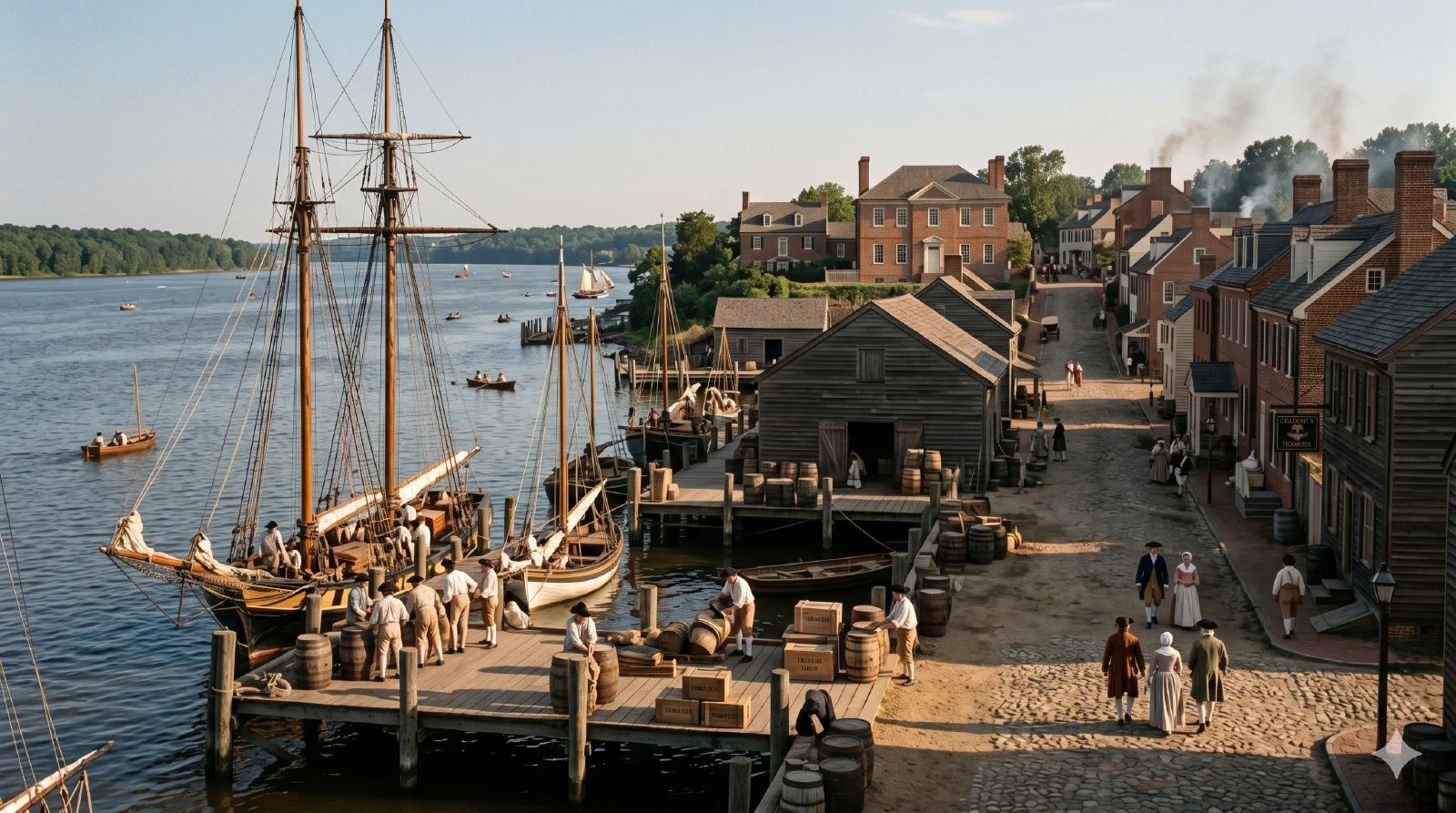
Colonial Alexandria’s commerce is tobacco, flour, and human trafficking. The hogsheads of tobacco rolled down to the wharves are inspected and weighed at the public warehouse on the waterfront; the cleared and graded leaf is shipped out to Glasgow and Bristol, and the ships return with manufactured goods, indentured servants, and enslaved Africans. The town’s enslaved population is documented at every social register of the era — domestic staff in the Alexander, Fairfax, Carlyle, and Washington households; field labor on the plantations ringing the city; warehouse hands at the wharves. The patterns of enslavement that will define antebellum Alexandria’s slave-trade economy a century later are already in place.
Anglican parish establishment
The town’s first major institutional building is 118 North Washington Street 118 North Washington Street Alexandria's Georgian-style Episcopal parish church, consecrated in 1773; pew owners included George Washington and, decades later, the Lee family. , designed in 1767 by gentleman-architect James Wren James Wren b. 1728 · d. 1815 Eighteenth-century vestryman and gentleman-architect of Fairfax County, designer of the three surviving colonial Anglican parish churches in Northern Virginia — including in … and consecrated in 1773 — the first of three colonial Anglican parish churches that Wren designed across northern Virginia. Pew rights are sold for the funding of the construction; George Washington George Washington b. 1732 · d. 1799 Planter, military commander, and first President of the United States. Master of Mount Vernon from 1761 until his death in 1799, and a regular presence in Alexandria, which he … , by then a militia colonel and Mount Vernon proprietor, holds Pew 5. The 321 South Fairfax Street 321 South Fairfax Street Brick Presbyterian meeting house begun in 1775; site of the city's memorial services for George Washington on December 29, 1799, four days before his funeral at Mount Vernon. breaks ground in 1775 — Scottish merchants like Carlyle had been worshipping in private homes; the Meeting House is their first building of their own.
The eve of Revolution
By 1774 the Friendship Fire Company is organizing — 107 South Alfred Street 107 South Alfred Street 1855 Italianate firehouse at 107 South Alfred Street, home of the Friendship Fire Company — founded 1774, the oldest volunteer fire company in Alexandria. Operates today as the … dates its founding to that year, the oldest volunteer fire company in Alexandria. Washington is a documented contributor to its first hand-pumper. 221 King Street 221 King Street Small frame house at the northeast corner of King and Fairfax Streets, traditionally held to be the oldest extant house in Alexandria — though the building you see today is largely … stands at King and Fairfax Streets, traditionally identified as the home of one of the town’s 1749 founders. 134 North Royal Street 134 North Royal Street An 18th-century tavern complex at 134 North Royal Street that hosted George Washington's final Birthnight Ball in 1799 and served as a social and political hub of early Alexandria. … on North Royal Street is the social center of the late-colonial town — Washington will dance there at his last birthday ball; the Fairfax Resolves will be drafted upstairs in 1774, declaring colonial Virginia’s break with British taxation.
By summer 1775, the colonial era closes. The Fairfax County Committee of Safety meets at the courthouse; the Continental Congress sits in Philadelphia; and a Virginia colonel named George Washington rides north to take command of the army at Boston. The Northern Neck proprietary apparatus that founded the town will not survive the Revolution. The town it founded will.