
Early Republic
Revolutionary War through Jacksonian era
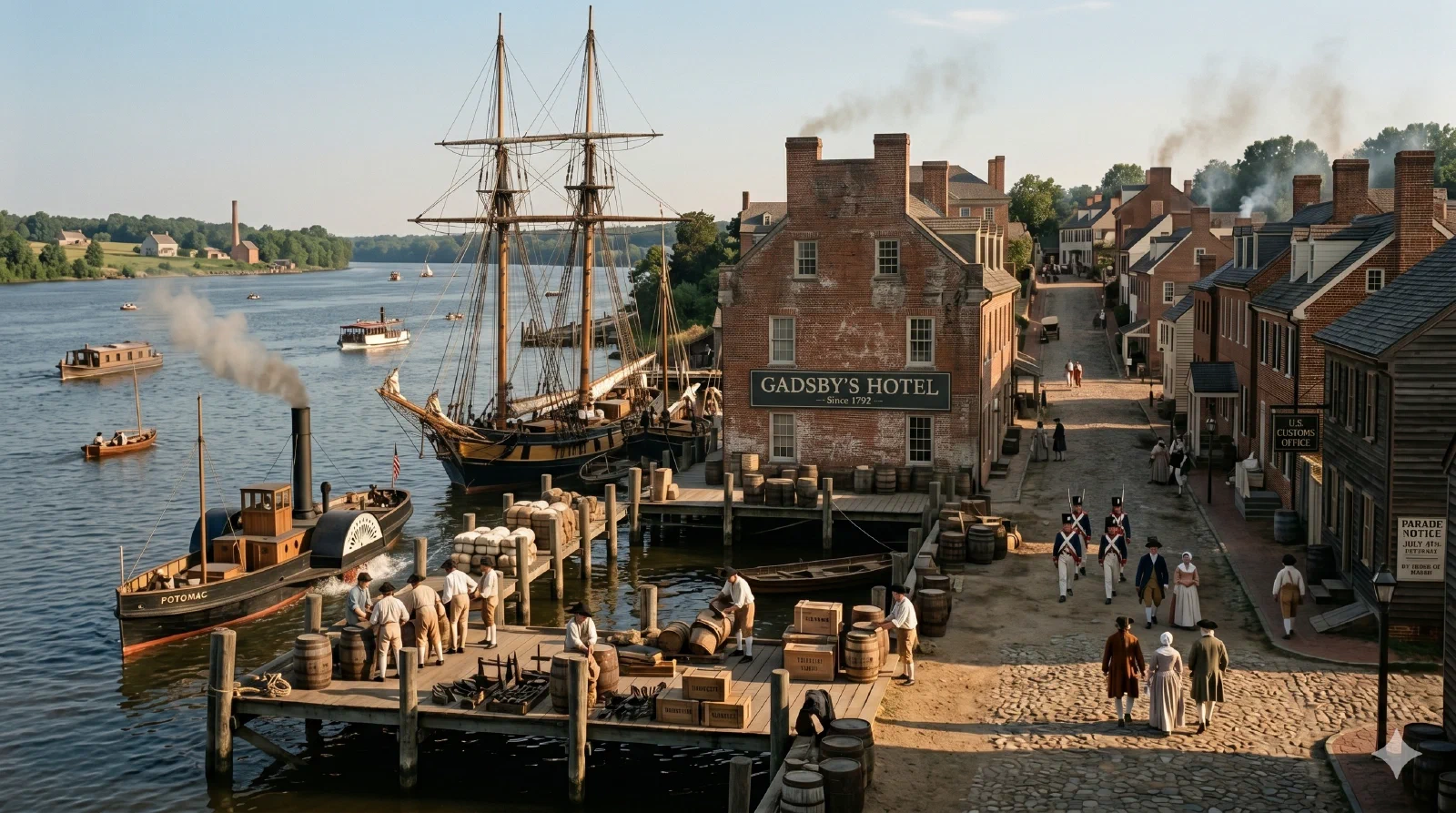
The early-republic Alexandria is, briefly, an American city in the District of Columbia. From 1801 through 1846 the town sits inside the federal capital, ceded to the United States by Virginia in the 1791 Residence Act and not retroceded back to Virginia until mid-century. The line between Old Town and Washington City is nominal in this period — Alexandrians watch the Capitol burn in 1814, ride into Washington for inaugurations, and conduct local politics under the awkward dual jurisdiction of Congress and the City of Alexandria.
The Lee–Carlyle ascendancy
The town’s first-rank Federalist families come into their full mid-life power in this era. The 607 Oronoco Street 607 Oronoco Street Federal-era house at 607 Oronoco Street rented by Anne Carter Lee from about 1812; principal childhood residence of her son Robert E. Lee before his 1825 appointment to West Point. … at 607 Oronoco Street is rented by Anne Hill Carter Lee Anne Hill Carter Lee b. 1773 · d. 1829 Mother of ; second wife of . Rented the Federal-era house at 607 Oronoco Street, Alexandria, raising her children there after her husband's financial collapse and imprisonment. in 1812 — widow of Light-Horse Harry Lee ( Henry "Light-Horse Harry" Lee III Henry "Light-Horse Harry" Lee III b. 1756 · d. 1818 Continental Army cavalry officer, ninth governor of Virginia, and father of . Sold the Oronoco Street property in 1784 to his cousin that became the . , Revolutionary cavalry hero, governor of Virginia, and bankrupt by 1812). Robert E. Lee, then five years old, will live in the Oronoco Street house through his West Point years. Edmund Jennings Lee Edmund Jennings Lee b. 1772 · d. 1843 Mayor of Alexandria (1815-1818), lawyer, and youngest brother of and . Lived from 1801 in his house at 428 North Washington Street, then bought at auction in 1828. , the boy’s uncle, serves as mayor of Alexandria during this period; another uncle, Charles Lee (U.S. Attorney General) Charles Lee (U.S. Attorney General) b. 1758 · d. 1815 United States Attorney General (1795-1801) under presidents Washington and Adams; brother of and . Practiced law in Alexandria; married Anne Lee, daughter of Declaration signer . , has served as the second U.S. Attorney General under Adams.
121 North Fairfax Street 121 North Fairfax Street Stone Georgian mansion built in 1753 by Scottish merchant John Carlyle; headquarters in April 1755 for General Edward Braddock's Congress of five royal governors planning the … , the colonial seat of the Scottish-merchant Carlyle family, passes through several owners as Anne Fairfax Carlyle Anne Fairfax Carlyle b. 1761 · d. 1778 Second surviving daughter of and ; married of Gloucester County, Va., in 1777 and died at seventeen the day her only son was born. ’s line dies out. By the 1820s the house has been carved into multi-family rental and the Federalist mercantile elite is consolidating around the 614 Oronoco Street 614 Oronoco Street Federal-style house built in 1785 by Philip Richard Fendall on land acquired from the Lee family. Occupied by a rotating cast of Lee family members through the nineteenth century … at the corner of Oronoco and Washington and the new 220 North Washington Street 220 North Washington Street Late-Georgian 1797 townhouse at the corner of North Washington and Queen built by merchant John Wise. Charles Lee, U.S. Attorney General and brother of Light-Horse Harry, lived … townhouse on North Washington Street.
Civic institutions
In 1786 George Washington George Washington b. 1732 · d. 1799 Planter, military commander, and first President of the United States. Master of Mount Vernon from 1761 until his death in 1799, and a regular presence in Alexandria, which he … chairs the founding committee of the 614 Wolfe Street 614 Wolfe Street Two-story brick schoolhouse built 1786 on Wolfe Street. was a founding trustee and bequeathed funds for free education of poor children. Later home to a free school for Black … on Wolfe Street — Virginia’s first chartered free school for indigent boys. The Benjamin Hallowell Benjamin Hallowell b. 1799 · d. 1877 Quaker educator, scientist, and surveyor who ran a boys' boarding school at 609 Oronoco Street from 1824 onward. received his pre–West Point tutoring from Hallowell in 1824–1825. Quaker school will follow in 1824, training a young Robert E. Lee for West Point in the process.
The 133 North Fairfax Street 133 North Fairfax Street Federal-style 1807 banking house at the corner of North Fairfax and Cameron Streets — the surviving home of the Bank of Alexandria, chartered in 1792 as the first bank in Virginia … , the first chartered bank in Virginia, opens in 1807 in a Federal-style banking house on North Fairfax. The 413 Prince Street 413 Prince Street Early-19th-century brick building used as the Bank of Potomac's executive office and as a Virginia governor's residence. NRHP-listed 2025. opens shortly after; in the 1830s the Bank of Potomac building becomes the residence of Virginia’s governor in exile during a political dispute, the source of the building’s later name.
The 1 Wilkes Street 1 Wilkes Street The 1843 stone tide lock at the southern terminus of the Alexandria Canal, which connected the Chesapeake & Ohio Canal at Georgetown with the Alexandria waterfront via a seven-mile … opens in 1843, just past this era’s close — but the Alexandria Canal Company is chartered in 1830, the seven-mile canal route from Georgetown is surveyed in the late 1820s, and the engineering and financing of the project belong to this era.
The slave trade comes to King Street
By the 1820s the domestic slave trade has begun reorganizing itself around Alexandria’s deep-water port and proximity to Washington’s political markets. The slave-trade firms that will define antebellum Alexandria — Franklin & Armfield, Joseph Bruin’s operation — are organizing in the late 1820s. The complex at 1315 Duke Street 1315 Duke Street Federal-style brick house at 1315 Duke Street built in the 1810s by Brigadier General Robert Young of the DC Militia; from 1828 to 1837 the headquarters of Franklin & Armfield, the … (1315 Duke Street) becomes the headquarters of John Armfield John Armfield b. 1797 · d. 1871 North Carolina–born slave trader who managed the Alexandria operations of Franklin & Armfield from 1828 to 1836, directing the collection and forced transport of thousands of … ’s operation in 1828; 1707 Duke Street 1707 Duke Street Antebellum jail compound operated by slave trader Joseph Bruin from the 1840s through emancipation. NRHP-listed 2000. a few blocks south follows shortly after.
The town that won’t be the capital
Alexandria’s brief D.C. tenure ends with retrocession — the 1846 federal statute returning the southern portion of the District to Virginia. The cited reasons are economic: Alexandrians complain that as a D.C. city they cannot host the slave trade that nearby Washington had restricted. (The retrocession bill is signed before the Compromise of 1850 — but the writing is on the wall.) The retrocession sets the stage for the antebellum decade, when Alexandria becomes the largest domestic slave-trade center in the United States.