
Jim Crow Era
Segregation, WWI, WWII, early civil rights
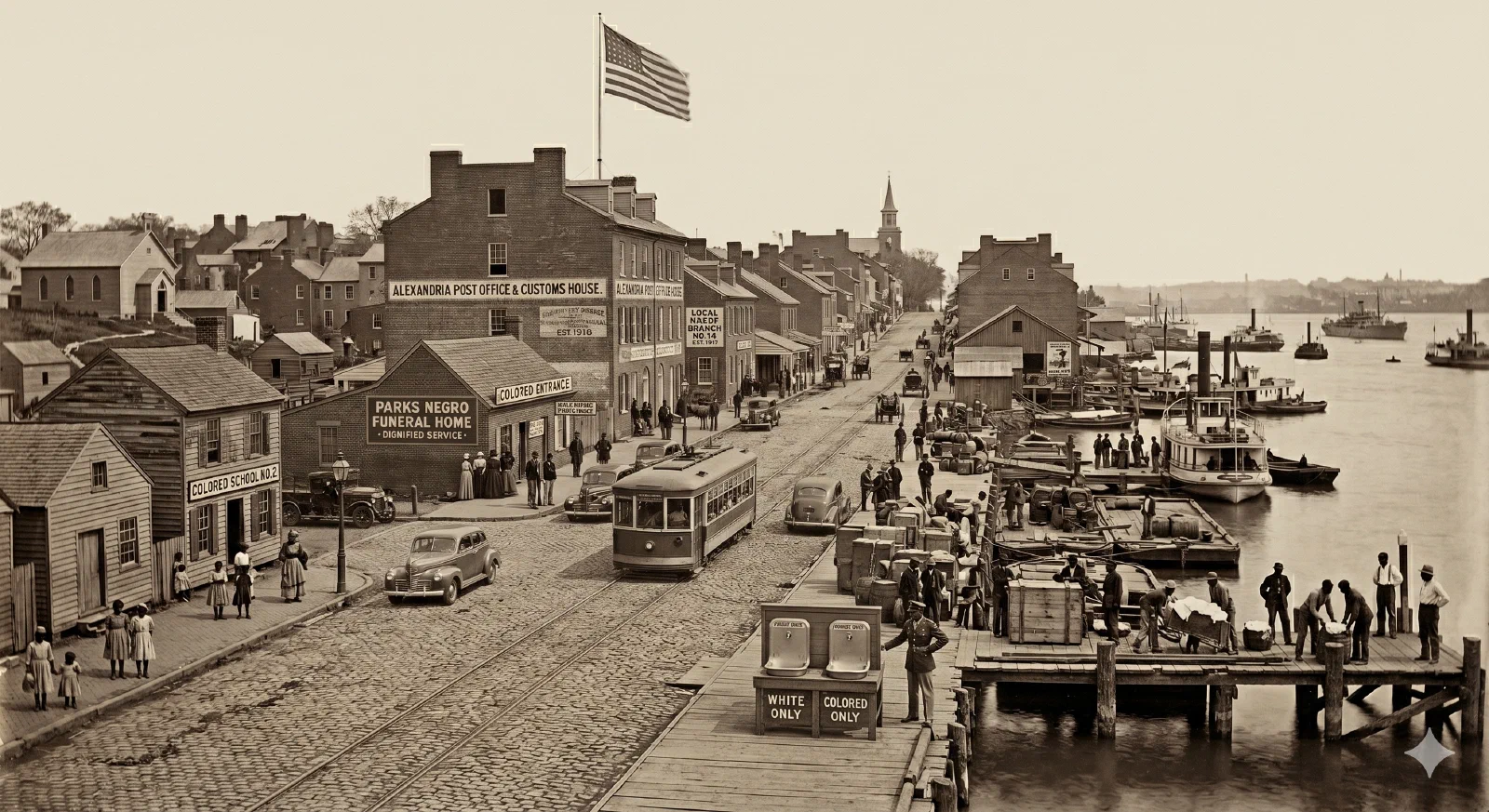
For sixty years after the 1902 Virginia constitution institutionalizes Black disenfranchisement, Alexandria operates under formal legal segregation. The schools, the parks, the lunch counters, the public library, the hospitals, the housing, the streetcar lines — all segregated by statute or custom. Two cities run side by side: a white Alexandria of expanding federal employment, defense-housing construction, and civic-institutional respectability; and a Black Alexandria that organizes its own schools, churches, fraternal orders, professional life, and — beginning in the late 1930s — its own legal challenges to the system.
Federal Alexandria takes shape
The early 20th century brings the federal government to Alexandria’s doorstep. The 110 Callahan Drive 110 Callahan Drive 1905 railway terminal at the foot of King Street, currently serving Amtrak, VRE, and Washington Metro Blue/Yellow lines. NRHP-listed 2013. opens in 1905. The 105 North Union Street 105 North Union Street Waterfront munitions plant built in 1918 as the U.S. Naval Torpedo Station; produced torpedoes through World War II, served as federal records storage after the war, and has … is built in 1918 on the waterfront as the U.S. Naval Torpedo Station, producing torpedoes through both world wars. 101 Callahan Drive 101 Callahan Drive A 333-foot granite tower atop Shuter's Hill, completed 1932 by Freemasons across the United States to honor as Charter Master of . Conceived after an 1871 fire at the lodge's Old … opens in 1932 on Shooter’s Hill — neoclassical 333-foot tower, visible across the city. 100 South Fairfax Street 100 South Fairfax Street The 1903 neoclassical home of at the corner of King and South Fairfax streets, the bank's sixth and final headquarters after a half-century of moves around Old Town. (1903) anchors the central business district at King and Fairfax; the The Burke and Herbert families The Burke and Herbert families Two Alexandria families joined in 1852 by a single business partnership that became Virginia's oldest continuously operating bank. Five generations of Herberts and multiple … have been running Alexandria’s oldest bank since 1852.
In Del Ray, 1005 Mount Vernon Avenue 1005 Mount Vernon Avenue Brick Stripped Classical / Art Deco school on Mount Vernon Avenue in Del Ray, built 1934 and opened 1935 as George Washington High School — a consolidation of the city's earlier … opens in 1934 as the city’s first integrated secondary school — though “integrated” in the contemporary sense meant white-only; Black students continued to attend Parker-Gray. The Colonial Revival 1934 building will produce Jim Morrison Jim Morrison b. 1943 · d. 1971 Lead vocalist and lyricist of The Doors. Son of a U.S. Navy admiral; attended Alexandria's (then George Washington High School) class of 1961 while his family lived in Alexandria … (Class of 1961), Cass Elliot Cass Elliot b. 1941 · d. 1974 Founding member of The Mamas & the Papas. Spent her teenage years in Alexandria in the late 1950s, where her family ran a delicatessen in the Del Ray / Mount Vernon Avenue area. (briefly enrolled, late 1950s), and a generation of mid-century Alexandria’s white-civic leadership.
Defense-housing Alexandria
World War II remakes the western and southern fringes of the city. parkfairfax-historic-district parkfairfax-historic-district 132-acre Colonial Revival garden-apartment community completed 1941–1943 by the Metropolitan Life Insurance Company under FHA defense-housing financing — an early example of … is built 1941–43 by the Metropolitan Life Insurance Company under FHA defense-housing financing — 132 acres, 1,684 garden-apartment units, designed by Leonard Schultze & Associates — to absorb the explosive growth of the federal workforce. Richard Nixon Richard Nixon b. 1913 · d. 1994 37th President of the United States (1969–1974). Lived in Alexandria at 3538 Gunston Road, Apt. T-2 in in two stints — 1943–44 during his Office of Price Administration work and … will move into Apartment T-2 at 3538 Gunston Road in 1943; nine years later Gerald Ford Gerald Ford b. 1913 · d. 2006 38th President of the United States (1974–1977). Twenty-three-year Alexandria resident — first in 1951–55 as freshman Congressman from Michigan, then at 514 Crown View Drive … will move into the same community as a freshman congressman.
4800 Duke Street 4800 Duke Street 164-acre former U.S. Army installation on Duke Street, active 1942–1995. Headquartered the Defense Logistics Agency, the Defense Mapping Agency, and elements of the U.S. Army … opens on Duke Street in 1942 as a wartime Army installation. Richmond Highway Richmond Highway ~8,656-acre U.S. Army installation along Richmond Highway in Fairfax County, established 1917 as Camp A.A. Humphreys, renamed Fort Humphreys 1922, renamed Fort Belvoir 1935 in … , established in 1917 as Camp A.A. Humphreys, is renamed Fort Belvoir in 1935; through World War II it becomes the U.S. Army’s senior Engineer-School installation.
The 1939 library sit-in
The defining Black-civil-rights moment of mid-Jim-Crow Alexandria is the August 21, 1939 sit-in at the 717 Queen Street 717 Queen Street Alexandria's first free public library, opened on Queen Street in 1937, and site of a sit-in on August 21, 1939 that is among the earliest documented civil-rights direct actions in … , the city’s first free public library — opened in 1937 and operated as a whites-only facility by the Alexandria Library Association Alexandria Library Association founded 1937 The private nonprofit operating Alexandria's first free public library, which opened on Queen Street in 1937. The association's segregation policy excluding Black patrons was the … . Civil-rights attorney Samuel W. Tucker Samuel W. Tucker b. 1913 · d. 1990 Alexandria-born civil-rights attorney who organized and led the August 21, 1939 sit-in at the segregated on Queen Street — one of the earliest documented civil-rights sit-ins in … organizes the action: five Black men enter the library, request library cards, are refused, and remain reading until the police arrest them. The city eventually declines to prosecute and instead builds a separate-but-equal “colored branch” library — but the 1939 sit-in is among the earliest documented civil-rights sit-ins in the United States, predating the 1960 Greensboro lunch-counter sit-ins by twenty-one years.
The Greek-American thread
The mid-Jim-Crow decades also build out the Mediterranean immigrant communities that will define west-end Alexandria’s small-business landscape across the century. The The Androus family The Androus family Greek-American Alexandria family with documented mid-twentieth- century-through-present roots in the city. Head-of-family figure in the surfaced public record is Theodore S. … establishes itself in this era — a Greek-American line whose later South Richmond Highway South Richmond Highway Mid-rise commercial office building on South Richmond Highway (Alexandria's Route 1 corridor), owned/operated by the . Established by 1971 per the published practice history of … on Richmond Highway and Androus Foundation philanthropic work continue today.
The corridor of Episcopal schools
While Parker-Gray serves Black Alexandria, the white Episcopal school corridor along Quaker Lane and Seminary Ridge expands. 1200 North Quaker Lane 1200 North Quaker Lane The first high school in Virginia, founded 1839 by Bishop William Meade of the Episcopal Diocese on a 100-acre campus west of Old Town. First principal William Nelson Pendleton … continues from the antebellum era. 3737 Seminary Road 3737 Seminary Road Episcopal theological seminary founded in Alexandria in 1823 and relocated to its present hilltop campus in 1827. Occupied by Union forces during the Civil War and used as a … graduates Rev. Dr. W.A.R. Goodwin Rev. Dr. W.A.R. Goodwin b. 1869 · d. 1939 Episcopal priest and historic-preservation visionary; "father" of the Colonial Williamsburg restoration. Trained at the (Class of 1893); convinced philanthropist John D. … in 1893 — the priest-turned-preservationist who will, beginning in the 1920s, spend the rest of his life translating Williamsburg into Colonial Williamsburg with John D. Rockefeller Jr.’s funding.