
Mid-Century Transformation
Civil rights, redevelopment, Cold War Alexandria
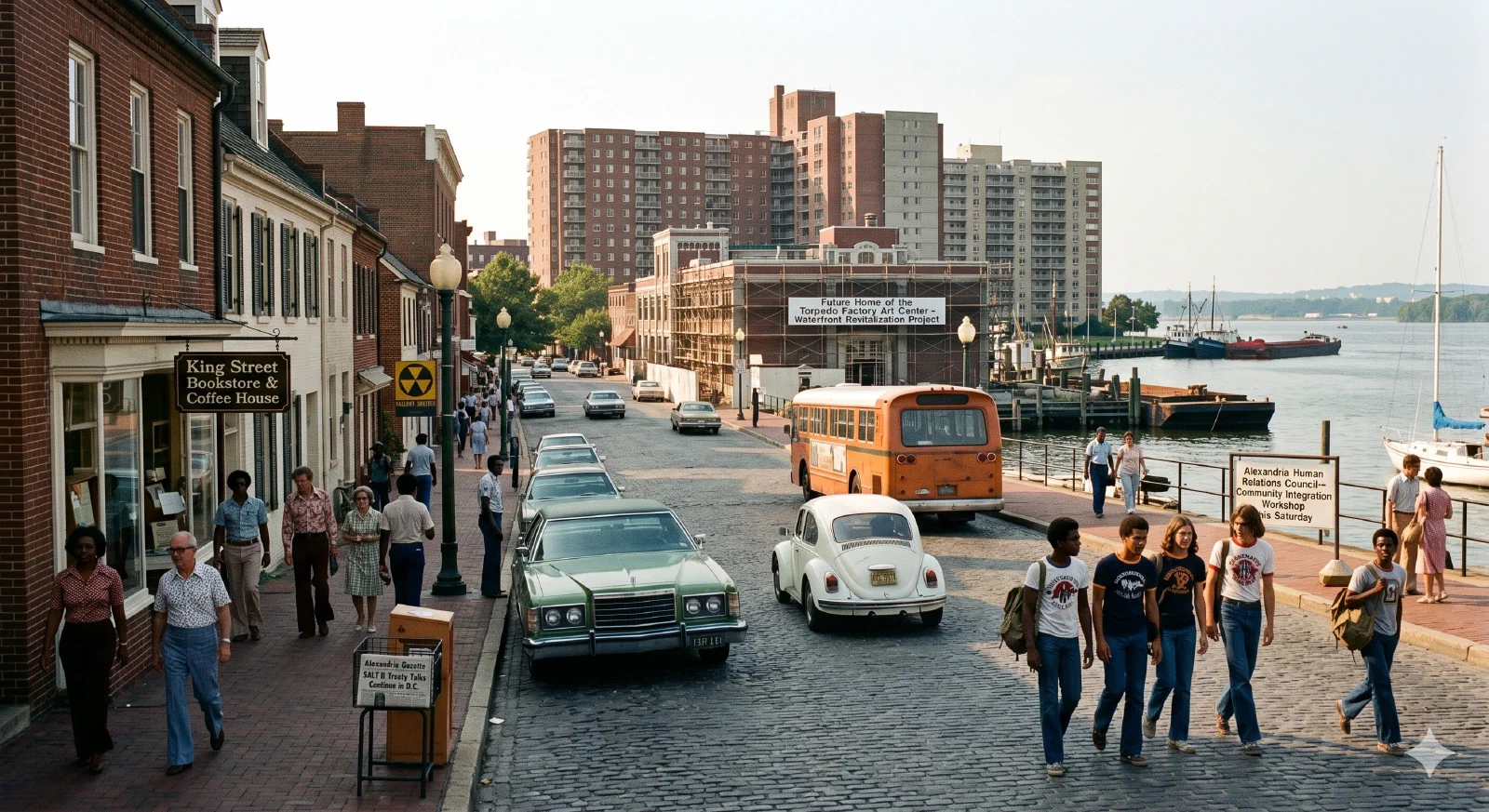
The thirty years between 1960 and 1990 are Alexandria’s most rapid demographic and physical transformation since the Civil War. Three forces run in parallel: civil-rights desegregation (school, public-accommodation, and housing), the Cold War federal-employment buildout that fills the western Alexandria corridor with defense-related office work, and the historic-preservation movement that reframes Old Town from a declining inner-city neighborhood into a curated tourism economy. By 1990 the city looks substantially like the city it is today.
School and public-accommodation desegregation
900 Wythe Street 900 Wythe Street Site of Alexandria's segregated public school for Black students, opened in 1920 at 900 Wythe Street and replaced in 1950 by a new Parker-Gray High School that served until … closes in 1965 with the consolidation of Alexandria’s segregated school system into the unified district that today is Alexandria City Public Schools. 201 Cambridge Road 201 Cambridge Road Catholic co-educational secondary school founded in 1964 by the Diocese of Arlington on Cambridge Road; alumni include Dave Grohl (transferred junior, early 1980s) and a long roll … opens in 1964 as a Catholic co-educational secondary school. The K-12 corridor of Episcopal schools — Episcopal High School, 3737 Seminary Road 3737 Seminary Road Episcopal theological seminary founded in Alexandria in 1823 and relocated to its present hilltop campus in 1827. Occupied by Union forces during the Civil War and used as a … , and the several K-8 schools that will merge into St. Stephen’s & St. Agnes in 1991 — desegregates over the same decade.
The 1939 library sit-in’s organizer Samuel W. Tucker Samuel W. Tucker b. 1913 · d. 1990 Alexandria-born civil-rights attorney who organized and led the August 21, 1939 sit-in at the segregated on Queen Street — one of the earliest documented civil-rights sit-ins in … continues civil-rights practice from his Princess Street office, joining the NAACP Legal Defense Fund and arguing post-Brown v. Board school-desegregation cases against Massive Resistance counties across Virginia.
The Eisenhower Valley federal buildout
In 1958, insurance agent Hubert N. "Dutch" Hoffman Jr. Hubert N. "Dutch" Hoffman Jr. b. 1920 · d. 2002 Alexandria real-estate developer who in 1958 bought seventy acres of Eisenhower Valley swamp and trailer-park landfill for two hundred thousand dollars and over the next … mortgages everything he owns to buy seventy acres of swamp and trailer-park landfill along Cameron Run, anticipating the Capital Beltway. A decade later he opens 2461 Eisenhower Avenue 2461 Eisenhower Avenue Mid-rise office building completed 1968 at 2461 Eisenhower Avenue — the first major structure on the seventy-acre Eisenhower Valley parcel that bought from swampland in 1958. … (2461 Eisenhower Avenue, 1968) with the U.S. Department of Defense as its anchor tenant — the first major office building on the reclaimed land. Hoffman Building 2 follows in 1971; by 1972 the combined Hoffman Center totals approximately one million square feet of office space. The Eisenhower Valley becomes a federal-office corridor, an extension of the Pentagon-and-Mark-Center cluster a few miles north.
The The Androus family The Androus family Greek-American Alexandria family with documented mid-twentieth- century-through-present roots in the city. Head-of-family figure in the surfaced public record is Theodore S. … ’s South Richmond Highway South Richmond Highway Mid-rise commercial office building on South Richmond Highway (Alexandria's Route 1 corridor), owned/operated by the . Established by 1971 per the published practice history of … on Richmond Highway anchors the southern stretch of the Route 1 corridor. Hughes Orthodontics, a tenant in the building from 1971 to 1992, is one of the mid-century medical practices that follow the federal-employment demographic into south Alexandria.
Cameron Station and the Cold-War installations
4800 Duke Street 4800 Duke Street 164-acre former U.S. Army installation on Duke Street, active 1942–1995. Headquartered the Defense Logistics Agency, the Defense Mapping Agency, and elements of the U.S. Army … reaches its peak operational years in this era. The 164-acre Duke Street installation hosts the Defense Logistics Agency, the Defense Mapping Agency, and elements of the U.S. Army Materiel Command at various points across the 1960s, ’70s, and ’80s. Richmond Highway Richmond Highway ~8,656-acre U.S. Army installation along Richmond Highway in Fairfax County, established 1917 as Camp A.A. Humphreys, renamed Fort Humphreys 1922, renamed Fort Belvoir 1935 in … continues its role as the U.S. Army’s senior installation in the Washington metro, and the broader Defense Threat Reduction Agency / INSCOM mission set takes shape on the Belvoir parcel.
The mid-century-modern residential thread
Architect Charles Goodman builds the 510 North Quaker Lane 510 North Quaker Lane Mid-century modern residence designed by architect Charles M. Goodman, who pioneered modernist housing in the Washington region. NRHP-listed 2013. and the broader Hollin Hills mid-century-modern community on the southern Mt. Vernon corridor in the 1950s and ’60s — flat-roofed post-and-beam houses set on wooded lots, the closest thing Alexandria gets to a Frank Lloyd Wright-influenced residential community. 816 Vicar Lane 816 Vicar Lane Cul-de-sac suburban house off Quaker Lane that was the residence of from his 1970 NASA retirement until his death at Alexandria Hospital on June 16, 1977. on Quaker Lane is the boyhood home of Wernher von Braun Wernher von Braun b. 1912 · d. 1977 German-American rocket engineer; technical lead of Nazi Germany's V-2 program and later director of NASA's Marshall Space Flight Center, where he led development of the Saturn V … during his NASA years. 2605 King Street 2605 King Street Single-family residence on the upper / western stretch of King Street in the corridor annexed from Alexandria County in 1915. Possibly associated by family connection with the … and 6023 Fort Hunt Road 6023 Fort Hunt Road 1924 private country club at 6023 Fort Hunt Road on the Potomac River south of Old Town Alexandria. 18-hole golf course, tennis courts, and clubhouse facilities serve a Belle Haven … (1924, but still running) define the upper-King-Street and Belle Haven residential geographies of the era.
The presidents pass through
Alexandria’s mid-century is unusually well-populated with future U.S. presidents in their pre-presidential apartment years. Richard Nixon Richard Nixon b. 1913 · d. 1994 37th President of the United States (1969–1974). Lived in Alexandria at 3538 Gunston Road, Apt. T-2 in in two stints — 1943–44 during his Office of Price Administration work and … lives in parkfairfax-historic-district parkfairfax-historic-district 132-acre Colonial Revival garden-apartment community completed 1941–1943 by the Metropolitan Life Insurance Company under FHA defense-housing financing — an early example of … 1947–51 as freshman Congressman. Gerald Ford Gerald Ford b. 1913 · d. 2006 38th President of the United States (1974–1977). Twenty-three-year Alexandria resident — first in 1951–55 as freshman Congressman from Michigan, then at 514 Crown View Drive … succeeds him in Parkfairfax 1951–55, then commissions the new house at 514 Crown View Drive that will be the Ford family’s home through Ford’s full congressional career, his vice presidency, and the first ten days of his presidency in August 1974 — the last private residence ever occupied by a sitting U.S. president.
Birchmere, the music
The 3701 Mount Vernon Avenue 3701 Mount Vernon Avenue Listening-room music venue on Mount Vernon Avenue, founded in 1966 at an earlier location and relocated in 1997 to the present purpose-built hall. A nationally known stop on the … opens on Mount Vernon Avenue — listening-room bluegrass-and-folk music venue, the kind of small cultural anchor that converts a mid-century commercial strip into a destination. The cultural-cluster economy that will define late-mid-century Alexandria takes shape.