
Reconstruction and Early Jim Crow
Freedmen's communities, legal segregation
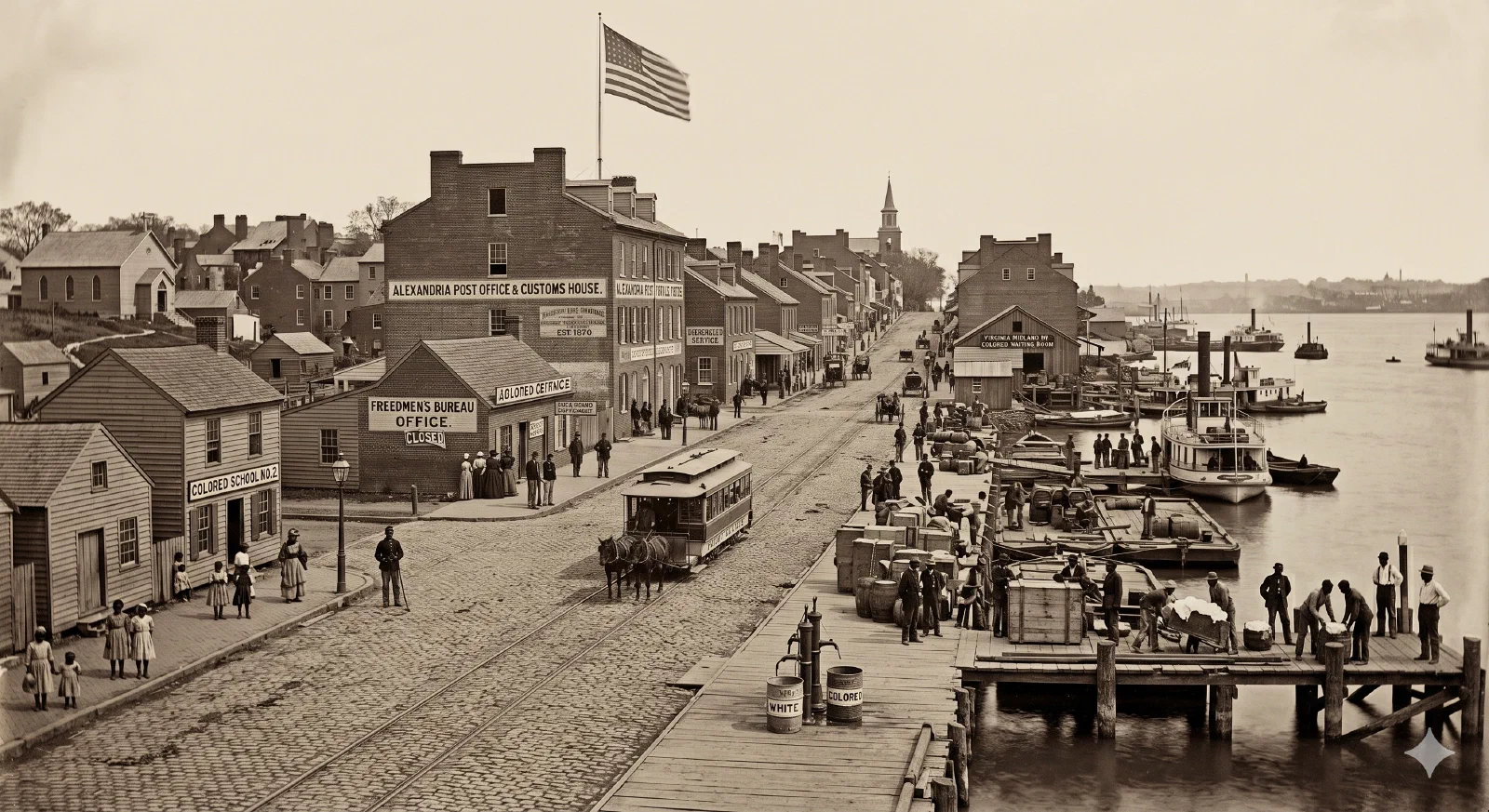
The thirty-five years after Appomattox are Alexandria’s two-act drama. Act one (1865–1880): Black freedom is real. Black Alexandrians vote, hold elective office, found churches and schools, buy property, run businesses, and shape the political life of the re-admitted Commonwealth. Act two (1880–1900): the Redeemer backlash organizes itself, and the legal infrastructure of Jim Crow — poll taxes, residency requirements, segregated schools and public accommodations — methodically reverses the gains. The arc closes at the turn of the twentieth century with the political and civil exclusion of Alexandria’s Black population substantially complete.
Founding Black institutions
The Black community organized in the contraband camps of the war years builds its own civic infrastructure. 900 Wythe Street 900 Wythe Street Site of Alexandria's segregated public school for Black students, opened in 1920 at 900 Wythe Street and replaced in 1950 by a new Parker-Gray High School that served until … opens on Wythe Street as Alexandria’s segregated public school for Black students — operating continuously from this era through 1965, the institutional anchor of the African-American Parker-Gray neighborhood Parker-Gray neighborhood Historically African-American residential and commercial district north and west of Old Town, anchored by the Parker-Gray School. NRHP-listed 2010. neighborhood that will produce Earl Lloyd Earl Lloyd b. 1928 · d. 2015 First African American to play in a National Basketball Association game (October 31, 1950, with the Washington Capitols). Born in Alexandria; graduate of in the segregated … (first Black NBA player) and Samuel W. Tucker Samuel W. Tucker b. 1913 · d. 1990 Alexandria-born civil-rights attorney who organized and led the August 21, 1939 sit-in at the segregated on Queen Street — one of the earliest documented civil-rights sit-ins in … (civil-rights attorney, organizer of the 1939 library sit-in). 320 South Washington Street 320 South Washington Street Founded in 1863 by formerly enslaved Black congregants; one of the earliest independent Black Baptist churches in the South. NRHP-listed 2004. (founded 1863), the 404 South Royal Street 404 South Royal Street Mid-19th-century residence of George Lewis Seaton, a free Black master carpenter who served in the Virginia House of Delegates during Reconstruction. NRHP-listed 2004. (residence of George Lewis Seaton, a freedman elected to the Virginia House of Delegates in 1869), and 411 South Columbus Street 411 South Columbus Street Late-19th-century Black fraternal lodge, part of Alexandria's African-American civic infrastructure during Jim Crow. NRHP-listed 2004. (a Black fraternal lodge) anchor the social and civic life.
The Black cemeteries of Alexandria — the 1001 South Washington Street 1001 South Washington Street Burial ground established in 1864 by the Union military government on the southern edge of Federally-occupied Alexandria for self-emancipated Black people — "contrabands" in … on South Washington (already established 1864) and the new 4195 West Braddock Road 4195 West Braddock Road African-American cemetery established 1885 on land adjacent to Fort Ward, used by descendants of the freedmen's community known as The Fort. NRHP-listed 2018. on the southern slope of Seminary Hill (founded 1885) — preserve the burial-ground geography of post-emancipation Alexandria. The 1100 Wilkes Street 1100 Wilkes Street Cluster of twelve adjacent burial grounds stretching across the 1100 block of Wilkes Street, including Methodist Protestant, Presbyterian, Quaker, Black Methodist (Bethel), Hebrew … , a cluster of twelve adjacent burial grounds running across South Washington, ages into its post-war function during these decades.
Industry on the western edge
While Black Alexandria builds civic infrastructure inside Old Town, white Alexandria builds industrial infrastructure on the city’s western edge. 300 North West Street 300 North West Street Glass bottle and jar works that operated in west-end Alexandria from the 1890s until the Depression, employing hundreds of workers including children before Virginia's child-labor … opens on West Street producing bottles and jars for the regional market. 1200 Duke Street 1200 Duke Street Headquarters of T. J. Fannon & Sons at 1200 Duke Street, the Alexandria heating-fuel firm founded by Thomas J. Fannon as a wood-and-coal yard in 1885 and continuously operated by … establishes its coal-and-fuel yard at 1200 Duke Street; the firm will operate continuously into the late 20th century. The 201 Prince Street 201 Prince Street Late-19th-century commercial building at the corner of Prince and Lee streets, an early local example of small-town bank architecture. NRHP-listed 1980. opens at the corner of King and St. Asaph, the first major post-war commercial structure in the central business district.
The countryside beyond
The plantations on Alexandria’s perimeter age into a different geography in this era. Seminary Hill (off Seminary Road, near St. Stephens Road) Seminary Hill (off Seminary Road, near St. Stephens Road) Layered Seminary Hill site that was the country estate "Muckross" of Burke & Herbert Bank co-founder Arthur Herbert, the Civil War earthwork Fort Worth (1861-1865), and finally the … on Seminary Hill — the country estate that had served as Confederate General Beauregard’s encampment in 1861 and Union Fort Worth through the war — passes back into civilian ownership and is re-imagined as residential property; the surrounding Seminary Ridge corridor begins its slow conversion from agricultural land to suburban residential. 2823 King Street 2823 King Street Twenty-two-acre garden cemetery in Alexandria's Rosemont district, chartered 1856 by thirty Alexandrians on land sold from the estate of Hugh C. Smith. A representative entry in … acquires its essentially complete late-19th-century landscape character.
The Redeemer turn
By the late 1870s the political reaction is well underway. Mahone’s Readjuster coalition delays the worst of the Redeemer project in Virginia through the early 1880s, but by the 1890s the Democratic-conservative reconquest is essentially complete. The 1889 dedication of the South Washington Street and Prince Street South Washington Street and Prince Street Confederate monument cast 1889 by Caspar Buberl, relocated from the intersection of Washington and Prince streets on June 2, 2020. NRHP-listed 2017. at the intersection of South Washington and Prince — Caspar Buberl’s bronze of a Confederate soldier facing south — is the Lost Cause’s monumental claim on the city. (The statue stood until 2020, when the Sons of Confederate Veterans removed it in the wake of the George Floyd protests.) By 1900 Alexandria’s Black political life is constrained to its religious, fraternal, and educational institutions; the formal exclusion of Black voters from the political process will be ratified by the 1902 Virginia constitution.