
1
Wilkes Street
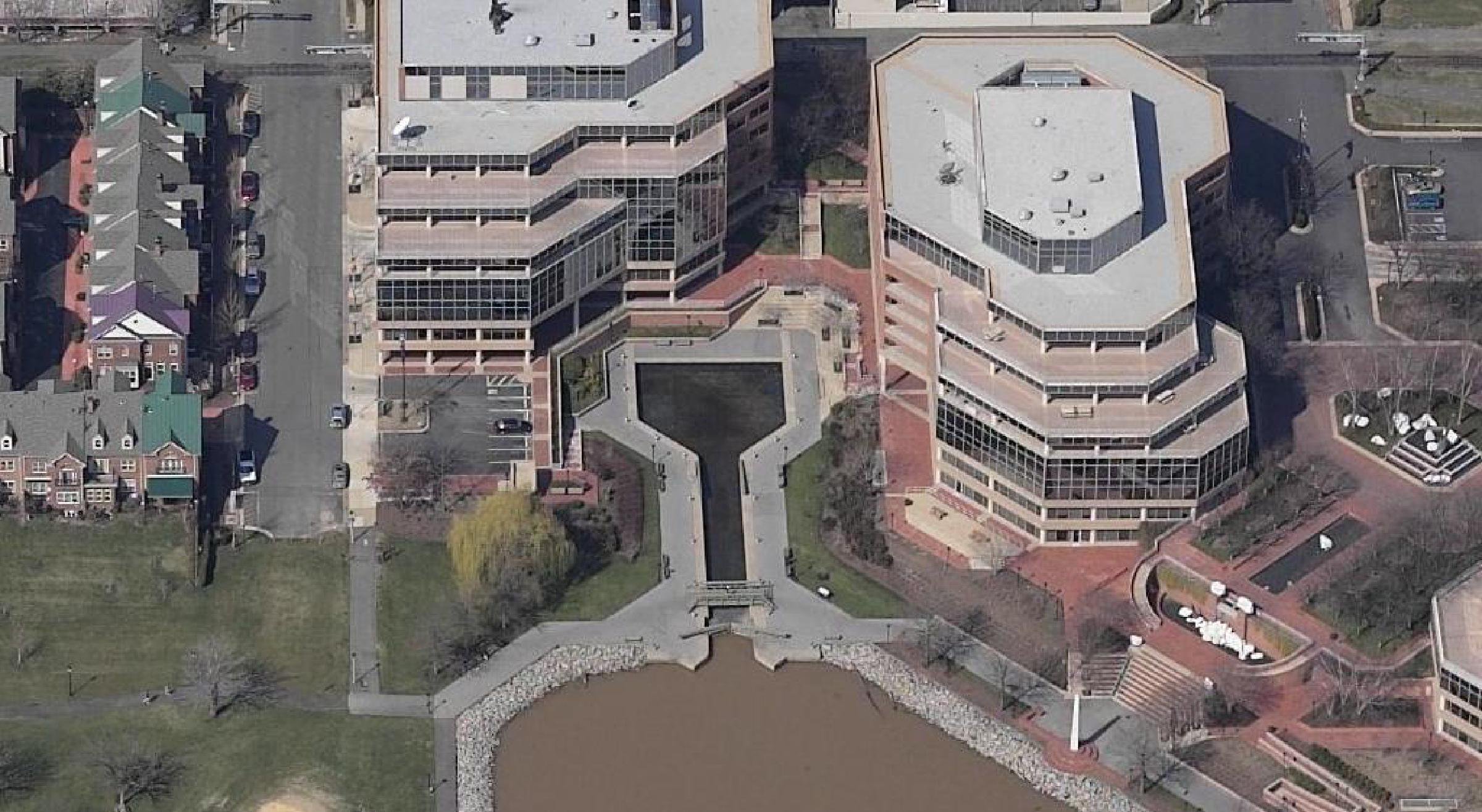
The 1843 stone tide lock at the southern terminus of the Alexandria Canal, which connected the Chesapeake & Ohio Canal at Georgetown with the Alexandria waterfront via a seven-mile spur.
- 1843
- Utilitarian
- Extant
- National Register of Historic Places
Place narrative
The Alexandria Canal was chartered in 1830 to give Alexandria’s merchants direct access to the commerce of the Chesapeake & Ohio Canal, which terminated across the Potomac at Georgetown. The seven-mile spur crossed the river on a purpose-built aqueduct, ran south along the west bank of the Potomac, and descended through locks to a tide basin at the Alexandria waterfront [1] HABS Alexandria survey Government record . The canal opened for traffic in 1843.
The stone tide lock at the south end of the basin allowed canal boats to exchange the fresh water of the canal for the tidal water of the Potomac and be loaded onto ocean-going vessels. For a generation the canal carried coal, flour, and other western commodities to Alexandria’s wharves [2] Powell, History of Old Alexandria, 1928 Book . The Civil War interrupted operations; Union forces destroyed the aqueduct in 1861 to deny its use to Confederate troops, and though the canal resumed limited service after the war, the rise of the railroads made it obsolete.
The canal was abandoned by 1886 and most of its route was filled and built over in the following decades. Excavations along the waterfront in the 1970s and later uncovered portions of the stone tide lock, which has been partially preserved and interpreted in place. The present tide lock installation sits at the foot of Wilkes Street in a small waterfront park [3] Alexandria Library Special Collections Manuscript .
Timeline
4 chronological entries across 2 eras.
The building
- Utilitarian
Gallery
Placeholder illustration of Alexandria Canal Tide Lock. Seed placeholder — KingSt.com, 2026. To be replaced with archival photograph. 
Secondary placeholder view of Alexandria Canal Tide Lock. Seed placeholder — KingSt.com, 2026. To be replaced with archival photograph.
Connected
Benjamin Dulany
b. 1752 · d. 1816
Maryland-born merchant and planter with extensive landholdings on both sides of the Potomac, including Shuter's Hill west of Alexandria. His household straddled the social world of …
Visitor notable · Canal subscriber · %!d(float64=1840)–%!d(float64=1845)
Freedmen of the Contrabands Camp
founded 1861
Collective entity representing the several thousand formerly enslaved people who fled to Union-occupied Alexandria during the Civil War, settling in camps at Shuter's Hill, around …
Resident · Waterfront · %!d(float64=1862)–%!d(float64=1865)
Nearby in time
606 South Washington Street 606 South Washington Street
Mid-19th-century chapel, part of Alexandria's antebellum African Methodist Episcopal congregation. NRHP-listed 2004.
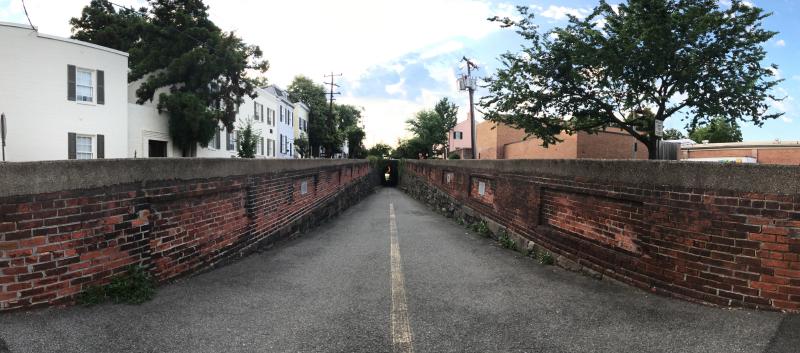
Wilkes Street Tunnel from the western approach, July 2017 — the brick-arched railroad tunnel cut beneath Wilkes Street in the early 1850s for the Orange & Alexandria Railroad to reach the Potomac wharves, today an Old Town pedestrian and bicycle passage. © KingSt.com, July 2017 Wilkes Street (between South Royal and South Lee)
Brick-arched railroad tunnel carved beneath Wilkes Street in the early 1850s for the Orange & Alexandria Railroad to reach the city's …
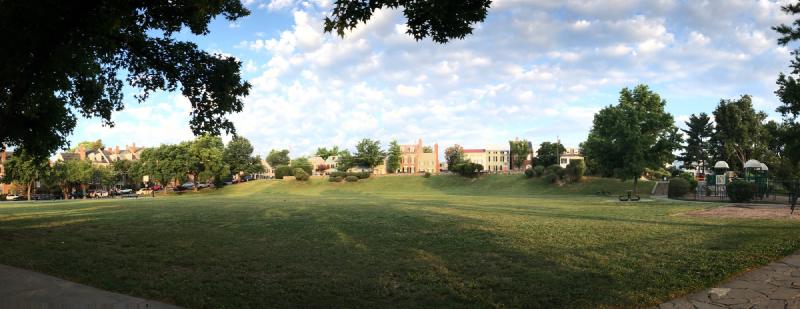
Windmill Hill Park at sunrise, July 2017 — the open grass meadow that once held Robert Townshend Hooe's c. 1791 grain windmill, with the Old Town row houses of South Union Street rising on the inland side and the playground visible at right. © KingSt.com, July 2017 501 South Union Street
Six-acre city park at 501 South Union Street, occupying the south Old Town waterfront hill that gave its name first to a c. 1791 wind-driven …
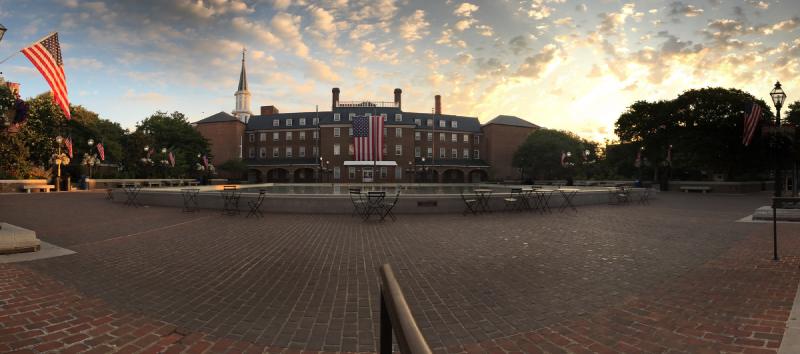
Market Square at sunrise, July 2017 — the city's eighteenth-century public square in its weekday-morning calm, framed by City Hall and the Fourth-of-July flags hung along the lamp posts. © KingSt.com, July 2017 301 King Street
Public square at 301 King Street fronting Alexandria City Hall — site of an open-air farmers market continuously operated since 1753, the …
Nearby in space
Windmill Hill Park at sunrise, July 2017 — the open grass meadow that once held Robert Townshend Hooe's c. 1791 grain windmill, with the Old Town row houses of South Union Street rising on the inland side and the playground visible at right. © KingSt.com, July 2017 501 South Union Street
Six-acre city park at 501 South Union Street, occupying the south Old Town waterfront hill that gave its name first to a c. 1791 wind-driven …
Wilkes Street Tunnel from the western approach, July 2017 — the brick-arched railroad tunnel cut beneath Wilkes Street in the early 1850s for the Orange & Alexandria Railroad to reach the Potomac wharves, today an Old Town pedestrian and bicycle passage. © KingSt.com, July 2017 Wilkes Street (between South Royal and South Lee)
Brick-arched railroad tunnel carved beneath Wilkes Street in the early 1850s for the Orange & Alexandria Railroad to reach the city's …
Placeholder illustration of Interarms Warehouse Complex South Union. Seed placeholder — KingSt.com, 2026. To be replaced with archival photograph. South Union Street
Complex of converted warehouse buildings along South Union Street used by Interarms from the late 1950s to the late 1990s to store surplus …
201 Prince Street 201 Prince Street
Greek Revival temple-front building completed 1851 at 201 Prince Street as the Bank of the Old Dominion. Used during the Civil War as a …
Now
No current occupant on file. Are you, or someone you know, the present occupant? Claim this place to add operating hours, a current photo, and a short note.
Wilkes Street
Named for John Wilkes — English politician and Patriot ally, c. 1796.
Interpretive signs nearby
The City of Alexandria has installed 1 historical interpretive sign within walking distance of this place. Each link below opens the sign's page on this site, with the full image and trail context.
W side S. Union at entrance to Windmill Hill Park
Sources
- 1.
Historic American Buildings Survey, Alexandria, Virginia records, National Park Service / Library of Congress.
Government record
- 2.
Mary G. Powell, The History of Old Alexandria, Virginia, from July 13, 1749 to May 24, 1861, Richmond: William Byrd Press, 1928.
Book
- 3.
Alexandria Library, Local History/Special Collections, Barrett Branch, Alexandria, Virginia.
Manuscript
See something wrong?
Every correction is logged dated to this page. Family history, old photographs, or a citation we missed — everything goes into the file.