
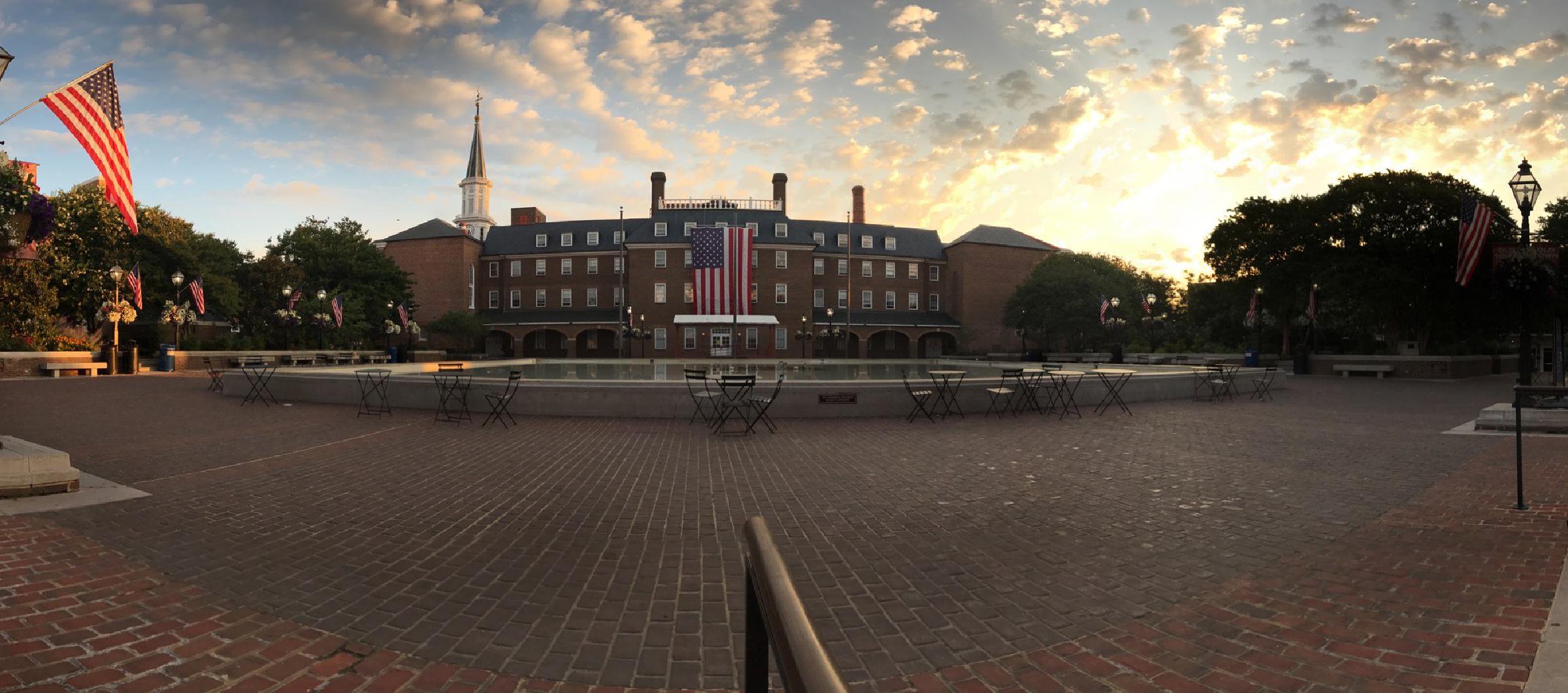
301
King Street
Alexandria’s seat of municipal government, market house, and — for most of the nineteenth century — the lodge hall and museum of Alexandria-Washington Lodge No. 22 Alexandria-Washington Lodge No. 22 founded 1783 Alexandria's senior Masonic lodge, chartered in 1788 under the Grand Lodge of Virginia with as its first Worshipful Master. Custodian of the largest private collection of … , which kept the country’s largest private collection of George Washington Masonic artifacts upstairs. The present 1873 Second Empire building is Adolf Cluss’s reconstruction of the earlier City Hall after the May 19, 1871 fire that catalyzed the national movement for what is now the 101 Callahan Drive 101 Callahan Drive A 333-foot granite tower atop Shuter's Hill, completed 1932 by Freemasons across the United States to honor as Charter Master of . Conceived after an 1871 fire at the lodge's Old … . NRHP-listed 1984.
- 1873
- Second Empire
- Extant
- National Register of Historic Places
Place narrative
The block bounded by Cameron, Royal, King, and Fairfax streets has been the center of Alexandria’s civic life since the town’s 1749 founding. By the early nineteenth century the block carried a multi-use building that served simultaneously as market house, city hall, and Masonic hall — Alexandria’s combined government, commerce, and fraternal headquarters under one roof.
The Masonic upper floor
From the early 1800s the upper floors of the King Street building housed the meeting rooms of Alexandria-Washington Lodge No. 22 Alexandria-Washington Lodge No. 22 founded 1783 Alexandria's senior Masonic lodge, chartered in 1788 under the Grand Lodge of Virginia with as its first Worshipful Master. Custodian of the largest private collection of … , the lodge that George Washington George Washington b. 1732 · d. 1799 Planter, military commander, and first President of the United States. Master of Mount Vernon from 1761 until his death in 1799, and a regular presence in Alexandria, which he … had chartered as Worshipful Master in 1788. After Washington’s death at Mount Vernon in December 1799 the lodge became custodian of his personal Masonic objects — the silver trowel he had used to lay the cornerstone of the U.S. Capitol in 1793, his Masonic Bible and apron, ceremonial regalia, and much of his correspondence — and over the decades that followed it built up the country’s largest single collection of Washington personal artifacts. The lodge’s upstairs rooms doubled as one of the earliest American museums [1] Alexandria-Washington Lodge No. 22 — "AW22 History" Website .
On February 21, 1825, the lodge formally received the Marquis de Lafayette Marquis de Lafayette b. 1757 · d. 1834 French general, American Revolutionary War officer, lifelong friend of , and one of the most celebrated foreign visitors in Alexandria's history. During his 1824–25 American grand … in these rooms during a Washington’s-birthday joint reception with Brooke Lodge No. 2 and Evangelical Lodge No. 8. Lafayette accepted honorary membership and presented the lodge with the great iron key to the Bastille that he had once sent to Washington at Mount Vernon [2] City of Alexandria — "Lafayette in Alexandria" Government record .
The 1871 fire
Early on the morning of May 19, 1871, fire broke out in the City Hall complex. Members rushing in were able to save most of the Washington artifacts and a significant share of the lodge’s records, but the museum’s natural-science and art collection — one of the oldest in the United States — was largely lost [3] Alexandria-Washington Lodge No. 22 — "From the Archives: Witness Account of the 1871 Lodge Fire" Website . Beyond the immediate damage, the fire terrified Masons nationwide. The realization that irreplaceable founding-era relics could vanish in a single night catalyzed a half-century movement that would ultimately produce the fireproof granite tower of the 101 Callahan Drive 101 Callahan Drive A 333-foot granite tower atop Shuter's Hill, completed 1932 by Freemasons across the United States to honor as Charter Master of . Conceived after an 1871 fire at the lodge's Old … on Shuter’s Hill.
Adolf Cluss and the 1873 rebuild
To rebuild, the city engaged Adolf Cluss, the Washington-area architect later known for the Smithsonian Arts and Industries Building. Cluss reconstructed the City Hall in the Second Empire style on the original footprint, reinforced the interior with steel beams and stone to make it substantially fireproof, and worked with the lodge to expand the upstairs museum and lodge rooms. The reconstructed building was occupied by 1874 [3] Alexandria-Washington Lodge No. 22 — "From the Archives: Witness Account of the 1871 Lodge Fire" Website .
The lodge continued to meet on King Street for another half-century, moving its rooms — and the Washingtoniana — to the Shuter’s Hill Memorial only after the Memorial’s 1932 dedication. The 1873 City Hall remains in continuous municipal use today and was listed on the National Register of Historic Places in 1984.
Timeline
4 chronological entries across 3 eras.
Lafayette received by Lodge No. 22 upstairs [1] Source City of Alexandria — "Lafayette in Alexandria"
Fire at the City Hall and Lodge Hall complex [2] Source Alexandria-Washington Lodge No. 22 — "From the Archives: Witness Account of the 1871 Lodge Fire"
Adolf Cluss rebuilds City Hall in Second Empire style [2] Source Alexandria-Washington Lodge No. 22 — "From the Archives: Witness Account of the 1871 Lodge Fire"
Listed on the National Register of Historic Places [3] Source Alexandria-Washington Lodge No. 22 — "AW22 History"
The building
- Second Empire
Gallery
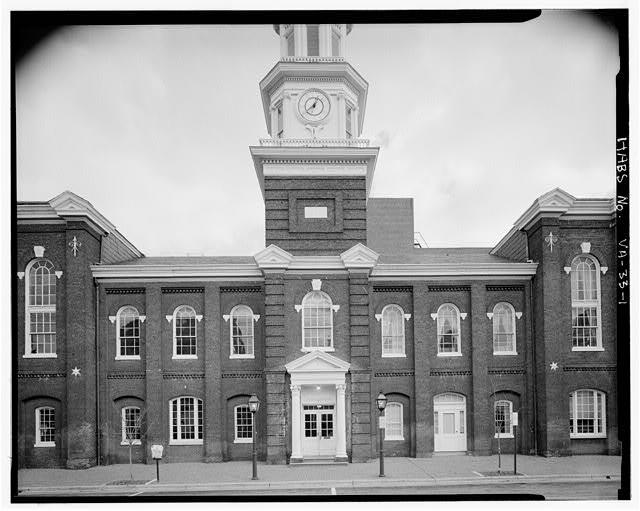
Alexandria Market House & City Hall (Masonic Hall), 301 King Street, Alexandria, Independent City, VA · Library of Congress, Prints & Photographs Division · http://www.loc.gov/item/va1295/

Nearby in time
Episcopal High School's 100-acre campus from above, September 2019 — Hoxton House (white columns, right) anchors the south end; the Collegiate Gothic academic buildings ring the central quad. Aerial view of Episcopal High School, by Penguino2020 / Wikimedia Commons, CC BY-SA 4.0 (2019) 1200 North Quaker Lane
The first high school in Virginia, founded 1839 by Bishop William Meade of the Episcopal Diocese on a 100-acre campus west of Old Town. …
6023 Fort Hunt Road 6023 Fort Hunt Road
1924 private country club at 6023 Fort Hunt Road on the Potomac River south of Old Town Alexandria. 18-hole golf course, tennis courts, and …
2461 Eisenhower Avenue 2461 Eisenhower Avenue
Mid-rise office building completed 1968 at 2461 Eisenhower Avenue — the first major structure on the seventy-acre Eisenhower Valley parcel …
Theodore Christopher · via Wikimedia Commons · CC0 1315 Duke Street
Federal-style brick house at 1315 Duke Street built in the 1810s by Brigadier General Robert Young of the DC Militia; from 1828 to 1837 the …
Nearby in space
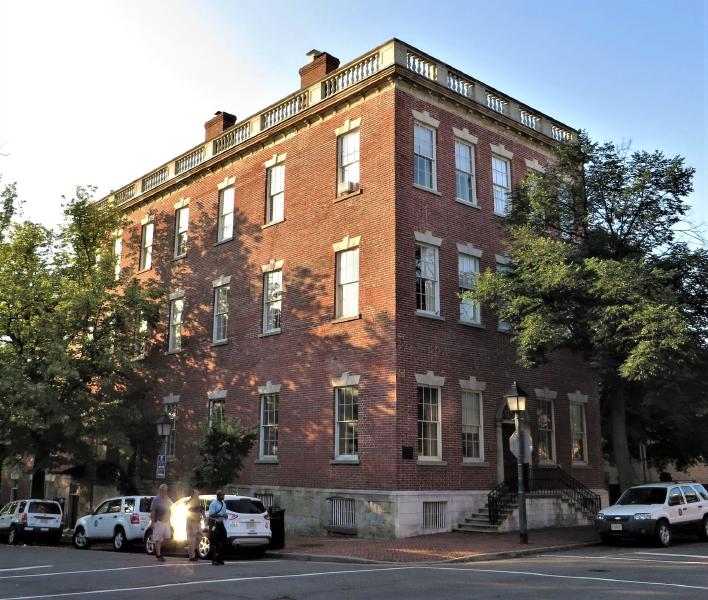
The 1807 Bank of Alexandria building at 133 N. Fairfax Street, Old Town Alexandria — the surviving Federal-style banking house after the late-1960s demolition of the Civil War-era hotel expansion. Photographed June 2014. Bank of Alexandria photographed by Ken Lund / Flickr, CC BY-SA 2.0 (2014) 133 North Fairfax Street
Federal-style 1807 banking house at the corner of North Fairfax and Cameron Streets — the surviving home of the Bank of Alexandria, …
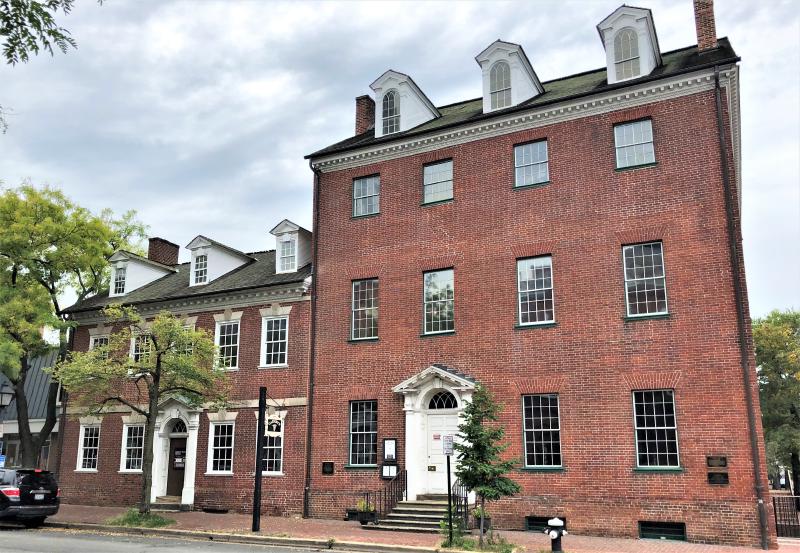
Beyond My Ken · via Wikimedia Commons · CC BY-SA 4.0 134 North Royal Street
An 18th-century tavern complex at 134 North Royal Street that hosted George Washington's final Birthnight Ball in 1799 and served as a …
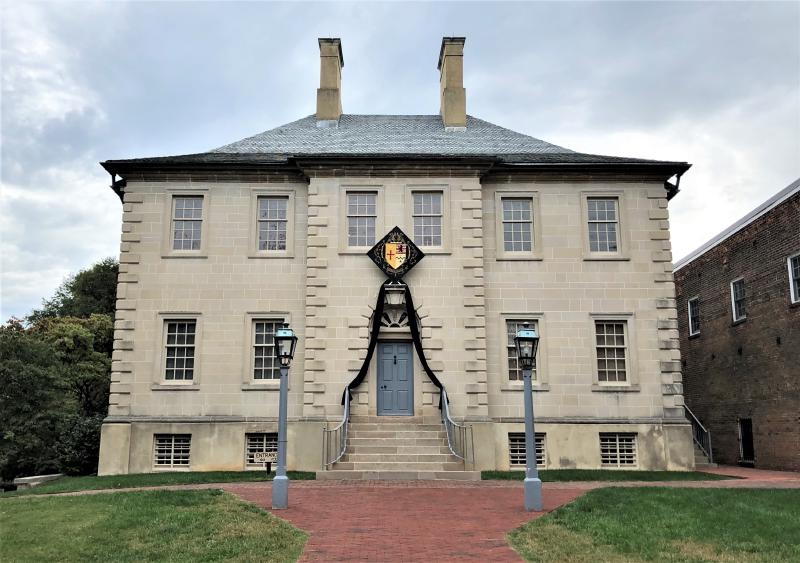
Beyond My Ken · via Wikimedia Commons · CC BY-SA 4.0 121 North Fairfax Street
Stone Georgian mansion built in 1753 by Scottish merchant John Carlyle; headquarters in April 1755 for General Edward Braddock's Congress of …
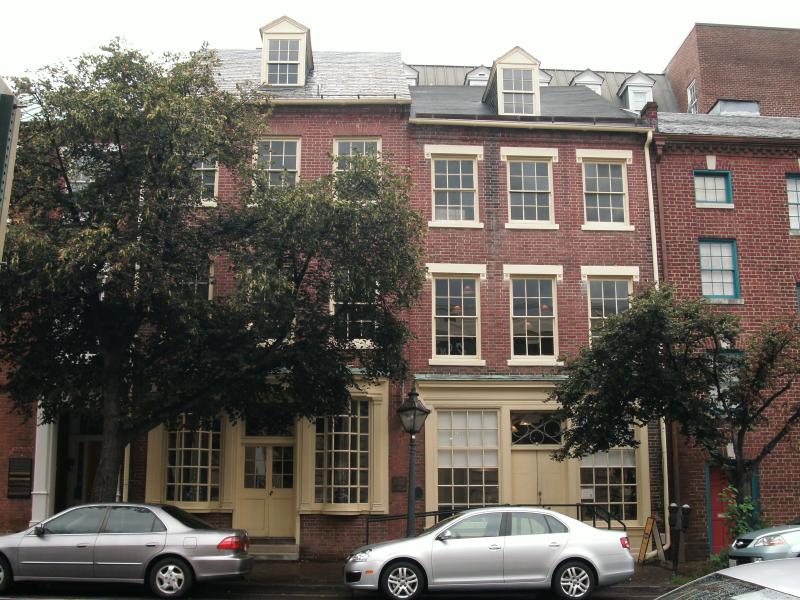
The original uploader was Ser Amantio di Nicolao at English Wikipedia . · via Wikimedia Commons · CC BY 3.0 105 South Fairfax Street
Apothecary operated 1792-1933 by the Stabler and Leadbeater families; designated a National Historic Landmark in 2021. NRHP-listed 1982.
Now
No current occupant on file. Are you, or someone you know, the present occupant? Claim this place to add operating hours, a current photo, and a short note.
King Street
Named for King George II of Great Britain (reigning 1727-1760), c. 1749.
Interpretive signs nearby
The City of Alexandria has installed 11 historical interpretive signs within walking distance of this place. Each link below opens the sign's page on this site, with the full image and trail context.
Restored Government of Virginia
125 N Royal St
325 Cameron St
311 Cameron St
121 N. Fairfax Street
Market Square
411 King St
326 King St
The Lynching of Benjamin Thomas
300 King St
221 King St
Stabler-Leadbeater Apothecary Museum
218 King St
Sources
- 1.
Alexandria-Washington Lodge No. 22, "AW22 History," aw22.org, accessed 2026. The lodge's own history, documenting Washington's April 28, 1788 chartering as first Worshipful Master and the lodge's continuous operation to the present day.
Website https://aw22.org/aw22-history/ →
- 2.
Office of Historic Alexandria, "Lafayette in Alexandria," alexandriava.gov, accessed 2026. Municipal interpretive history of the Marquis de Lafayette's 1824–25 visits to Alexandria, including the February 21, 1825 Masonic reception at which Lafayette accepted honorary membership in Lodge No. 22 and presented the Bastille key.
Government record https://www.alexandriava.gov/historic-alexandria/lafayette-in-alexandria →
- 3.
Alexandria-Washington Lodge No. 22, "From the Archives: Witness Account of the 1871 Lodge Fire," aw22.org, accessed 2026. Contains the lodge's own period account of the May 19, 1871 fire at the King Street City Hall and Market House, including the rescue of the bulk of the Washingtoniana and the loss of much of the natural-science and art collection.
Website https://aw22.org/from-the-archives-witness-account-of-the-1871-lodge-fire/ →
See something wrong?
Every correction is logged dated to this page. Family history, old photographs, or a citation we missed — everything goes into the file.