
4800
Duke Street
164-acre former U.S. Army installation on Duke Street, active 1942–1995. Headquartered the Defense Logistics Agency, the Defense Mapping Agency, and elements of the U.S. Army Materiel Command across its Cold-War-era life. Closed under the 1988 BRAC round, final shutdown 1995. Redeveloped 1998–2002 as the present Cameron Station residential community — ~2,000 housing units plus Cameron Station Boulevard Cameron Station Boulevard 45-acre civic park laid out across the former parade-ground center of during the 1998–2002 LCOR redevelopment of the parcel. Named for Ben Brenman, an Alexandria civic figure … (45 acres) and the Charles E. Beatley Jr. Central Library, named for Charles E. Beatley Jr. Charles E. Beatley Jr. b. 1916 · d. 2006 Two-term mayor of Alexandria, Virginia (1976–1979 and 1985–1991); namesake of the Charles E. Beatley Jr. Central Library at 5005 Duke Street on the redeveloped parcel. Career … , the Alexandria mayor who served the city during the planning years for the redevelopment.
- 1942
- Mid-century military / postwar residential redevelopment
- Extant demolished 1995
Place narrative
Cameron Station was a 164-acre U.S. Army installation that occupied the western Alexandria parcel between Duke Street, North Quaker Lane, and the western city boundary from 1942 through 1995 — a fifty-three-year operational life that spanned the full World War II / Cold War / post-Cold-War arc of the modern federal-military presence in Alexandria. [1] Wikipedia — Cameron Station (Alexandria, Virginia) Website
The installation took its name from Cameron Run and the colonial-era Cameron / Lord Fairfax tract — the same Cameron lineage that names Cameron Run, Cameron Valley, and Cameron Street in downtown Old Town Alexandria, an inheritance from the eighteenth-century proprietary land grant that covered the larger Northern Neck of Virginia.
Cold-War operations (1942–1995)
Cameron Station was built in 1942 as a wartime Army logistics installation and over its operational life housed at various points the headquarters or major elements of:
The Defense Logistics Agency (DLA) — the U.S. military’s worldwide logistics command
The Defense Mapping Agency (DMA) — the U.S. military’s cartographic and geospatial-intelligence command, before its successor agency NIMA (later NGA) was stood up
Elements of the U.S. Army Materiel Command
The Defense Contract Audit Agency (DCAA) — federal civilian audit command
Peak workforce on the installation reached the low thousands of military and civilian personnel across the various tenant commands during the Cold-War decades.
BRAC closure and redevelopment (1988–2002)
Cameron Station was selected for closure under the 1988 round of the Base Realignment and Closure (BRAC) process — the federal-statutory framework for shrinking the post-Cold-War U.S. military footprint. The Army began the closeout in the early 1990s and the installation was formally shut down in 1995, with the tenant commands relocated to other federal facilities (DLA to Fort Belvoir; DMA / NIMA / NGA to a new Springfield headquarters; DCAA to Fort Belvoir).
The City of Alexandria and the federal General Services Administration negotiated the parcel’s transfer through the mid-1990s, and a public-private partnership with developer LCOR Inc. carried out the redevelopment between 1998 and 2002. The Cold-War tenant commands relocated to other federal facilities — DLA and DCAA to Richmond Highway Richmond Highway ~8,656-acre U.S. Army installation along Richmond Highway in Fairfax County, established 1917 as Camp A.A. Humphreys, renamed Fort Humphreys 1922, renamed Fort Belvoir 1935 in … , and the Defense Mapping Agency successor (NIMA, later NGA) to a new Springfield headquarters. The redevelopment plan retained the Cameron Station name across the new residential community and divided the parcel into:
Approximately 2,000 housing units (single-family detached homes, townhouses, and condominium units)
Cameron Station Boulevard Cameron Station Boulevard 45-acre civic park laid out across the former parade-ground center of during the 1998–2002 LCOR redevelopment of the parcel. Named for Ben Brenman, an Alexandria civic figure … , a 45-acre civic park laid out across the former parade-ground / open-space center of the military installation
The Charles E. Beatley Jr. Central Library — Alexandria’s main public library facility, opened 2000 at 5005 Duke Street and named for Charles E. Beatley Jr. Charles E. Beatley Jr. b. 1916 · d. 2006 Two-term mayor of Alexandria, Virginia (1976–1979 and 1985–1991); namesake of the Charles E. Beatley Jr. Central Library at 5005 Duke Street on the redeveloped parcel. Career … , the Alexandria mayor whose two non-consecutive tenures (1976–79 and 1985–91) bridged the mayoral-leadership years for the redevelopment’s planning phase
The redevelopment is widely cited as one of the more successful examples of post-BRAC base reuse in the Washington metropolitan area, retaining significant civic open space (the Brenman park), delivering substantial residential capacity at a range of price points, and preserving a major institutional anchor (the central library branch) on a parcel that could otherwise have been wholly given over to private residential development.
Out-of-scope research targets
Specific deployment-history details for the various Cold-War-era tenant commands at Cameron Station — the dates of DLA’s tenancy versus DMA’s, the size of each command’s footprint, the specific buildings each occupied — are research-bound for a future deepening against National Archives military-records holdings and Alexandria Library Special Collections coverage of the BRAC-era closeout. [2] Alexandria Library Special Collections Manuscript
Timeline
4 chronological entries across 3 eras.
The building
- Mid-century military / postwar residential redevelopment
No images yet — contribute a photo.
Nearby in time
Richmond Highway Richmond Highway
~8,656-acre U.S. Army installation along Richmond Highway in Fairfax County, established 1917 as Camp A.A. Humphreys, renamed Fort Humphreys …
Placeholder illustration of Interarms Hq 10 Prince Street. Seed placeholder — KingSt.com, 2026. To be replaced with archival photograph. 10 Prince Street
Former office of International Armament Corporation (Interarms) at the foot of Prince Street; administrative headquarters of Samuel …
6023 Fort Hunt Road 6023 Fort Hunt Road
1924 private country club at 6023 Fort Hunt Road on the Potomac River south of Old Town Alexandria. 18-hole golf course, tennis courts, and …
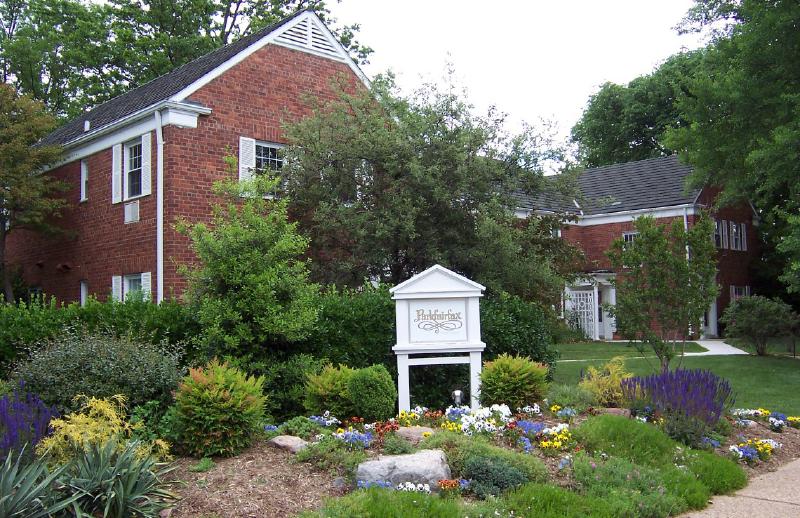
Unknown · via Wikimedia Commons · CC BY 2.5 132-acre Colonial Revival garden-apartment community completed 1941–1943 by the Metropolitan Life Insurance Company under FHA …
Nearby in space
Cameron Station Boulevard Cameron Station Boulevard
45-acre civic park laid out across the former parade-ground center of during the 1998–2002 LCOR redevelopment of the parcel. Named for Ben …
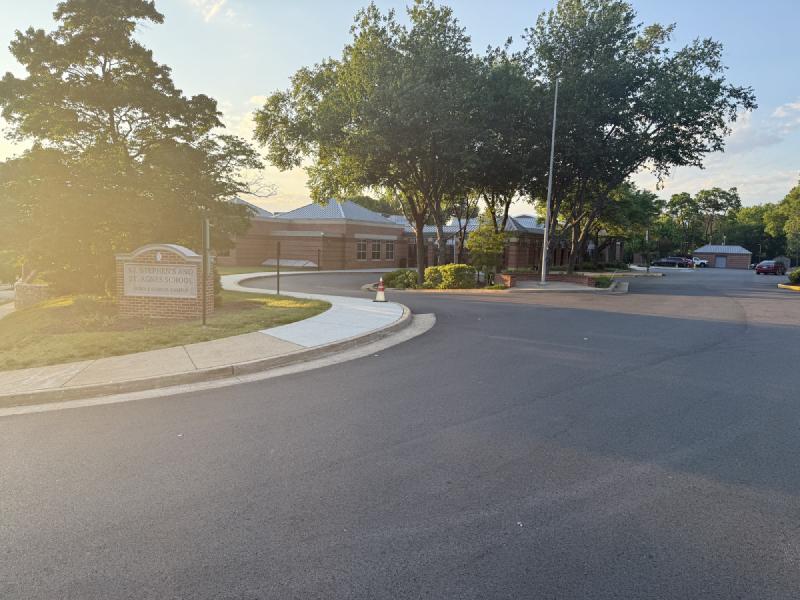
St. Stephen's and St. Agnes Middle School Campus on West Braddock Road at sunrise — the entrance sign and the brick academic buildings beyond, back-lit by golden-hour light. © KingSt.com, 2024 4401 West Braddock Road
Middle School (grades 6–8) of St. Stephen's & St. Agnes since the late 1990s, on the West Braddock Road campus that previously housed …
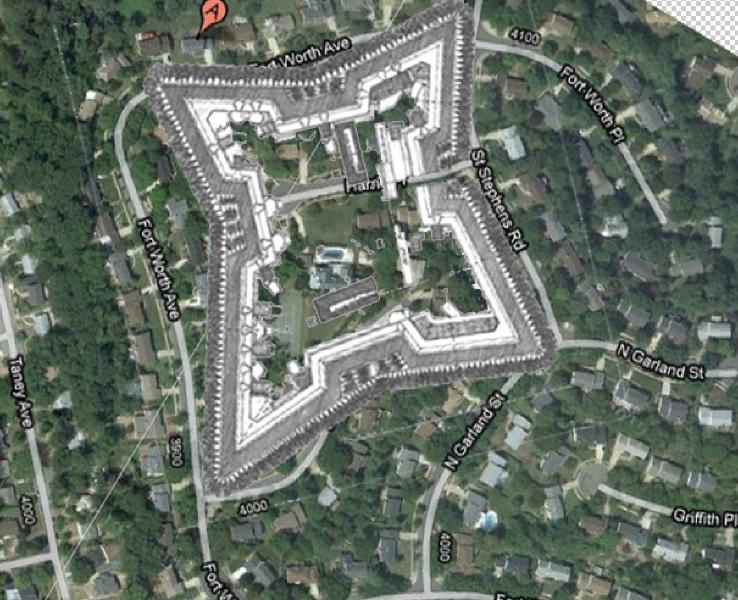
The 1864 Fort Worth engineering plan superimposed on modern Seminary Ridge satellite imagery — the fort's star-shaped earthwork still imprinted on today's residential street grid. Composite by KingSt.com (1864 NARA plan over modern aerial), 2026 Seminary Hill (off Seminary Road, near St. Stephens Road)
Layered Seminary Hill site that was the country estate "Muckross" of Burke & Herbert Bank co-founder Arthur Herbert, the Civil War earthwork …
1000 Saint Stephens Road 1000 Saint Stephens Road
Upper School (grades 9–12) of St. Stephen's & St. Agnes School, occupying the Saint Stephens Road campus opened in January 1957 by St. …
Now
No current occupant on file. Are you, or someone you know, the present occupant? Claim this place to add operating hours, a current photo, and a short note.
Duke Street
Named for Royal duke (likely the Duke of Cumberland, son of George II), c. 1749.
Sources
- 1.
Wikipedia, "Cameron Station (Alexandria, Virginia)" article, accessed 2026-05-03. Documents the 164-acre Duke Street site; 1942 construction; tenant commands across 1942–95 active period (DLA, DMA, AMC, DCAA); 1988 BRAC selection and 1995 shutdown; 1998–2002 LCOR-led redevelopment.
Website https://en.wikipedia.org/wiki/Cameron_Station_(Alexandria,_Virginia) →
- 2.
Alexandria Library, Local History/Special Collections, Barrett Branch, Alexandria, Virginia.
Manuscript
See something wrong?
Every correction is logged dated to this page. Family history, old photographs, or a citation we missed — everything goes into the file.