
Richmond Highway
a.k.a. Richmond Highway
~8,656-acre U.S. Army installation along Richmond Highway in Fairfax County, established 1917 as Camp A.A. Humphreys, renamed Fort Humphreys 1922, renamed Fort Belvoir 1935 in recognition of the belvoir-plantation belvoir-plantation The c. 1741 manor house of on the southern Northern Neck proprietary tract — social anchor of the colonial Fairfax–Washington circle, where young was mentored by William Fairfax … that formerly occupied the parcel. Today INSCOM HQ, DLA HQ (post-BRAC ‘88 relocation from 4800 Duke Street 4800 Duke Street 164-acre former U.S. Army installation on Duke Street, active 1942–1995. Headquartered the Defense Logistics Agency, the Defense Mapping Agency, and elements of the U.S. Army … ), DTRA, MEDCOM elements, ~170 tenant commands, ~13,000 federal workers. Site of the National Museum of the U.S. Army, opened November 11, 2020.
- 1917
- Mid-twentieth-century military
- Extant
Place narrative
Fort Belvoir is the U.S. Army’s flagship Washington-area installation, occupying ~8,656 acres along Richmond Highway in Fairfax County between Mt. Vernon and Lorton. The site has been in continuous U.S. Army use since 1917. [1] Wikipedia — Fort Belvoir Website
Origins (1917–1935)
The Army acquired the southern Belvoir Neck parcel in 1915 and established Camp A.A. Humphreys in 1917 as a training camp for the U.S. Army Corps of Engineers during World War I — named for Andrew A. Humphreys, the Civil War-era Army engineer and chief of staff to Major General George Meade at Gettysburg. The training camp was renamed Fort Humphreys in 1922 as it transitioned from a wartime training camp into a permanent Engineer School installation.
In 1935 the installation was renamed Fort Belvoir, in explicit recognition of the belvoir-plantation belvoir-plantation The c. 1741 manor house of on the southern Northern Neck proprietary tract — social anchor of the colonial Fairfax–Washington circle, where young was mentored by William Fairfax … — the c. 1741 William Fairfax William Fairfax b. 1691 · d. 1757 Colonial-era owner and builder of (c. 1741); cousin and Virginia agent of Thomas Fairfax, 6th Lord Fairfax of Cameron, the Proprietor of the Northern Neck. President of the … manor whose archaeological ruins survived on the southwest portion of the parcel. The Belvoir name was meant to root the modern military installation in the colonial-era Fairfax–Washington social geography of the southern Northern Neck.
Cold-War expansion (1935–1988)
Through the World War II, Korean-War, and Cold-War decades, Fort Belvoir functioned as the Army’s senior Engineer-School and research-and-development installation. The U.S. Army Engineer Center moved from Belvoir to Fort Leonard Wood, Missouri in 1988, redirecting Belvoir toward the federal-intelligence mission set that defines the installation today.
Post-BRAC consolidation (1988–present)
The 1988 Base Realignment and Closure (BRAC) round selected 4800 Duke Street 4800 Duke Street 164-acre former U.S. Army installation on Duke Street, active 1942–1995. Headquartered the Defense Logistics Agency, the Defense Mapping Agency, and elements of the U.S. Army … (the Duke Street installation in western Alexandria) for closure and relocation of its tenant commands. The Defense Logistics Agency (DLA) relocated its headquarters from Cameron Station to Fort Belvoir as part of the 1995 closeout — a direct cross-reference between the two installations. The 2005 BRAC round further consolidated Washington-area Army headquarters operations onto Fort Belvoir, bringing thousands of additional federal workers to the parcel.
Today Fort Belvoir hosts:
- U.S. Army Intelligence and Security Command (INSCOM) HQ - Defense Logistics Agency (DLA) HQ (relocated from Cameron Station) - Defense Threat Reduction Agency (DTRA) - U.S. Army Medical Command (MEDCOM) elements - National Geospatial-Intelligence Agency (NGA) at the Belvoir North Area campus (the relocated successor to the Defense Mapping Agency that had previously been a Cameron Station tenant)
- The National Museum of the U.S. Army, the first museum dedicated to the full sweep of U.S. Army history, opened on the parcel November 11, 2020 (Veterans Day)
- More than 170 tenant commands and approximately 13,000 federal civilian and military workers [2] U.S. Army — Fort Belvoir official site Website
Fort Belvoir is among the largest single federal-employment nodes in Northern Virginia and the dominant federal land-use on the southern Richmond Highway corridor between Alexandria and the Mason Neck peninsula.
Timeline
4 chronological entries across 2 eras.
The building
- Mid-twentieth-century military
No images yet — contribute a photo.
Nearby in time
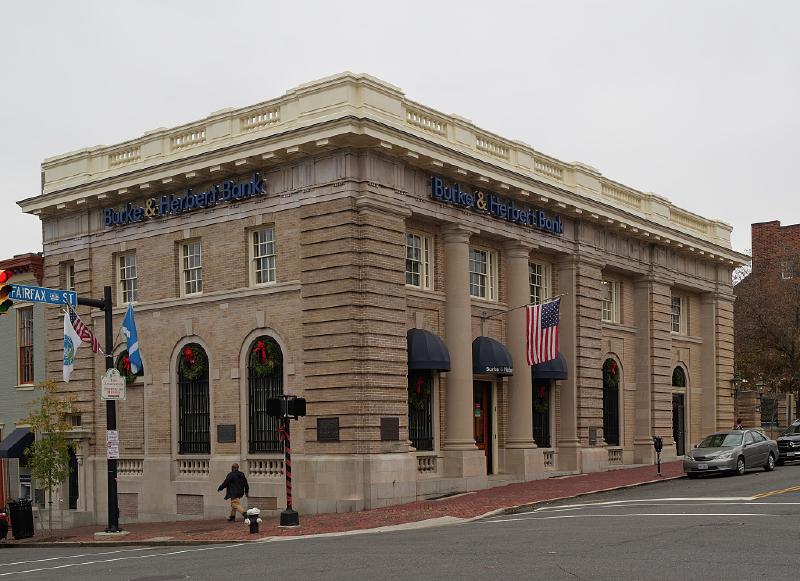
The Burke & Herbert Bank building in Alexandria, Virginia, a city immediately south of Washington, D.C., and once a larger, more thriving river port than the nation's capital city · Library of Congress, Prints & Photographs Division · http://www.loc.gov/item/2020724810/ 100 South Fairfax Street
The 1903 neoclassical home of at the corner of King and South Fairfax streets, the bank's sixth and final headquarters after a half-century …

Placeholder illustration of Alexandria Library 1939. Seed placeholder — KingSt.com, 2026. To be replaced with archival photograph. 717 Queen Street
Alexandria's first free public library, opened on Queen Street in 1937, and site of a sit-in on August 21, 1939 that is among the earliest …
1100 Wilkes Street 1100 Wilkes Street
Cluster of twelve adjacent burial grounds stretching across the 1100 block of Wilkes Street, including Methodist Protestant, Presbyterian, …
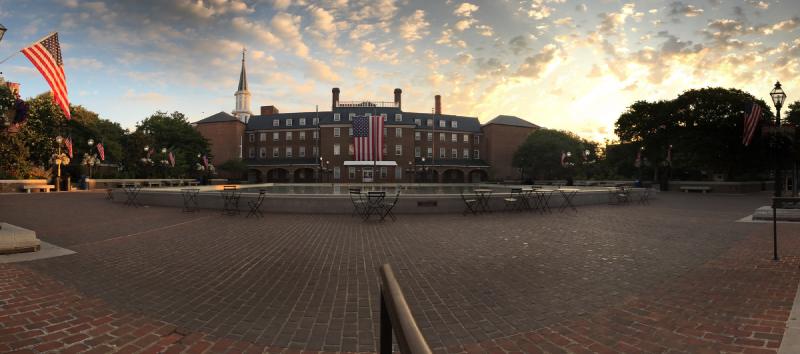
Market Square and Alexandria City Hall at sunrise, July 2017 — the brick plaza dressed for the Fourth of July with the American flag hung from the central facade. © KingSt.com, July 2017 301 King Street
Alexandria's seat of municipal government, market house, and — for most of the nineteenth century — the lodge hall and museum of , which …
Nearby in space
The c. 1741 manor house of on the southern Northern Neck proprietary tract — social anchor of the colonial Fairfax–Washington circle, where …
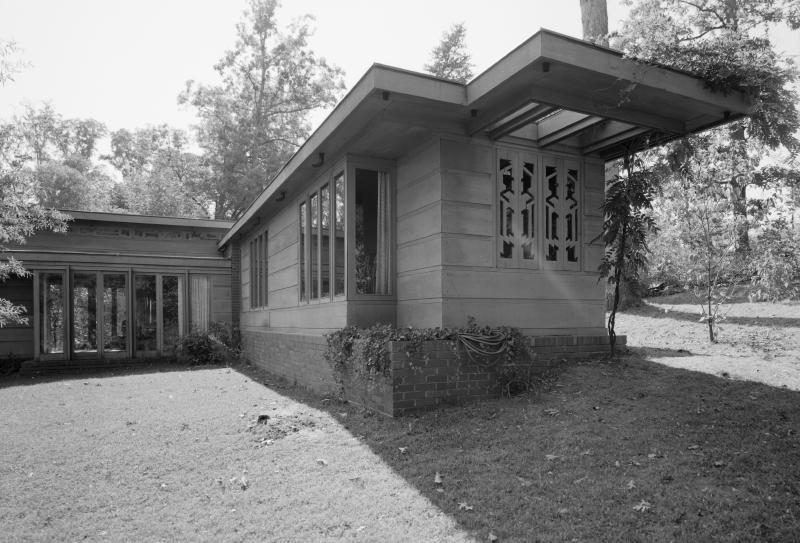
Unknown author Unknown author · via Wikimedia Commons · Public domain 9000 Richmond Highway
Usonian house built in 1940 for journalist Loren Pope; relocated to the parcel in 1964 to escape Interstate 66 construction at its …
9000 Richmond Highway 9000 Richmond Highway
Federal-style brick mansion built 1800–1805 by and on a 2,000-acre tract carved from the Mount Vernon estate as their wedding gift from .
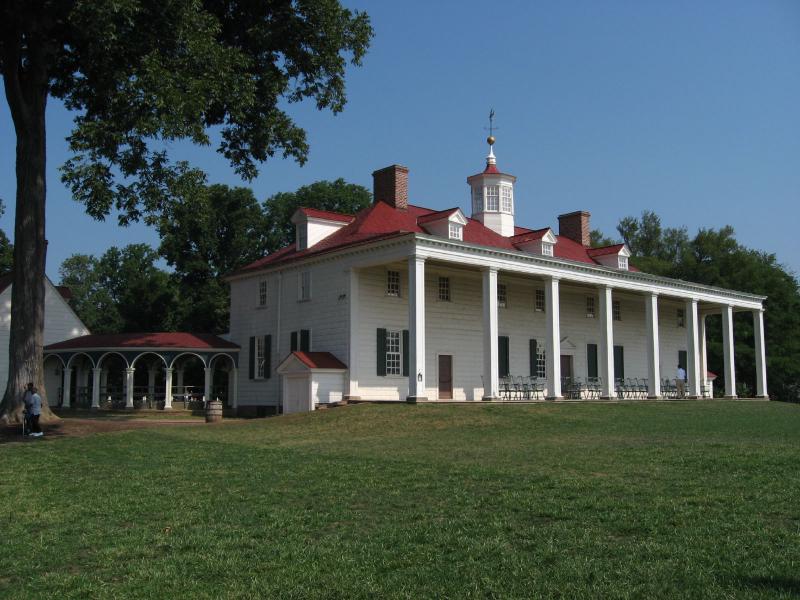
Ken Lund from Reno, Nevada, USA · via Wikimedia Commons · CC BY-SA 2.0 3200 Mount Vernon Memorial Highway
Five-farm plantation on the Potomac owned by George Washington from 1761 until his death in 1799; home to Washington, his family, and more …
Now
No current occupant on file. Are you, or someone you know, the present occupant? Claim this place to add operating hours, a current photo, and a short note.
Sources
- 1.
Wikipedia, "Fort Belvoir" article, accessed 2026-05-03. Documents the 1917 Camp A.A. Humphreys founding, 1922 Fort Humphreys rename, 1935 Fort Belvoir rename, ~8,656-acre site, current tenant commands (INSCOM, DLA, DTRA, MEDCOM, NGA), and the 1988 + 2005 BRAC consolidations.
- 2.
U.S. Army Garrison Fort Belvoir official website (home.army.mil/belvoir), accessed 2026-05-03. Documents tenant-command roster, installation history, and current operations.
Website https://home.army.mil/belvoir/ →
See something wrong?
Every correction is logged dated to this page. Family history, old photographs, or a citation we missed — everything goes into the file.