

101
Callahan Drive
A 333-foot granite tower atop Shuter’s Hill, completed 1932 by Freemasons across the United States to honor George Washington George Washington b. 1732 · d. 1799 Planter, military commander, and first President of the United States. Master of Mount Vernon from 1761 until his death in 1799, and a regular presence in Alexandria, which he … as Charter Master of Alexandria-Washington Lodge No. 22 Alexandria-Washington Lodge No. 22 founded 1783 Alexandria's senior Masonic lodge, chartered in 1788 under the Grand Lodge of Virginia with as its first Worshipful Master. Custodian of the largest private collection of … . Conceived after an 1871 fire at the lodge’s Old Town home threatened the Washingtoniana, designed by Harvey Wiley Corbett to evoke the ancient Lighthouse of Alexandria, and dedicated in three ceremonies presided over by Presidents Coolidge, Hoover, and Truman. NRHP-listed 2015.
- 1932
- Neoclassical with Egyptian and Beaux-Arts elements
- Extant
- National Register of Historic Places
Place narrative
Perched on the highest natural point in Alexandria, the George Washington Masonic National Memorial rises 333 feet above Shuter’s Hill as one of the most visually commanding landmarks in Northern Virginia — part temple, part museum, part shrine to the first President, and the living headquarters of Alexandria-Washington Lodge No. 22 Alexandria-Washington Lodge No. 22 founded 1783 Alexandria's senior Masonic lodge, chartered in 1788 under the Grand Lodge of Virginia with as its first Worshipful Master. Custodian of the largest private collection of … , the Masonic lodge that George Washington George Washington b. 1732 · d. 1799 Planter, military commander, and first President of the United States. Master of Mount Vernon from 1761 until his death in 1799, and a regular presence in Alexandria, which he … chartered as Worshipful Master in 1788. The memorial is not a federal monument. It was conceived, funded, and built almost entirely by Freemasons across the United States who believed Washington’s role as a Mason was inseparable from his role in founding the Republic [1] GWMNMA — "A Brief History" Website .
Freemasonry and the founding generation
Freemasonry is one of the world’s oldest fraternal organizations, tracing symbolic traditions to medieval stonemasons’ guilds and evolving by the eighteenth century into a civic and philosophical brotherhood that emphasized morality, charity, civic duty, personal improvement, and fraternity. By the 1770s the lodges had become a quiet circulatory system for the Enlightenment ideals moving through the American colonies — republicanism, reason and education, religious tolerance, and mutual aid — and many of the leading figures of the Revolution sat in them together: merchants, military officers, lawyers, artisans, and political leaders mingling in ways that were otherwise unusual for the era [2] Mount Vernon — "The George Washington Masonic National Memorial" Website .
George Washington was initiated a Mason in Fredericksburg, Virginia, on November 4, 1752, at the age of twenty. His Masonic life continued through his military and presidential career, and on April 28, 1788 he became the first Worshipful Master under charter of what is now Alexandria-Washington Lodge No. 22 Alexandria-Washington Lodge No. 22 founded 1783 Alexandria's senior Masonic lodge, chartered in 1788 under the Grand Lodge of Virginia with as its first Worshipful Master. Custodian of the largest private collection of … [3] Alexandria-Washington Lodge No. 22 — "AW22 History" Website . Five years later, on September 18, 1793, Washington wore Masonic regalia to lay the cornerstone of the United States Capitol — using a silver trowel made for the occasion by Alexandria silversmith John Duffey. That trowel was preserved by the Alexandria lodge and ceremonially returned to use in 1923 when the cornerstone of the Memorial itself was laid [4] Scottish Rite Journal — "100th Anniversary of the GWMNM Cornerstone Laying" Website .
Lafayette, the Bastille key, and the Washingtoniana
On February 21, 1825 — three months after the public reception that Alexandria gave him at the start of his American grand tour — the Marquis de Lafayette Marquis de Lafayette b. 1757 · d. 1834 French general, American Revolutionary War officer, lifelong friend of , and one of the most celebrated foreign visitors in Alexandria's history. During his 1824–25 American grand … returned to Alexandria and was formally received by Alexandria-Washington Lodge No. 22, together with Brooke Lodge No. 2 and Evangelical Lodge No. 8, in a joint celebration of Washington’s birthday. The Master of Lodge No. 22 presented Lafayette with a diploma of honorary membership; Lafayette in turn presented the Lodge with the large iron key to the Bastille — ten inches long, more than five pounds — that he had carried out of revolutionary Paris and once sent to Washington at Mount Vernon. The Bastille key is on permanent display in the Memorial museum today [5] City of Alexandria — "Lafayette in Alexandria" Government record [6] Grand Lodge of New York — "Marquis de Lafayette's Apron" Website .
After Washington’s death in 1799 his personal Masonic objects — letters, regalia, ceremonial tools, portraits, and other “Washingtoniana” — were entrusted to the Alexandria lodge, which kept them in its meeting rooms on the upper floor of the 301 King Street 301 King Street Alexandria's seat of municipal government, market house, and — for most of the nineteenth century — the lodge hall and museum of , which kept the country's largest private … on King Street.
The 1871 fire — and the movement that built the Memorial
On the morning of May 19, 1871, fire broke out in the King Street City Hall complex that housed the lodge. Members rushed in and managed to save a significant share of the lodge’s records and most of the Washington artifacts, but much of the lodge’s natural-science and art collection — one of the oldest museums in the United States — was lost [7] Alexandria-Washington Lodge No. 22 — "From the Archives: Witness Account of the 1871 Lodge Fire" Website . The fire terrified Masons nationwide, who suddenly understood that the irreplaceable relics linking their fraternity to the founding generation could vanish in a single night. Out of that alarm grew a movement that would last half a century: build a permanent, monumental, fireproof memorial to Washington — not simply a statue, but a national shrine.
Why Shuter’s Hill
The memorial was sited on Shuter’s Hill, the highest natural point in Alexandria. The placement was deliberate. The hill overlooks Old Town, visually aligns toward Washington, D.C., is visible for miles on the approaches into the city, and creates a symbolic dialogue with the Washington Monument across the Potomac. Shuter’s Hill had also functioned as a strategic overlook from colonial times through the Civil War defenses of Washington. Together those qualities transformed the memorial into both a civic beacon and a ceremonial gateway into Alexandria [1] GWMNMA — "A Brief History" Website .
Architecture: ancient temple meets American skyscraper
The architect was Harvey Wiley Corbett, a New York practitioner closely associated with early skyscraper development. Rather than designing a simple neoclassical pavilion, Corbett blended Greek and Roman temple architecture, Egyptian-inspired monumentality, the verticality of the early twentieth- century skyscraper, and Beaux-Arts ceremonial planning. The result is most often compared to the ancient Lighthouse of Alexandria on the Egyptian coast — a stepped tower rising from a temple base. The granite construction was specifically chosen to resist fire and preserve the lodge’s artifacts indefinitely [2] Mount Vernon — "The George Washington Masonic National Memorial" Website .
Three Presidents and the national subscription
The Memorial was a national Masonic undertaking. Grand Lodges from every state contributed funding, artifacts, and ceremonial participation, and three sitting Presidents — each a Freemason — presided over the principal ceremonies.
William Howard Taft William Howard Taft b. 1857 · d. 1930 27th President of the United States (1909–1913) and 10th Chief Justice of the United States (1921–1930) — the only person to have held both offices — and a Freemason raised in … , then Chief Justice of the United States, played an early organizational role for the national memorial association and attended the 1923 cornerstone ceremony alongside the Grand Masters of every U.S. grand lodge. President Calvin Coolidge Calvin Coolidge b. 1872 · d. 1933 30th President of the United States (1923–1929) and a Freemason. On November 1, 1923, before a crowd of roughly 14,000, Coolidge laid the cornerstone of the on Shuter's Hill using … laid the cornerstone on November 1, 1923 before a crowd of roughly 14,000, using the same Alexandria-made silver trowel Washington had used at the Capitol in 1793 [4] Scottish Rite Journal — "100th Anniversary of the GWMNM Cornerstone Laying" Website . President Herbert Hoover Herbert Hoover b. 1874 · d. 1964 31st President of the United States (1929–1933). On May 12, 1932 — during the bicentennial of Washington's birth — Hoover delivered the formal dedication address at the on … delivered the formal dedication address on May 12, 1932, during the bicentennial of Washington’s birth, after the exterior was complete [1] GWMNMA — "A Brief History" Website . A generation later, President Harry Truman Harry Truman b. 1884 · d. 1972 33rd President of the United States (1945–1953) and a Past Grand Master of the Grand Lodge of Missouri — one of the most active Freemasons ever to hold the office. Truman dedicated … — a Past Grand Master of the Grand Lodge of Missouri and one of the most active Masons ever to hold the office — dedicated the seventeen-foot bronze statue of Washington that anchors the Memorial’s central Memorial Hall.
The Memorial today
The Memorial functions simultaneously as an active Masonic lodge, a museum, an archive, a ceremonial hall, a research library, and one of Alexandria’s most-visited tourist destinations. Inside are the Washington artifacts saved from the 1871 fire (including the silver trowel and the family Bible used at Washington’s first inaugural), Lafayette’s Bastille key, period-themed lodge rooms, exhibits on the history of American fraternalism, and an observation deck whose panoramic windows take in Old Town, the Potomac, the National Mall, and the dome of the Capitol building whose cornerstone Washington laid. The Memorial was added to the National Register of Historic Places in 2015 [1] GWMNMA — "A Brief History" Website .
For Alexandria specifically, the building on Shuter’s Hill is a reminder that the city was not merely adjacent to Washington’s life — it was woven directly into his social, political, military, religious, and fraternal world.
Timeline
9 chronological entries across 5 eras.
George Washington initiated a Mason at Fredericksburg [1] Source Mount Vernon — "The George Washington Masonic National Memorial"
Washington chartered as Worshipful Master of Lodge No. 22 [2] Source Alexandria-Washington Lodge No. 22 — "AW22 History"
Lafayette receives honorary membership; presents the Bastille key [3] Source City of Alexandria — "Lafayette in Alexandria" [4] Source Grand Lodge of New York — "Marquis de Lafayette's Apron"
Fire at the lodge's King Street home spurs a national memorial movement [5] Source Alexandria-Washington Lodge No. 22 — "From the Archives: Witness Account of the 1871 Lodge Fire"
Cornerstone laid by President Coolidge [6] Source Scottish Rite Journal — "100th Anniversary of the GWMNM Cornerstone Laying"
- — present
Alexandria-Washington Lodge No. 22 — the lodge Washington chartered in 1788 — has met in the Memorial since its 1932 dedication. [2] Source Alexandria-Washington Lodge No. 22 — "AW22 History"
Memorial dedicated by President Hoover [7] Source GWMNMA — "A Brief History"
Truman dedicates the seventeen-foot bronze statue of Washington [7] Source GWMNMA — "A Brief History"
Listed on the National Register of Historic Places [7] Source GWMNMA — "A Brief History"
The building
- Neoclassical with Egyptian and Beaux-Arts elements
Gallery
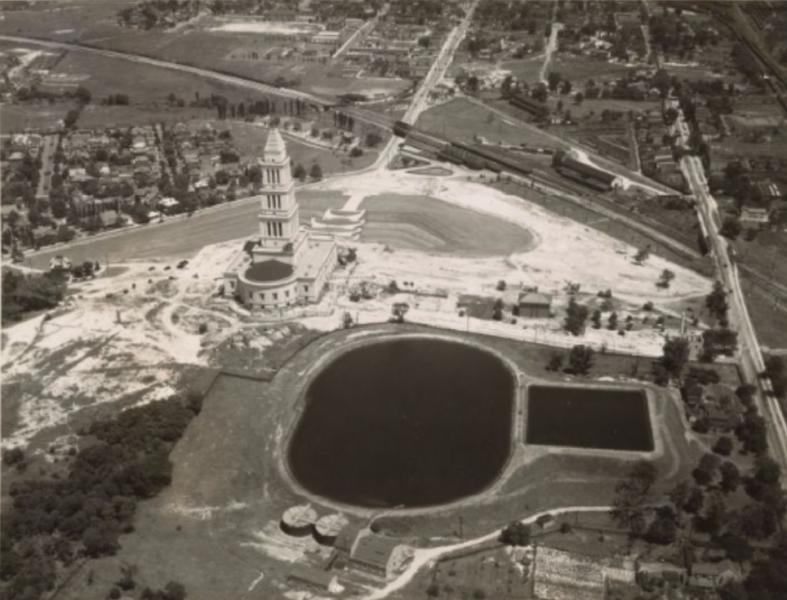
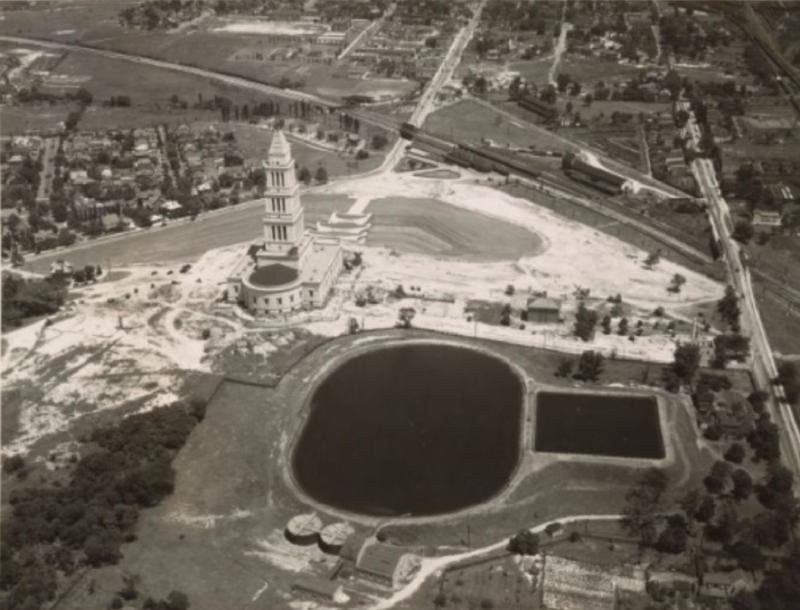
The George Washington Masonic National Memorial nearing completion, July 1931 — nine months before its May 1932 dedication by President Hoover. Unattributed press photograph, July 1931 — provenance to be confirmed.
Connected
Alexandria-Washington Lodge No. 22
founded 1783
Alexandria's senior Masonic lodge, chartered in 1788 under the Grand Lodge of Virginia with as its first Worshipful Master. Custodian of the largest private collection of …
Tenant · Lodge hall museum · %!d(float64=1932)
Nearby in time
Parker-Gray neighborhood Parker-Gray neighborhood
Historically African-American residential and commercial district north and west of Old Town, anchored by the Parker-Gray School. …
2605 King Street 2605 King Street
Single-family residence on the upper / western stretch of King Street in the corridor annexed from Alexandria County in 1915. Possibly …
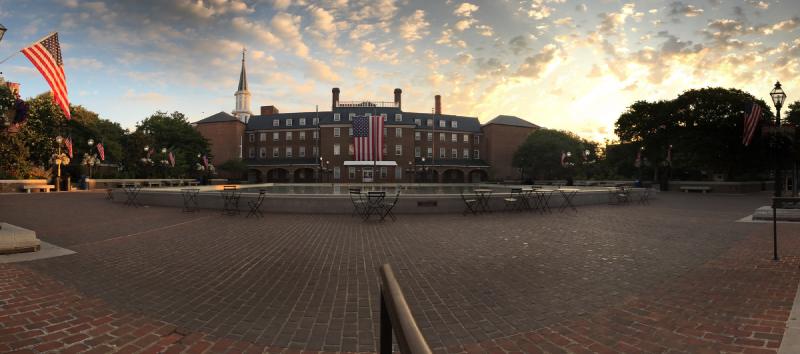
Market Square at sunrise, July 2017 — the city's eighteenth-century public square in its weekday-morning calm, framed by City Hall and the Fourth-of-July flags hung along the lamp posts. © KingSt.com, July 2017 301 King Street
Public square at 301 King Street fronting Alexandria City Hall — site of an open-air farmers market continuously operated since 1753, the …
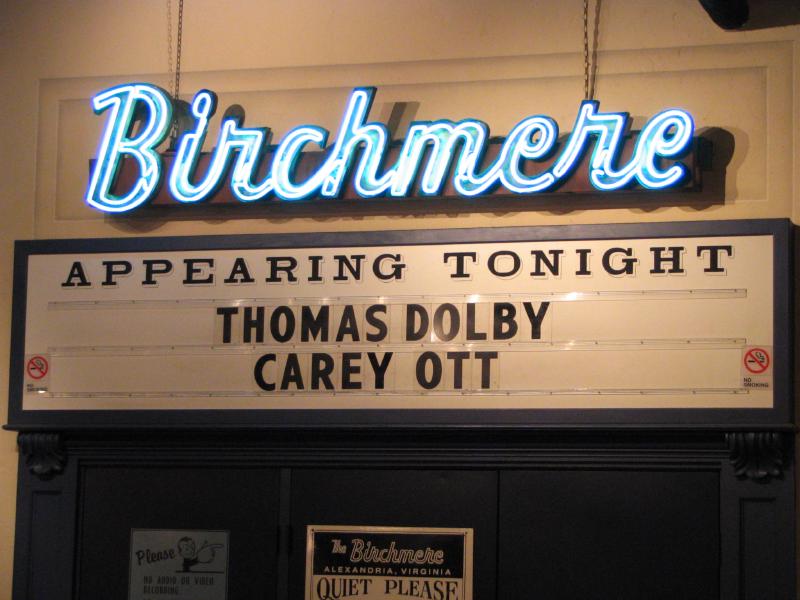
Rudi Riet from Washington, DC, United States · via Wikimedia Commons · CC BY-SA 2.0 3701 Mount Vernon Avenue
Listening-room music venue on Mount Vernon Avenue, founded in 1966 at an earlier location and relocated in 1997 to the present purpose-built …
Nearby in space
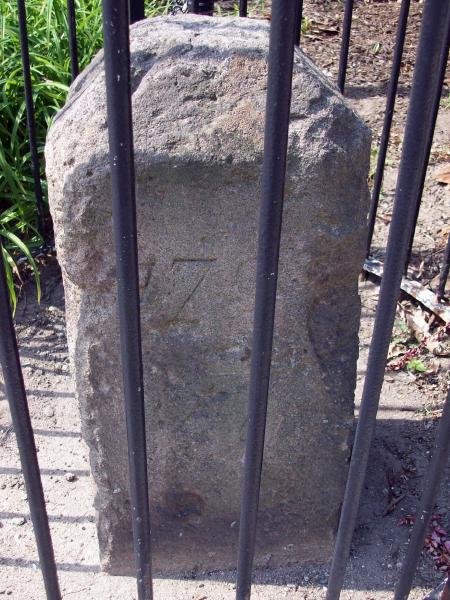
Bruce Andersen from Washington, DC · via Wikimedia Commons · CC BY-SA 2.0 7 Russell Road
Second of the original DC southwestern boundary stones, placed 1791-1792. NRHP-listed 1991.
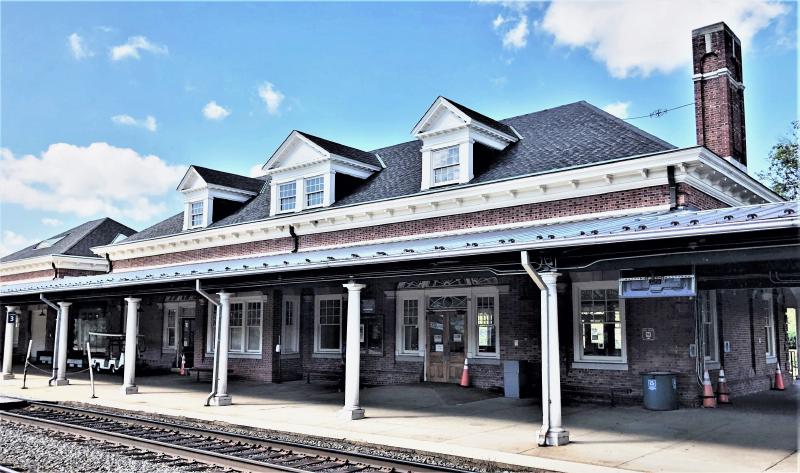
Beyond My Ken · via Wikimedia Commons · CC BY-SA 4.0 110 Callahan Drive
1905 railway terminal at the foot of King Street, currently serving Amtrak, VRE, and Washington Metro Blue/Yellow lines. NRHP-listed 2013.
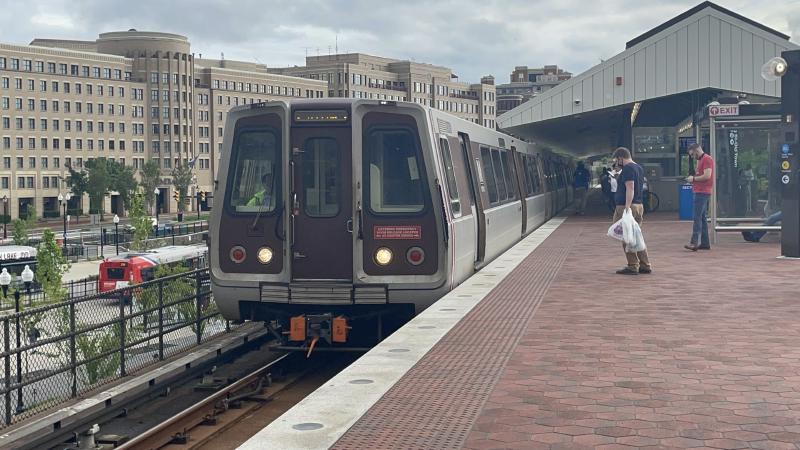
Er1ckRailfan · via Wikimedia Commons · CC BY-SA 4.0 1900 King Street
Washington Metro station opened December 1983 at the west end of King Street, catalyzing mixed-use redevelopment of the surrounding blocks …
Streetcar-suburb residential neighborhood developed 1908 onward on the western edge of Alexandria, characterized by Colonial Revival and …
Now
No current occupant on file. Are you, or someone you know, the present occupant? Claim this place to add operating hours, a current photo, and a short note.
Sources
- 1.
George Washington Masonic National Memorial Association, "A Brief History," gwmemorial.org, accessed 2026. Authoritative institutional history of the Memorial's conception, fundraising, design, construction, and dedication.
- 2.
The Mount Vernon Ladies' Association, "The George Washington Masonic National Memorial," mountvernon.org/George-Washington/Freemasonry, accessed 2026. Mount Vernon's institutional account of the Memorial, Washington's Masonic biography, and the architectural reference to the Lighthouse of Alexandria.
- 3.
Alexandria-Washington Lodge No. 22, "AW22 History," aw22.org, accessed 2026. The lodge's own history, documenting Washington's April 28, 1788 chartering as first Worshipful Master and the lodge's continuous operation to the present day.
Website https://aw22.org/aw22-history/ →
- 4.
Scottish Rite of Freemasonry, S.J., U.S.A., "The 100th Anniversary of the George Washington Masonic National Memorial Cornerstone Laying and the Scottish Rite," accessed 2026. Centennial-retrospective article on the November 1, 1923 cornerstone ceremony, including the reuse of the Alexandria-made silver trowel Washington had used to lay the U.S. Capitol cornerstone in 1793.
Website https://scottishrite.org/blog/article/100th-anniversary-gwmnm-cornerstone-laying/ →
- 5.
Office of Historic Alexandria, "Lafayette in Alexandria," alexandriava.gov, accessed 2026. Municipal interpretive history of the Marquis de Lafayette's 1824–25 visits to Alexandria, including the February 21, 1825 Masonic reception at which Lafayette accepted honorary membership in Lodge No. 22 and presented the Bastille key.
Government record https://www.alexandriava.gov/historic-alexandria/lafayette-in-alexandria →
- 6.
Grand Lodge of Free and Accepted Masons of the State of New York, "Marquis de Lafayette's Apron," nymasons.org, accessed 2026. Article on Lafayette's American Masonic gifts, including the iron Bastille key presented to Alexandria-Washington Lodge No. 22 in February 1825 and now on permanent display at the George Washington Masonic National Memorial.
- 7.
Alexandria-Washington Lodge No. 22, "From the Archives: Witness Account of the 1871 Lodge Fire," aw22.org, accessed 2026. Contains the lodge's own period account of the May 19, 1871 fire at the King Street City Hall and Market House, including the rescue of the bulk of the Washingtoniana and the loss of much of the natural-science and art collection.
Website https://aw22.org/from-the-archives-witness-account-of-the-1871-lodge-fire/ →
See something wrong?
Every correction is logged dated to this page. Family history, old photographs, or a citation we missed — everything goes into the file.