
219
South Payne Street
Union Army hospital established in February 1864 for U.S. Colored Troops and Black civilian refugees in occupied Alexandria. Named for Toussaint Louverture, the Haitian revolutionary.
- 1864
- Utilitarian
- Demolished demolished 1900
Place narrative
L’Ouverture Hospital was established in February 1864 on a block bounded by Prince, Duke, South Payne, and South West streets. It was one of the first Union military hospitals in the country dedicated to the care of African American soldiers and contrabands [1] NARA Civil War records Government record . The hospital’s several frame wards accommodated several hundred patients at its peak.
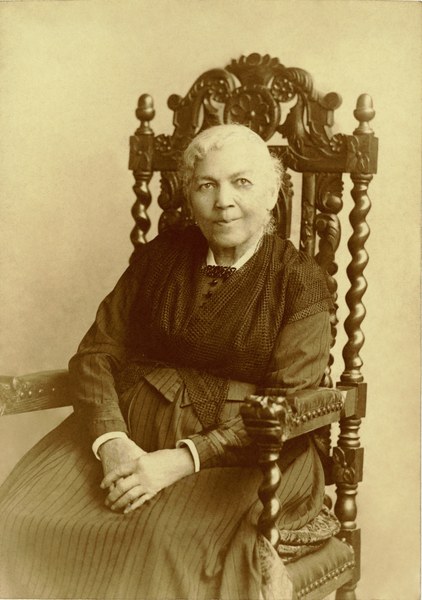
Harriet Jacobs Harriet Jacobs b. 1813 · d. 1897 Formerly enslaved author of Incidents in the Life of a Slave Girl (1861) who, with her daughter Louisa, worked among formerly enslaved people living in and around Union-occupied … and her daughter Louisa were among the civilian volunteers who worked at and around the hospital, distributing clothing and operating schools for Black children in the adjacent neighborhood. Their reports from Alexandria to the northern abolitionist press are among the fullest contemporary accounts of life in the occupied city [2] LOC Prints & Photographs Photograph . In December 1864 Black soldiers recovering at L’Ouverture signed and delivered a petition to Union military authorities protesting the planned burial of their comrades in the segregated Freedmen’s Cemetery rather than the new Alexandria National Cemetery; the petition succeeded and African American soldiers were reinterred in the national cemetery.
The hospital closed after the war and the buildings were dismantled. The site was built over in the late nineteenth and twentieth centuries; no above-ground remains survive. A historical marker at the corner of South Payne and Duke streets commemorates the hospital and the soldiers’ petition [3] Alexandria Library Special Collections Manuscript .
Timeline
5 chronological entries across 2 eras.
- –
Harriet Jacobs worked with freedpeople at and around the hospital, distributing aid and reporting conditions to the northern press. [1] Source LOC Prints & Photographs [2] Source NARA Civil War records
- –
L'Ouverture Hospital served Black soldiers and civilian refugees from the surrounding contraband camps. [2] Source NARA Civil War records
Establishment of L'Ouverture Hospital [2] Source NARA Civil War records
Soldiers' petition over burial practices [2] Source NARA Civil War records
Hospital buildings dismantled [3] Source Alexandria Library Special Collections
The building
- Utilitarian
Gallery
Historical-style placeholder of Louverture Hospital Site, c. 1864. Seed placeholder — KingSt.com, 2026. To be replaced with archival photograph. 
Secondary placeholder view of Louverture Hospital Site. Seed placeholder — KingSt.com, 2026. To be replaced with archival photograph.
Connected
Harriet Jacobs
b. 1813 · d. 1897
Formerly enslaved author of Incidents in the Life of a Slave Girl (1861) who, with her daughter Louisa, worked among formerly enslaved people living in and around Union-occupied …
Visitor notable · Aid work · %!d(float64=1864)–%!d(float64=1865)
Freedmen of the Contrabands Camp
founded 1861
Collective entity representing the several thousand formerly enslaved people who fled to Union-occupied Alexandria during the Civil War, settling in camps at Shuter's Hill, around …
Resident · Hospital · %!d(float64=1864)–%!d(float64=1865)
Nearby in time
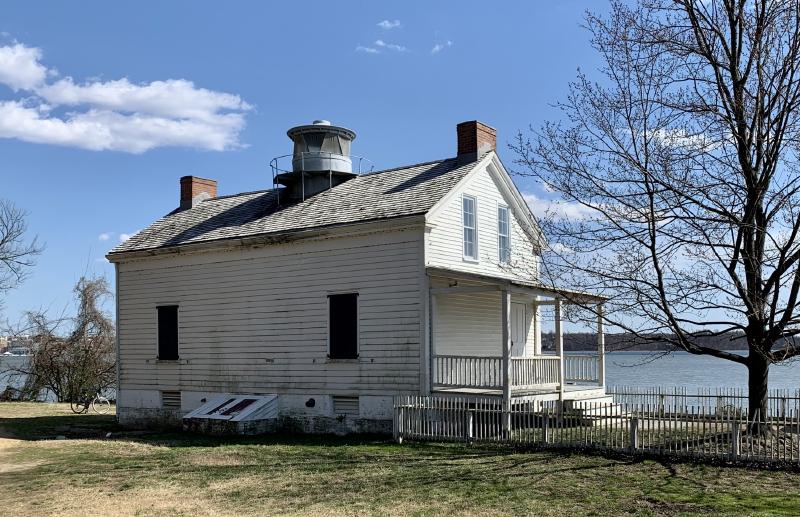
APK · via Wikimedia Commons · CC BY-SA 4.0 Jones Point Park
Frame lighthouse built 1855 at the south boundary stone of the original District of Columbia; one of the few surviving Potomac River inland …
The 1807 Bank of Alexandria building at 133 N. Fairfax Street, Old Town Alexandria — the surviving Federal-style banking house after the late-1960s demolition of the Civil War-era hotel expansion. Photographed June 2014. Bank of Alexandria photographed by Ken Lund / Flickr, CC BY-SA 2.0 (2014) 133 North Fairfax Street
Federal-style 1807 banking house at the corner of North Fairfax and Cameron Streets — the surviving home of the Bank of Alexandria, …
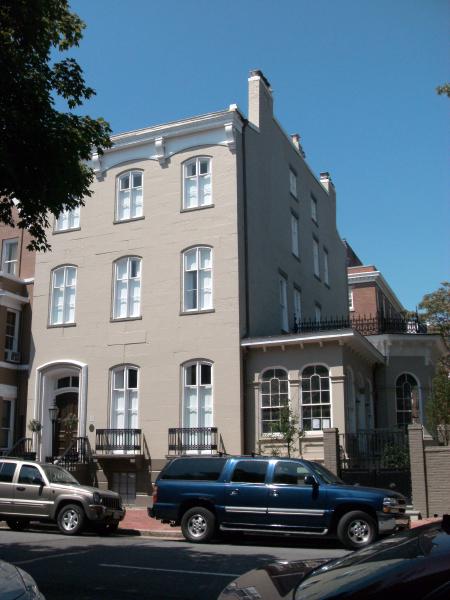
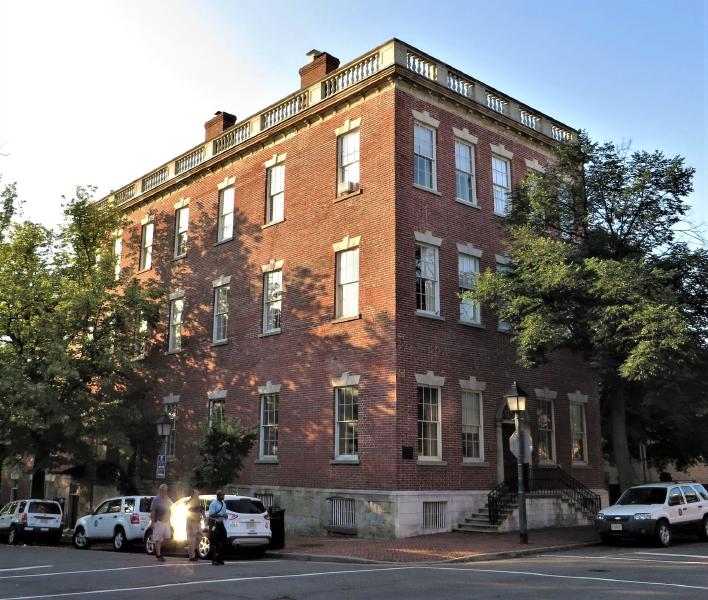
Ser Amantio de Nicalao · via Wikimedia Commons · CC BY-SA 3.0 811 Prince Street
Italianate residence built 1854 by merchant John Bayne; later occupied by the Fowle family of shipbuilders. NRHP-listed 1986.
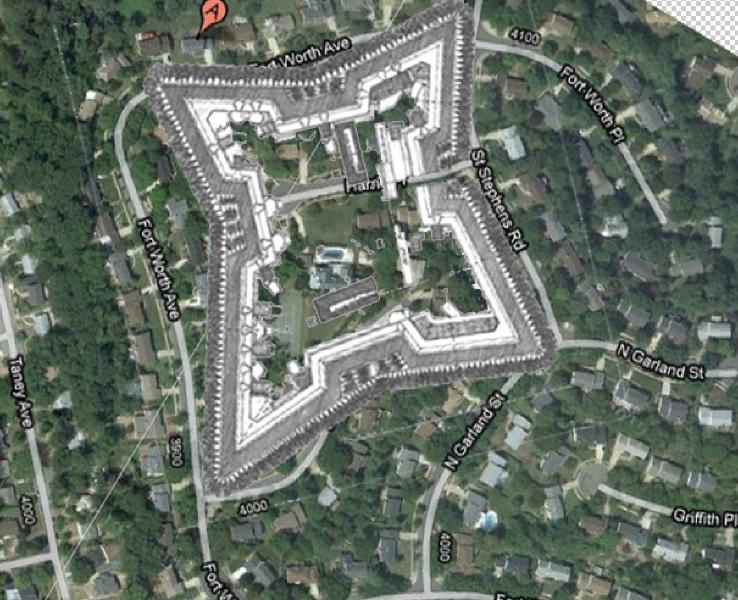
The 1864 Fort Worth engineering plan superimposed on modern Seminary Ridge satellite imagery — the fort's star-shaped earthwork still imprinted on today's residential street grid. Composite by KingSt.com (1864 NARA plan over modern aerial), 2026 Seminary Hill (off Seminary Road, near St. Stephens Road)
Layered Seminary Hill site that was the country estate "Muckross" of Burke & Herbert Bank co-founder Arthur Herbert, the Civil War earthwork …
Nearby in space
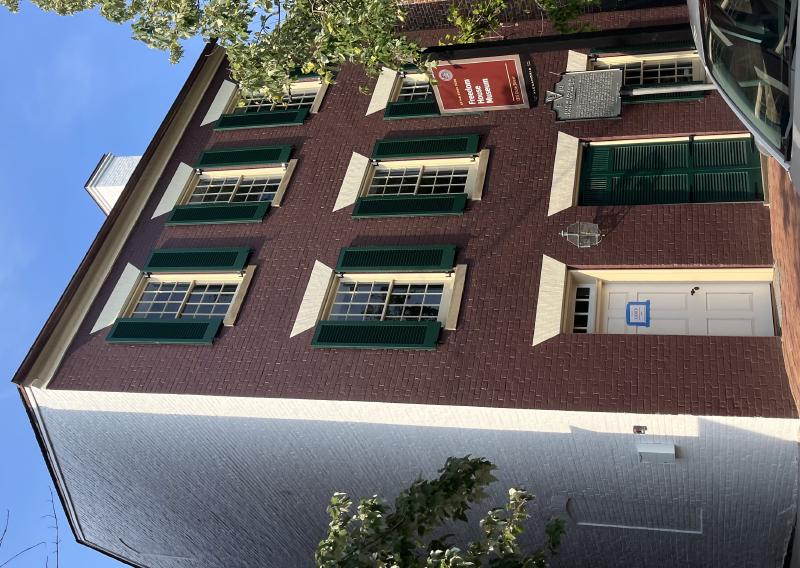
Theodore Christopher · via Wikimedia Commons · CC0 1315 Duke Street
Federal-style brick house at 1315 Duke Street built in the 1810s by Brigadier General Robert Young of the DC Militia; from 1828 to 1837 the …
1200 Duke Street 1200 Duke Street
Headquarters of T. J. Fannon & Sons at 1200 Duke Street, the Alexandria heating-fuel firm founded by Thomas J. Fannon as a wood-and-coal …
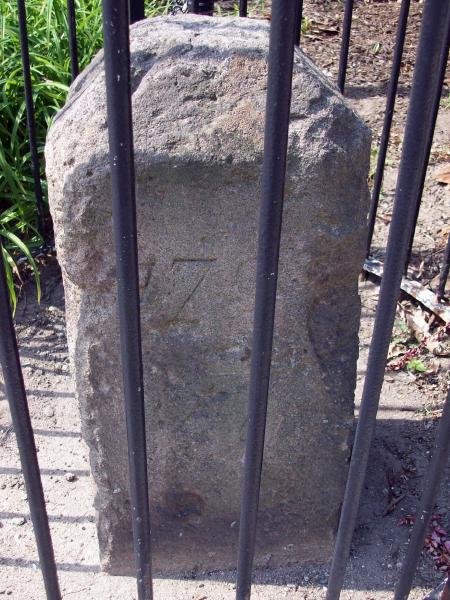
Bruce Andersen from Washington, DC · via Wikimedia Commons · CC BY-SA 2.0 1220 Wilkes Street
Sandstone boundary marker placed 1791 to mark the southwest corner of the original District of Columbia diamond. NRHP-listed 1991.
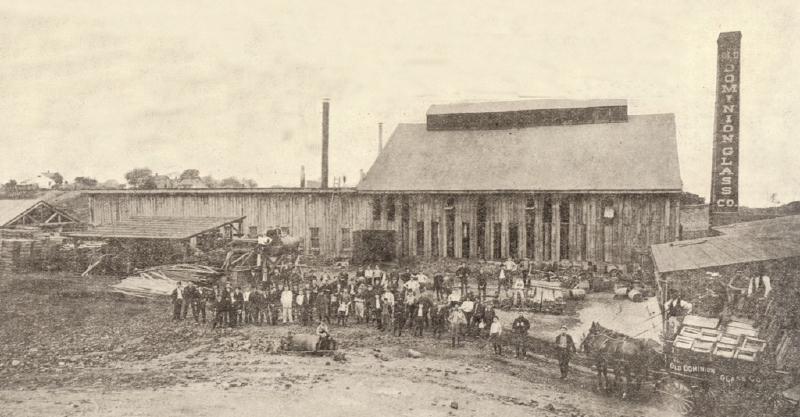
photographer not credited · via Wikimedia Commons · Public domain 300 North West Street
Glass bottle and jar works that operated in west-end Alexandria from the 1890s until the Depression, employing hundreds of workers including …
Now
No current occupant on file. Are you, or someone you know, the present occupant? Claim this place to add operating hours, a current photo, and a short note.
Payne Street
Named for Local nineteenth-century landowner (further research needed), c. 1810.
Interpretive signs nearby
The City of Alexandria has installed 4 historical interpretive signs within walking distance of this place. Each link below opens the sign's page on this site, with the full image and trail context.
Franklin and Armfield Slave Office (1315 Duke St)
1315 Duke St
L'Ouverture Hospital and Barracks
1302 Prince St
From Slavery to Freedom and Service
1323 Duke St
1401 Duke St
Sources
- 1.
National Archives and Records Administration, Union Provost Marshal records and Civil War-era military correspondence (RG 109, RG 110, RG 393).
Government record
- 2.
Library of Congress, Prints & Photographs Online Catalog (Washington: Library of Congress).
Photograph
- 3.
Alexandria Library, Local History/Special Collections, Barrett Branch, Alexandria, Virginia.
Manuscript
See something wrong?
Every correction is logged dated to this page. Family history, old photographs, or a citation we missed — everything goes into the file.