
900
Wythe Street
Site of Alexandria’s segregated public school for Black students, opened in 1920 at 900 Wythe Street and replaced in 1950 by a new Parker-Gray High School that served until desegregation in 1965.
- 1950
- Mid-Century Institutional
- Extant
- Parker-Gray Historic District
Place narrative
The original Parker-Gray School opened at 900 Wythe Street in 1920, the first Alexandria public school building dedicated to Black students. It was named for John Parker and Sarah A. Gray, two nineteenth-century teachers of Black children in the city. The school offered grades one through eight; Black students seeking a high-school diploma had to travel to Washington or other nearby cities [1] Alexandria Library Special Collections Manuscript .
A replacement building on the same site opened in 1950 as Parker-Gray High School, serving as the city’s only public secondary school for Black students. The institution, Parker-Gray School Parker-Gray School founded 1920 Alexandria's segregated public school for Black students, named for John Parker and Sarah Gray, two early Black educators in the city. Parker-Gray operated as the city's only Black … , closed as a segregated high school in 1965 when Alexandria desegregated under federal court order and its students were reassigned to T. C. Williams and George Washington high schools [1] Alexandria Library Special Collections Manuscript . The building subsequently served as a middle school and is now the Charles Houston Recreation Center.
The surrounding neighborhood was formally designated the Parker-Gray Historic District by the City of Alexandria in 1984, recognizing its role as the center of the city’s African American community during the twentieth century [2] HABS Alexandria survey Government record .
Timeline
6 chronological entries across 2 eras.
- –
The Parker-Gray School operated at this site from 1920 through its closure as a segregated high school in 1965. [1] Source Alexandria Library Special Collections
- –
The surrounding Parker-Gray neighborhood was the center of Alexandria's Black community during the segregation era; its residents were descendants of the wartime contraband community. [1] Source Alexandria Library Special Collections
Opening of the original Parker-Gray School [1] Source Alexandria Library Special Collections
- –
Earl Lloyd attended Parker-Gray High School, graduating in 1946 as a star basketball, football, and baseball athlete before becoming the first African American to play in an NBA regular-season game on 31 October 1950. [2] Source Alexandria Legends — Earl Lloyd [3] Source NBA — Earl Lloyd biography
Construction of Parker-Gray High School [1] Source Alexandria Library Special Collections
Desegregation closes Parker-Gray High School [1] Source Alexandria Library Special Collections
The building
- Mid-Century Institutional
Gallery
Secondary placeholder view of Parker Gray School Site. Seed placeholder — KingSt.com, 2026. To be replaced with archival photograph.
Connected
Parker-Gray School
founded 1920· dissolved 1965
Alexandria's segregated public school for Black students, named for John Parker and Sarah Gray, two early Black educators in the city. Parker-Gray operated as the city's only Black …
Operator · School · %!d(float64=1920)–%!d(float64=1965)
Freedmen of the Contrabands Camp
founded 1861
Collective entity representing the several thousand formerly enslaved people who fled to Union-occupied Alexandria during the Civil War, settling in camps at Shuter's Hill, around …
Resident · Neighborhood · %!d(float64=1920)–%!d(float64=1965)
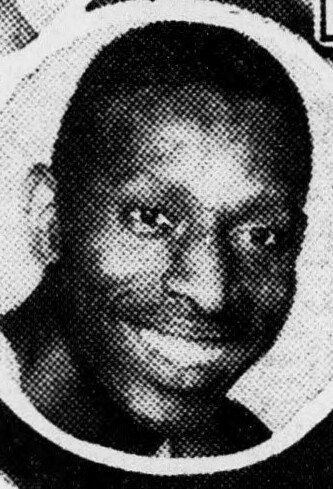
Earl Lloyd
b. 1928 · d. 2015
First African American to play in a National Basketball Association game (October 31, 1950, with the Washington Capitols). Born in Alexandria; graduate of in the segregated …
Visitor notable · School · %!d(float64=1942)–%!d(float64=1946)
Nearby in time
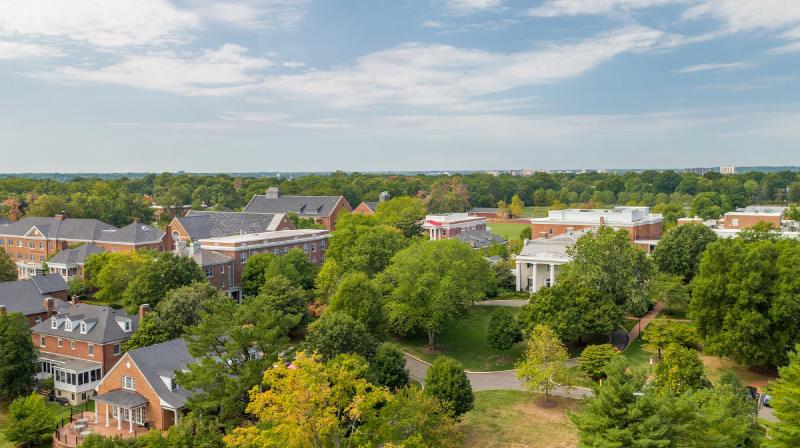
Episcopal High School's 100-acre campus from above, September 2019 — Hoxton House (white columns, right) anchors the south end; the Collegiate Gothic academic buildings ring the central quad. Aerial view of Episcopal High School, by Penguino2020 / Wikimedia Commons, CC BY-SA 4.0 (2019) 1200 North Quaker Lane
The first high school in Virginia, founded 1839 by Bishop William Meade of the Episcopal Diocese on a 100-acre campus west of Old Town. …
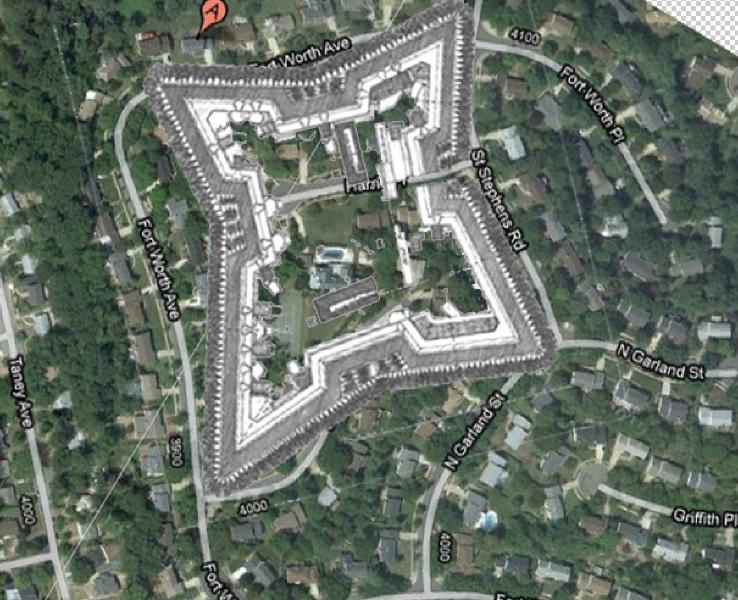
The 1864 Fort Worth engineering plan superimposed on modern Seminary Ridge satellite imagery — the fort's star-shaped earthwork still imprinted on today's residential street grid. Composite by KingSt.com (1864 NARA plan over modern aerial), 2026 Seminary Hill (off Seminary Road, near St. Stephens Road)
Layered Seminary Hill site that was the country estate "Muckross" of Burke & Herbert Bank co-founder Arthur Herbert, the Civil War earthwork …
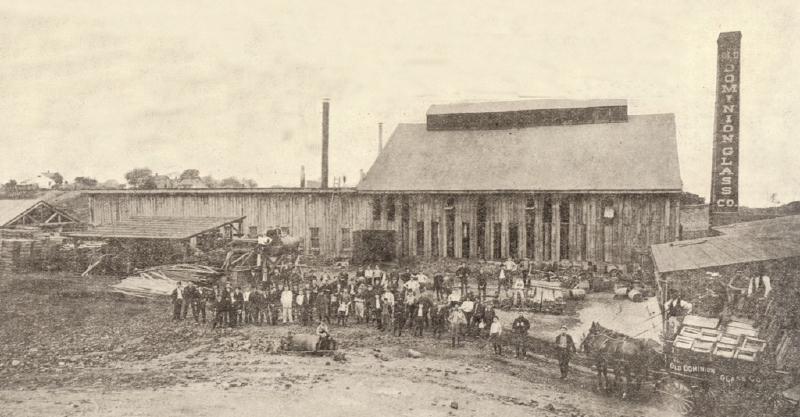
photographer not credited · via Wikimedia Commons · Public domain 300 North West Street
Glass bottle and jar works that operated in west-end Alexandria from the 1890s until the Depression, employing hundreds of workers including …
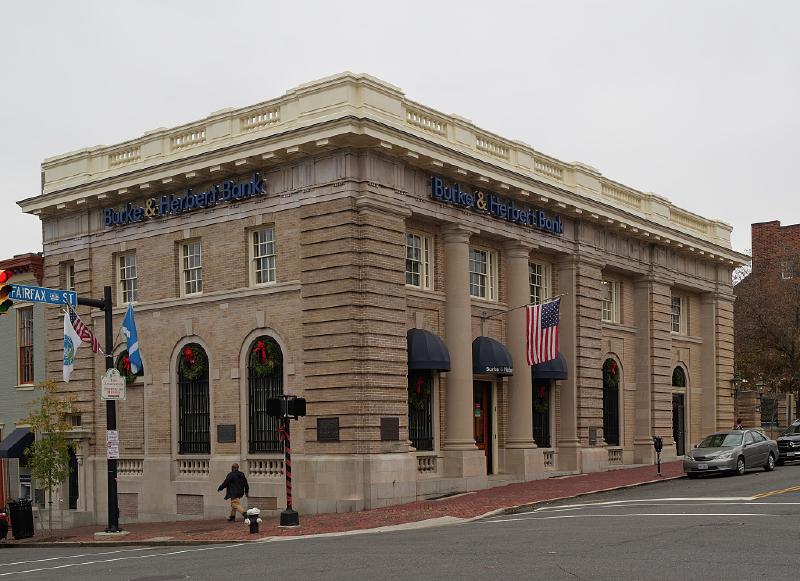
The Burke & Herbert Bank building in Alexandria, Virginia, a city immediately south of Washington, D.C., and once a larger, more thriving river port than the nation's capital city · Library of Congress, Prints & Photographs Division · http://www.loc.gov/item/2020724810/ 100 South Fairfax Street
The 1903 neoclassical home of at the corner of King and South Fairfax streets, the bank's sixth and final headquarters after a half-century …
Nearby in space
Parker-Gray neighborhood Parker-Gray neighborhood
Historically African-American residential and commercial district north and west of Old Town, anchored by the Parker-Gray School. …
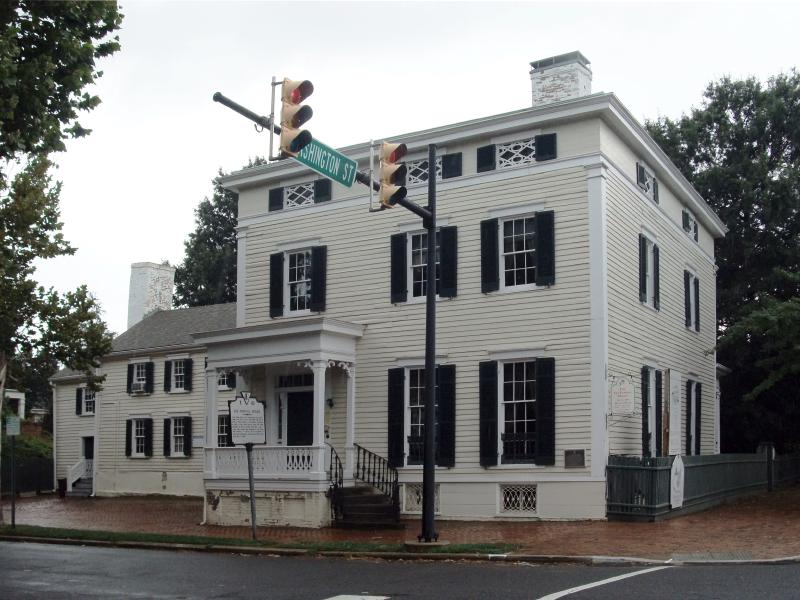
The original uploader was Ser Amantio di Nicolao at English Wikipedia . · via Wikimedia Commons · CC BY 3.0 614 Oronoco Street
Federal-style house built in 1785 by Philip Richard Fendall on land acquired from the Lee family. Occupied by a rotating cast of Lee family …
Placeholder illustration of Alexandria Library 1939. Seed placeholder — KingSt.com, 2026. To be replaced with archival photograph. 717 Queen Street
Alexandria's first free public library, opened on Queen Street in 1937, and site of a sit-in on August 21, 1939 that is among the earliest …
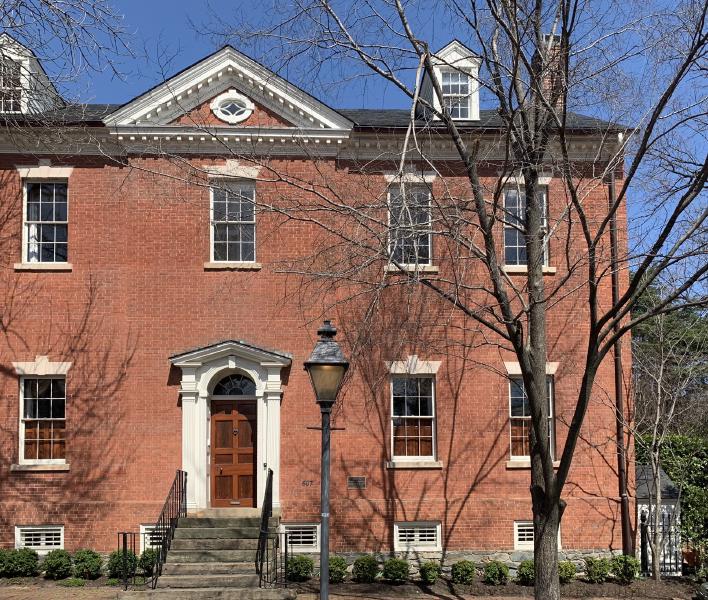
APK · via Wikimedia Commons · CC BY-SA 4.0 607 Oronoco Street
Federal-era house at 607 Oronoco Street rented by Anne Carter Lee from about 1812; principal childhood residence of her son Robert E. Lee …
Now
No current occupant on file. Are you, or someone you know, the present occupant? Claim this place to add operating hours, a current photo, and a short note.
Wythe Street
Named for George Wythe — Virginia signer of the Declaration of Independence, jurist, c. 1810.
Interpretive signs nearby
The City of Alexandria has installed 5 historical interpretive signs within walking distance of this place. Each link below opens the sign's page on this site, with the full image and trail context.
901 Wythe St. (Front of Ch. Houston Rec. Center)
North Patrick Street between Pendleton and Wythe Streets
The Student-Athletes of Parker-Gray High School
901 Wythe St. (Rear of Ch. Houston Rec. Center)
The Civil War and Archaeology of the Block
North Patrick Street between Pendleton and Wythe Streets
Sources
- 1.
Alexandria Library, Local History/Special Collections, Barrett Branch, Alexandria, Virginia.
Manuscript
- 2.
Historic American Buildings Survey, Alexandria, Virginia records, National Park Service / Library of Congress.
Government record
See something wrong?
Every correction is logged dated to this page. Family history, old photographs, or a citation we missed — everything goes into the file.