
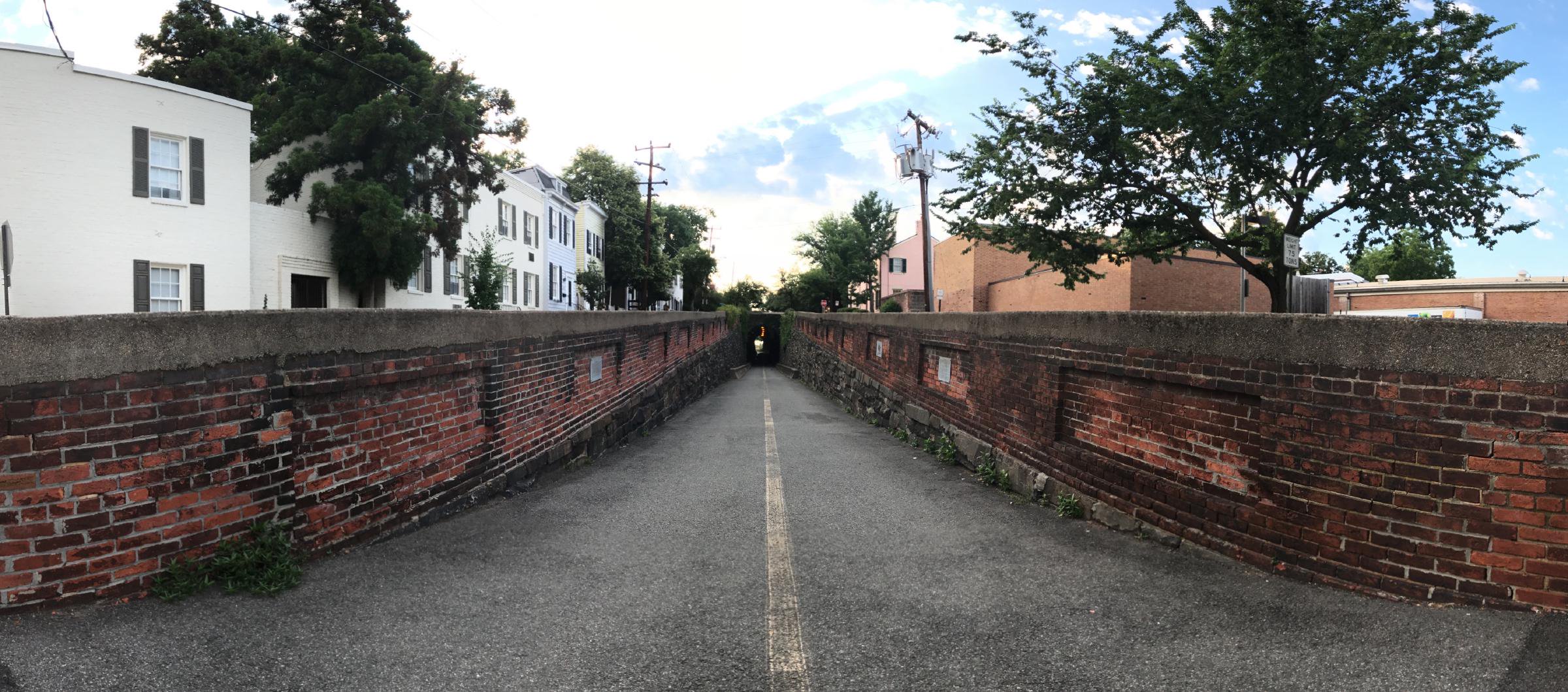
Wilkes Street (between South Royal and South Lee)
a.k.a. Wilkes Street (between South Royal and South Lee)
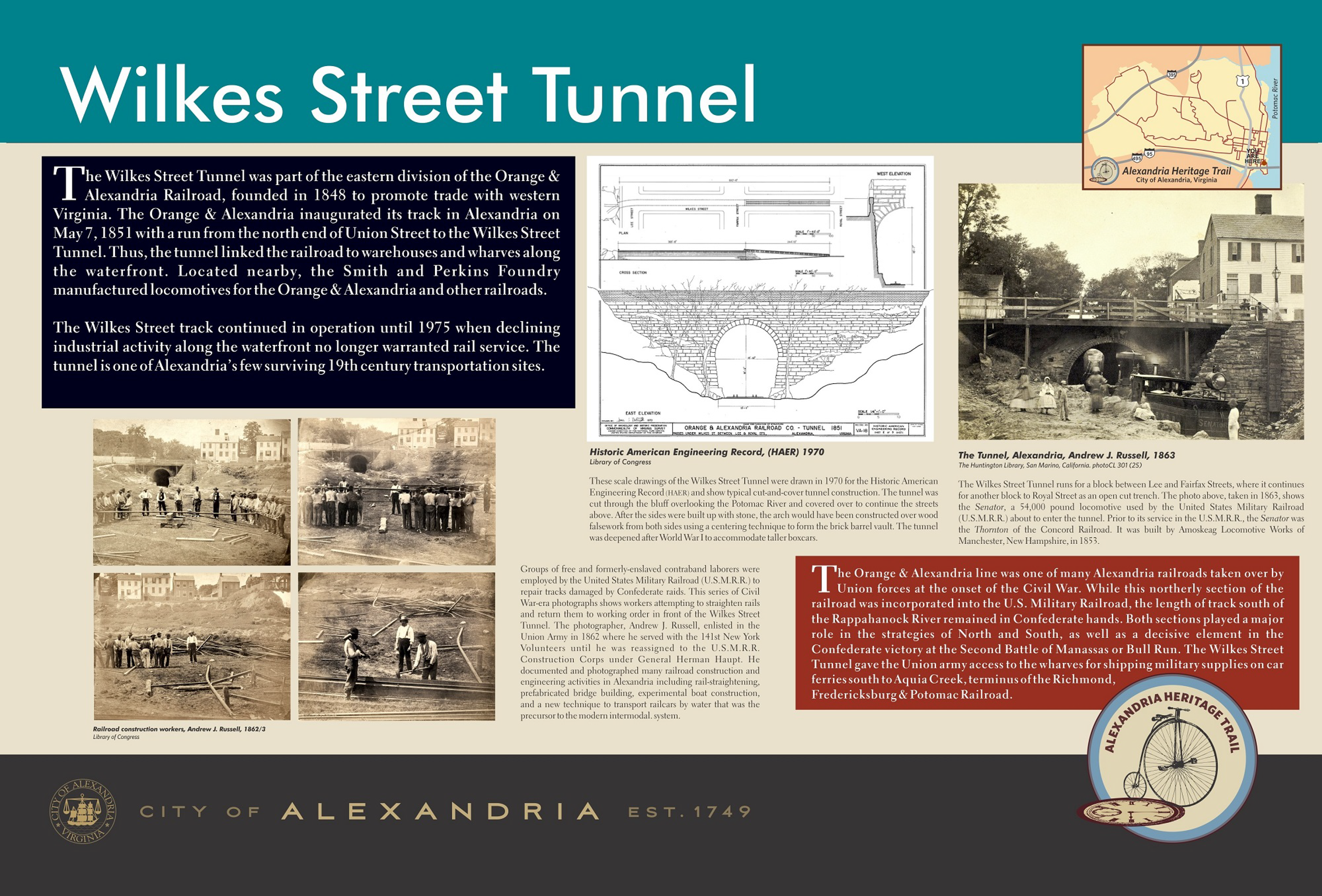
Brick-arched railroad tunnel carved beneath Wilkes Street in the early 1850s for the Orange & Alexandria Railroad to reach the city’s wharves on the Potomac without disrupting the colonial east-west street grid. Operated by the U.S. Military Railroad through Federal occupation (1861-1865) and by successor freight lines into the twentieth century; today an Old Town pedestrian and bicycle passage with an Alexandria Heritage Trail interpretive marker at the western approach.
- 1851approx
- Brick-arched railroad tunnel with stone portals
- Extant
- Alexandria Heritage Trail (city marker series)
Place narrative
The Wilkes Street Tunnel is a short brick-arched railroad tunnel cut beneath Wilkes Street in the early 1850s, between the surface streets of South Royal and South Lee. It allowed the Orange & Alexandria Railroad — chartered by the Virginia General Assembly in 1848 — to traverse the rise Wilkes Street follows on a north-south alignment without disrupting the east-west colonial street grid above. From the tunnel’s southern portal the line descended to the Alexandria wharves on the Potomac; from its northern portal the line ran up to the inland trunk that eventually reached Gordonsville and Lynchburg.
Civil War — the U.S. Military Railroad
The O&A line was one of the most strategically important pieces of antebellum infrastructure to fall into Federal hands when Union forces occupied Alexandria on May 24, 1861. From occupation forward, the tunnel and the line it served were operated by the U.S. Military Railroad (USMRR), the wartime federal agency that ran the captured southern rail lines as a Union supply network. Through the tunnel, freight moved between inland depots and the Alexandria wharves where it was transferred to and from coastal steamers; the small brick portal was a daily sight of the city’s wartime supply economy. The USMRR vacated the line at the war’s end in 1865 and returned it to its corporate successor.
Postwar and decommissioning
The line passed through a series of postwar corporate successors — the Virginia Midland Railway, Southern Railway, and ultimately Norfolk Southern — and the tunnel continued to carry freight to the waterfront wharves for roughly a century after the war. As Alexandria’s waterfront industrial use declined through the mid-twentieth century, traffic through the tunnel slowed and eventually ended. The rails were lifted, the cut was paved, and the tunnel was repurposed as a public pedestrian and bicycle passage.
The tunnel today
The tunnel today runs about a city block, with stone portals at each end and a brick-vault ceiling inside. The Alexandria Heritage Trail marker on the west side of South Union Street, on the approach path to the tunnel’s eastern portal, interprets the structure for walkers. The 501 South Union Street 501 South Union Street Six-acre city park at 501 South Union Street, occupying the south Old Town waterfront hill that gave its name first to a c. 1791 wind-driven grain mill and then to "Hayti" — the … sits a block north of the eastern portal and is the most common pedestrian connection.
Timeline
3 chronological entries across 3 eras.
Tunnel cut for the Orange & Alexandria Railroad
U.S. Military Railroad takes over the line through Wilkes Street Tunnel
USMRR returns the line to corporate operation
The building
- Brick-arched railroad tunnel with stone portals
No images yet — contribute a photo.
Nearby in time
Richmond Highway Richmond Highway
~8,656-acre U.S. Army installation along Richmond Highway in Fairfax County, established 1917 as Camp A.A. Humphreys, renamed Fort Humphreys …
4195 West Braddock Road 4195 West Braddock Road
African-American cemetery established 1885 on land adjacent to Fort Ward, used by descendants of the freedmen's community known as The Fort. …
1100 Wilkes Street 1100 Wilkes Street
Cluster of twelve adjacent burial grounds stretching across the 1100 block of Wilkes Street, including Methodist Protestant, Presbyterian, …
320 South Washington Street 320 South Washington Street
Founded in 1863 by formerly enslaved Black congregants; one of the earliest independent Black Baptist churches in the South. NRHP-listed …
Nearby in space
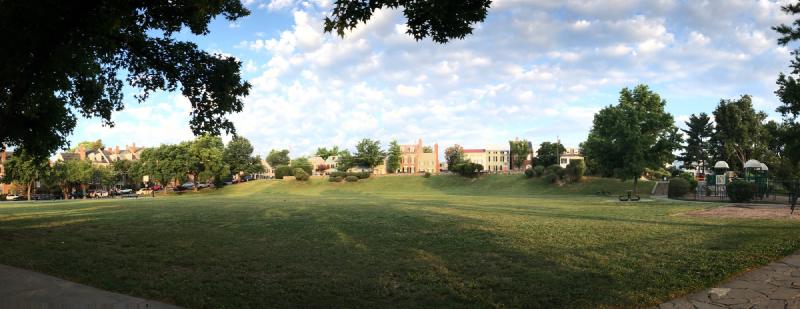
Windmill Hill Park at sunrise, July 2017 — the open grass meadow that once held Robert Townshend Hooe's c. 1791 grain windmill, with the Old Town row houses of South Union Street rising on the inland side and the playground visible at right. © KingSt.com, July 2017 501 South Union Street
Six-acre city park at 501 South Union Street, occupying the south Old Town waterfront hill that gave its name first to a c. 1791 wind-driven …
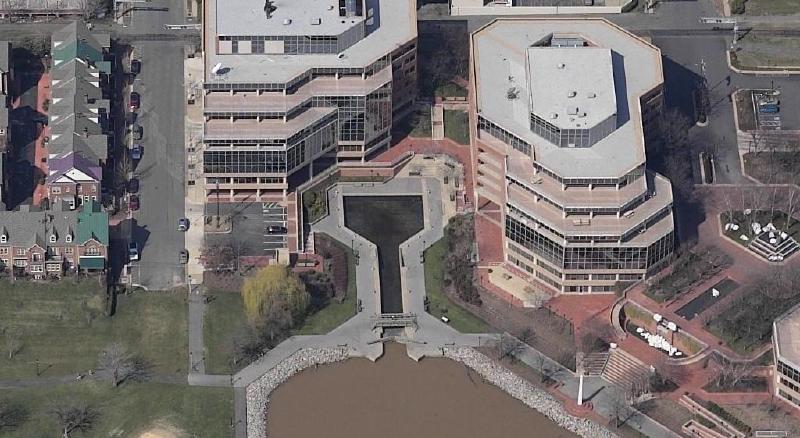
SDC at en.wikipedia · via Wikimedia Commons · Public domain 1 Wilkes Street
The 1843 stone tide lock at the southern terminus of the Alexandria Canal, which connected the Chesapeake & Ohio Canal at Georgetown with …
Placeholder illustration of Interarms Warehouse Complex South Union. Seed placeholder — KingSt.com, 2026. To be replaced with archival photograph. South Union Street
Complex of converted warehouse buildings along South Union Street used by Interarms from the late 1950s to the late 1990s to store surplus …
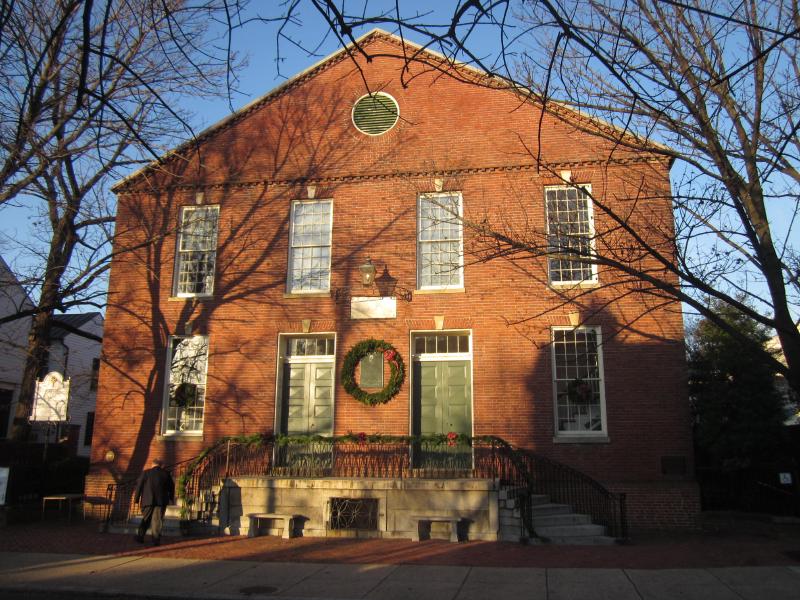
Doug Kerr from Albany, NY, United States · via Wikimedia Commons · CC BY-SA 2.0 321 South Fairfax Street
Brick Presbyterian meeting house begun in 1775; site of the city's memorial services for George Washington on December 29, 1799, four days …
Now
No current occupant on file. Are you, or someone you know, the present occupant? Claim this place to add operating hours, a current photo, and a short note.
Interpretive signs nearby
The City of Alexandria has installed 3 historical interpretive signs within walking distance of this place. Each link below opens the sign's page on this site, with the full image and trail context.
W side S. Union on path to Wilkes Street Tunnel
African American Neighborhoods in the Civil War
Windmill Hill Park
W side S. Union at entrance to Windmill Hill Park
See something wrong?
Every correction is logged dated to this page. Family history, old photographs, or a citation we missed — everything goes into the file.