
Arsenal on the Potomac
Samuel Cummings, Interarms, and four decades of surplus arms at Alexandria's waterfront
From a 1953 start-up to a Cold War global clearinghouse of military surplus, Interarms kept its inventory — sometimes hundreds of thousands of rifles — at a stretch of warehouses on the Alexandria waterfront.
In 1959 Guns magazine ran a feature on a thirty-two-year-old Philadelphia-born arms dealer operating out of a nondescript office at the foot of Prince Street. The headline was “Arsenal on the Potomac.” The dealer was Samuel Cummings Samuel Cummings b. 1927 · d. 1998 American-born, Monaco-based arms dealer who founded International Armament Corporation (Interarms) in 1953 and built its principal operations in Alexandria. At its peak Interarms … ; the company was the six-year-old Interarms Interarms founded 1953 Alexandria-based arms dealership founded by Samuel Cummings in 1953, doing business as Interarms. For much of the Cold War the firm held one of the largest private inventories of … ; the arsenal was a stretch of converted warehouses along South Union Street. For the next four decades Alexandria’s waterfront was, by a comfortable margin, the largest private military-surplus depot in the Western world [1] Brogan & Zarca, Deadly Business, 1983 Book .
The company
Cummings had served briefly in the Army at the end of World War II and worked for the CIA as a weapons specialist in the early 1950s before leaving to found International Armament Corporation in 1953. The business model was simple and, at the moment, unusually profitable: European governments were disposing of enormous inventories of pre-war and wartime small arms at pennies on the pound. Cummings bought them in bulk, refurbished them at his facilities or at contract shops, and sold them — to American civilian importers, to the sporting-goods trade, and to foreign governments that needed small arms cheaply and quickly.
By the early 1960s Interarms had consolidated in Alexandria. The administrative office at 10 Prince Street 10 Prince Street Former office of International Armament Corporation (Interarms) at the foot of Prince Street; administrative headquarters of Samuel Cummings's arms-dealing operation during its … housed Cummings’s American staff and the telex machines over which the international business flowed. Three blocks south along the waterfront, the South Union Street South Union Street Complex of converted warehouse buildings along South Union Street used by Interarms from the late 1950s to the late 1990s to store surplus military small arms. At peak the complex … held the inventory — at peak, according to Brogan and Zarca’s 1983 biography, several hundred thousand rifles, pistols, and carbines awaiting sale or shipment.
The surplus economy
The Cold War surplus economy was enormous and, for most of its duration, lightly regulated. European arsenals were full of Mauser rifles, Enfield rifles, American Lend-Lease M1 carbines, Italian Carcanos, Swedish Ljungmans. European governments wanted hard currency and storage space. American and Canadian civilian shooters wanted inexpensive, accurate, well-made surplus rifles. Interarms was in the middle: warehousing, refurbishing, re-packaging, and distributing.
Cummings lived principally in Monaco for much of his career and managed Interarms from both Monaco and Alexandria, traveling extensively. Published accounts describe him as deeply informed about the technical details of his inventory and publicly phlegmatic about the moral arguments against the trade. The 1970 Sports Illustrated profile, “The Merchant of Menace,” gave him his most quoted line about the business: he preferred to paraphrase himself [1] Brogan & Zarca, Deadly Business, 1983 Book .
Regulation and controversy
The Gun Control Act of 1968 ended much of the imported-military-rifle business that had made Interarms’s first decade profitable. The company adapted by shifting toward domestic wholesaling, manufacturing, and the handgun trade; the Alexandria waterfront remained its base. Federal regulators — the BATF, the State Department’s office of munitions control, and the various congressional committees that periodically investigated the arms trade — had continuous dealings with the company.
Local concern about the waterfront concentration of munitions surfaced periodically. City officials, neighbors, and occasionally the Alexandria Gazette raised questions about the warehouses at the south end of Union Street. The 1997 criminal case involving Cummings’s daughter, Susan Cummings, who was charged and convicted in connection with the fatal shooting of her boyfriend at a Fauquier County farm — unconnected to the Alexandria business — brought renewed tabloid attention to the family name during the final years of the company’s operation [2] Alexandria Library Special Collections Manuscript .
After Cummings
Cummings died in Monaco in April 1998. The Alexandria operation was wound down over the following year; inventory was sold to other dealers, the warehouses were vacated, and the Prince Street office was leased out. The waterfront that had held the arsenal has since been redeveloped as part of the Strand Street Strand Street The Potomac waterfront from the Torpedo Factory south to Jones Point, subject to a decades-long redevelopment project that has converted former industrial and shipping frontage to … project: the former warehouses are now residences, offices, and restaurants; the pier is a park.
The Brogan and Zarca biography and the two magazine features — Guns in 1959, Sports Illustrated in 1970 — remain the most extended published accounts of the business [3] LOC Prints & Photographs Photograph . Additional material sits in federal regulatory archives, in the personal papers of Cummings employees, and in the physical fabric of the Alexandria waterfront itself. What was, for four decades, a central node in the global trade in surplus arms is, today, most visible as the layout of a stretch of South Union Street.
On the ground
Placeholder illustration of Interarms Hq 10 Prince Street. Seed placeholder — KingSt.com, 2026. To be replaced with archival photograph. 10 Prince Street
Former office of International Armament Corporation (Interarms) at the foot of Prince Street; administrative headquarters of Samuel …
Placeholder illustration of Interarms Warehouse Complex South Union. Seed placeholder — KingSt.com, 2026. To be replaced with archival photograph. South Union Street
Complex of converted warehouse buildings along South Union Street used by Interarms from the late 1950s to the late 1990s to store surplus …
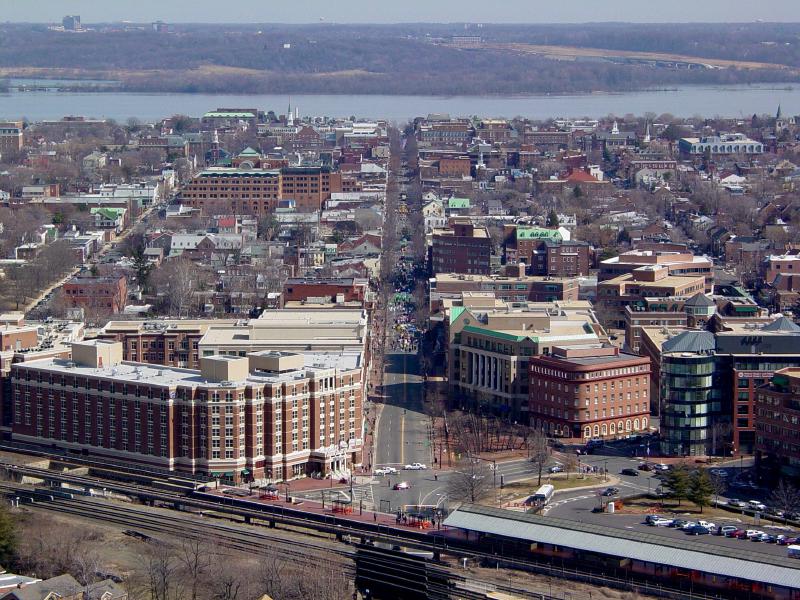
Ben Schumin · via Wikimedia Commons · CC BY-SA 3.0 Strand Street
The Potomac waterfront from the Torpedo Factory south to Jones Point, subject to a decades-long redevelopment project that has converted …
Dramatis personae
Samuel Cummings
b. 1927 · d. 1998
American-born, Monaco-based arms dealer who founded International Armament Corporation (Interarms) in 1953 and built its principal operations in Alexandria. At its peak Interarms …
Interarms
founded 1953· dissolved 1999
Alexandria-based arms dealership founded by Samuel Cummings in 1953, doing business as Interarms. For much of the Cold War the firm held one of the largest private inventories of …
Sources
- 1.
Patrick Brogan and Albert Zarca, Deadly Business: Sam Cummings, Interarms, and the Arms Trade, New York: W. W. Norton, 1983.
Book
- 2.
Alexandria Library, Local History/Special Collections, Barrett Branch, Alexandria, Virginia.
Manuscript
- 3.
Library of Congress, Prints & Photographs Online Catalog (Washington: Library of Congress).
Photograph