
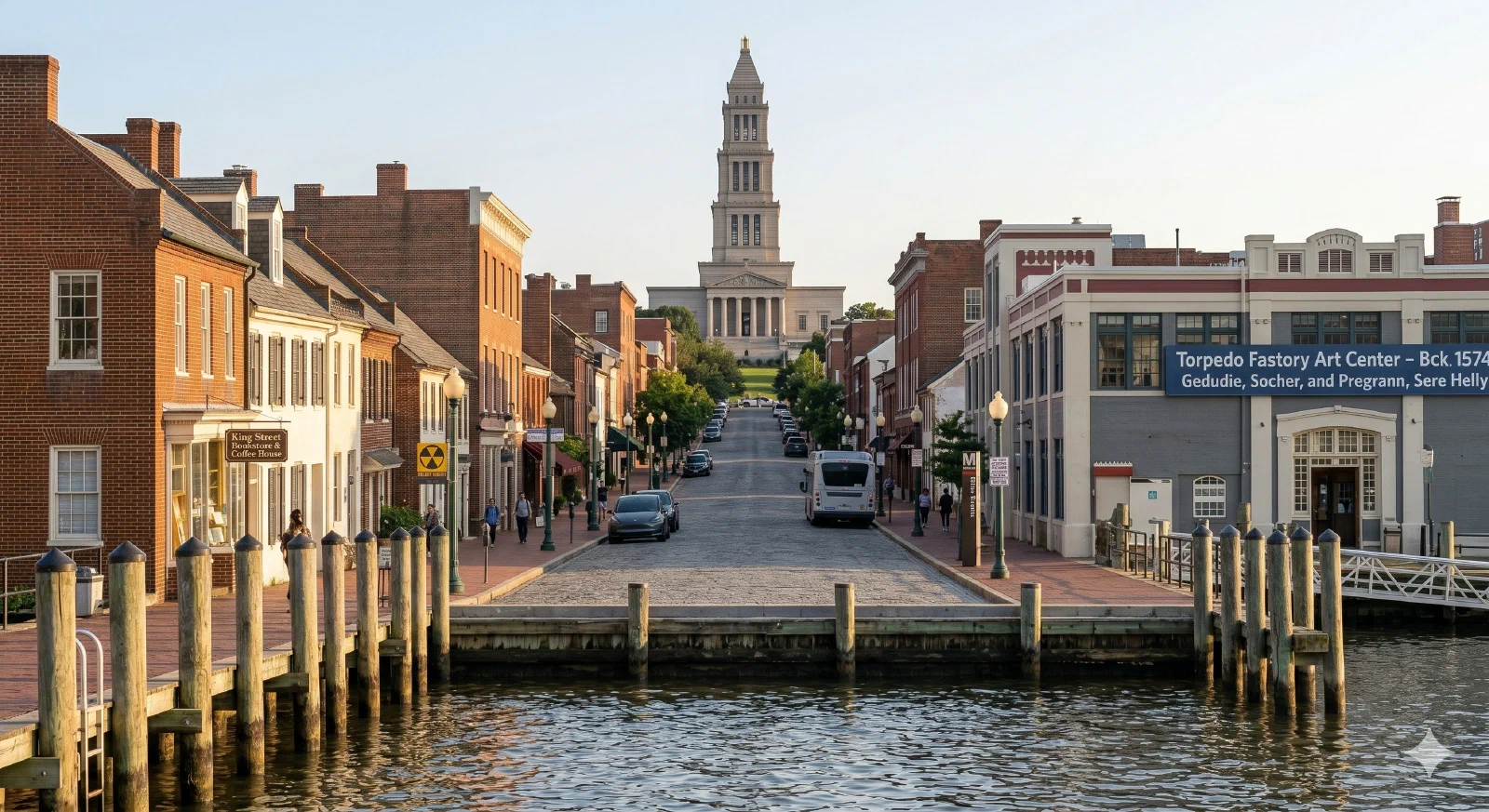
Modern Alexandria
Waterfront redevelopment, Metro expansion, present day
The Alexandria of the past three decades is the city of post-Cold-War redevelopment, historic-tourism economics, Metro-driven density, and the public reckoning with the slave trade that the antebellum-era port made the city’s defining nineteenth-century industry. The forces are simultaneously expansionist (BRAC consolidation, federal-anchor megaprojects, Potomac Yard development) and curatorial (the Beatley Library opens, the slave-trade complex at 1315 Duke becomes a museum, the Confederate statue is removed). The city in 1990 was still recognizably mid-century; the city in 2025 is a different place.
Cameron Station turns into a neighborhood
The 1988 BRAC selection of 4800 Duke Street 4800 Duke Street 164-acre former U.S. Army installation on Duke Street, active 1942–1995. Headquartered the Defense Logistics Agency, the Defense Mapping Agency, and elements of the U.S. Army … plays out across the 1990s. The Defense Logistics Agency relocates to Richmond Highway Richmond Highway ~8,656-acre U.S. Army installation along Richmond Highway in Fairfax County, established 1917 as Camp A.A. Humphreys, renamed Fort Humphreys 1922, renamed Fort Belvoir 1935 in … ; the Defense Mapping Agency’s successor (NIMA, then NGA) goes to a new Springfield campus. The Army formally shuts down Cameron Station in 1995. A public-private partnership between the City of Alexandria and developer LCOR Inc. redevelops the 164-acre parcel between 1998 and 2002 into: ~2,000 housing units (single-family, townhouse, condo); Cameron Station Boulevard Cameron Station Boulevard 45-acre civic park laid out across the former parade-ground center of during the 1998–2002 LCOR redevelopment of the parcel. Named for Ben Brenman, an Alexandria civic figure … (45-acre civic park on the former parade ground); and the Charles E. Beatley Jr. Central Library at 5005 Duke Street, named for Charles E. Beatley Jr. Charles E. Beatley Jr. b. 1916 · d. 2006 Two-term mayor of Alexandria, Virginia (1976–1979 and 1985–1991); namesake of the Charles E. Beatley Jr. Central Library at 5005 Duke Street on the redeveloped parcel. Career … , the two-term Alexandria mayor whose tenures bracketed the planning years.
Hoffman Town Center, the second generation
The The Hoffman family The Hoffman family Three-generation Alexandria real-estate developer family. Patriarch (1920–2002) bought 70 acres of Eisenhower Valley swampland for $200,000 in 1958 and over the next decades built … continues the Eisenhower Valley project that the patriarch Hubert N. "Dutch" Hoffman Jr. Hubert N. "Dutch" Hoffman Jr. b. 1920 · d. 2002 Alexandria real-estate developer who in 1958 bought seventy acres of Eisenhower Valley swamp and trailer-park landfill for two hundred thousand dollars and over the next … began in 1958. By the 2010s the Hoffman Center has expanded into the Hoffman Town Center; in 2017 the U.S. National Science Foundation moves its headquarters to the parcel, and the AMC Hoffman Town Center cinema multiplex opens. The Eisenhower Avenue Metro station — a 1980s addition to the Metro Yellow Line — anchors transit access to the corridor.
The waterfront and Old Town
Strand Street Strand Street The Potomac waterfront from the Torpedo Factory south to Jones Point, subject to a decades-long redevelopment project that has converted former industrial and shipping frontage to … acquires its modern form in this era. The 105 North Union Street 105 North Union Street Waterfront munitions plant built in 1918 as the U.S. Naval Torpedo Station; produced torpedoes through World War II, served as federal records storage after the war, and has … ’s 1974 conversion to the Torpedo Factory Art Center is consolidated; the King Street pedestrian-and-trolley corridor formalizes; the 301 King Street 301 King Street Public square at 301 King Street fronting Alexandria City Hall — site of an open-air farmers market continuously operated since 1753, the longest-running open-air market in the … 1980s civic restoration takes hold. The waterfront’s industrial uses give way to mixed-use residential and tourism.
The slave-trade reckoning
The 1315 Duke Street slave-trading compound that Franklin & Armfield ran in the 1830s — long forgotten as a parking-lot building — opens as the 1315 Duke Street 1315 Duke Street Federal-style brick house at 1315 Duke Street built in the 1810s by Brigadier General Robert Young of the DC Militia; from 1828 to 1837 the headquarters of Franklin & Armfield, the … in 2008 under the Northern Virginia Urban League, then transitions to the City of Alexandria in 2020 to be operated as a permanent museum under the Office of Historic Alexandria. The 1001 South Washington Street 1001 South Washington Street Burial ground established in 1864 by the Union military government on the southern edge of Federally-occupied Alexandria for self-emancipated Black people — "contrabands" in … , paved over for an Esso gas station in the 1960s, is rediscovered in the 1980s and reopens as a memorial in 2014 with the names of approximately 1,800 Black Alexandrians inscribed on the entrance wall. South Washington Street and Prince Street South Washington Street and Prince Street Confederate monument cast 1889 by Caspar Buberl, relocated from the intersection of Washington and Prince streets on June 2, 2020. NRHP-listed 2017. is removed by the Sons of Confederate Veterans in 2020. The Mary Miller Arnold Mary Miller Arnold b. 1938 · d. 2006 United States Senate Doorkeeper Supervisor for twenty-one years and a leader in the Animal Welfare League of Alexandria. Memphis State University alumna, born in Jonesboro, … and her father Edwin L. Arnold Sr. Edwin L. Arnold Sr. b. 1929 · d. 2012 United States Marine Corps Lieutenant and Korean War combat veteran; spent thirty-eight-plus years at the U.S. Veterans Administration / Department of Veterans Affairs, including … co-found the AVSOPS — Alexandria Volunteer Soldiers of the U.S. — project documenting the city’s USCT-descendant community.
Fort Belvoir + the Army Museum
Richmond Highway Richmond Highway ~8,656-acre U.S. Army installation along Richmond Highway in Fairfax County, established 1917 as Camp A.A. Humphreys, renamed Fort Humphreys 1922, renamed Fort Belvoir 1935 in … consolidates federal headquarters operations through the 2005 BRAC round, bringing thousands of additional federal workers to the parcel. On Veterans Day — November 11, 2020 — the National Museum of the U.S. Army opens at 1775 Liberty Drive on the western edge of the installation: 185,000 square feet, the first national museum dedicated to the full sweep of U.S. Army history. Designed by Skidmore, Owings & Merrill.
The next chapter
The Alexandria of 2025 is a city of ~160,000 residents, a Metro city with three Yellow/Blue Line stations and a fourth at Potomac Yard. The historic-preservation work of the 1970s–’90s has held; the slave-trade reckoning is ongoing; the federal-employment economy still anchors the regional labor market; the affordable- housing question — produced in part by the very preservation work that protected Old Town — is the unresolved policy challenge of the next decade.