
Episcopal Alexandria: a corridor of schools
From Bishop Meade's 1839 boys' school to a three-campus K–12 in Seminary Ridge
Five Episcopal schools, one corridor: Hoxton House and the founding of EHS in 1839; Lloyd House and the opening of St. Agnes in 1924; a Russell Road residence and the opening of St. Stephen's in 1944; the 1961 desegregation of St. Stephen's; the absorption of Ascension Academy on Braddock Road; and the 1991 merger that made the modern St. Stephen's & St. Agnes School.
There is a stretch of west Alexandria — perhaps a mile and a half on either side of Quaker Lane, with the 3737 Seminary Road 3737 Seminary Road Episcopal theological seminary founded in Alexandria in 1823 and relocated to its present hilltop campus in 1827. Occupied by Union forces during the Civil War and used as a … as its southern anchor and the rolling hills of 1200 North Quaker Lane 1200 North Quaker Lane The first high school in Virginia, founded 1839 by Bishop William Meade of the Episcopal Diocese on a 100-acre campus west of Old Town. First principal William Nelson Pendleton … as its eastern — that has been a continuous Episcopal-school landscape for 186 years. The road signs read St. Stephen’s, Quaker, Seminary, Braddock, Fontaine. The school crests on the buses passing each other on those roads read EHS, SSSAS, and once, until the late 1990s, Ascension. The story of that landscape is also a partial story of how a denomination, a city, and a region grew together, fought, segregated, integrated, and eventually merged.
1839 — Bishop Meade’s school
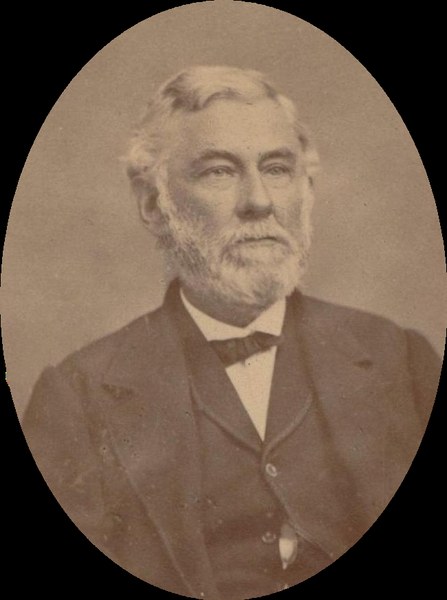
The first piece of the corridor was the dream of one man. William Meade William Meade b. 1789 · d. 1862 Second Bishop of Virginia (consecrated 1841; assistant bishop 1829–1841) and the founder of Episcopal High School in Alexandria in 1839 — the first high school in Virginia. A … , then assistant Bishop of Virginia and from 1841 the diocesan, had argued for years that the Episcopal Church in the upland South — slowly losing ground to the Presbyterians and the Methodists — needed an institution of its own to educate the next generation of Virginia Episcopalians together. The Diocese of Virginia bought a 100-acre tract on the western edge of Alexandria that had been the country home of Eliza Parke Custis, George Washington’s step-granddaughter, whose 1806 farmhouse — Hoxton House — sits at the south end of the campus to this day. In October 1839, the school opened with thirty-five boys and a single masters’ family [1] Episcopal High School — Since 1839 Website .
The first principal was William Nelson Pendleton William Nelson Pendleton b. 1809 · d. 1883 West Point–trained Episcopal priest who served as the first principal of Episcopal High School in Alexandria from its 1839 opening through 1844, then later as Robert E. Lee's chief … , West Point class of 1830 — fifth in his class — who had taken holy orders shortly after leaving the army. Five assistant masters opened the second year with 101 students. A three-story brick schoolhouse went up in 1840 alongside Hoxton. The school was called, simply, the High School — there were only a handful of secondary schools in the Commonwealth, and only this one in the diocese. The name stuck for a hundred years.
The first occupation
The corridor’s first interruption was the Civil War. Episcopal sat on ground that lay directly behind the Defenses of Washington’s outer ring; Fort Worth rose on the next hill, and Fort Ward half a mile to the west. Federal troops were on the campus within weeks of the Union seizure of Alexandria after the Marshall House killing of Col. Ellsworth in May 1861. The masters and most of the older boys went south, some of them to fight under their former principal — Pendleton was by then Robert E. Lee’s chief of artillery. The buildings served as a hospital, then as a barracks, then as a stable. The school did not reopen until October 1866.
1924 — Lloyd House and the girls
The second piece of the corridor opened eighty-five years after the first, and a mile and a half east of it. 220 North Washington Street 220 North Washington Street Late-Georgian 1797 townhouse at the corner of North Washington and Queen built by merchant John Wise. Charles Lee, U.S. Attorney General and brother of Light-Horse Harry, lived … — the Federal-period townhouse that John Wise had built in 1797 at the corner of North Washington and Queen, where Charles Lee had lived as a tenant and Benjamin Hallowell had taught a young Robert E. Lee — opened as St. Agnes Episcopal School for Girls in 1924. Forty-five pupils enrolled the first year, with Miss Mary Josephine White as principal. The school served the same diocesan-Alexandria families that had been sending sons to EHS for nearly a century but had had nowhere to send their daughters [2] SSSAS School History Website .
St. Agnes joined the Church Schools of the Diocese of Virginia (CSDV) in 1944, formalizing its institutional connection to Episcopal High School and to the network the diocese was building across Virginia. By that point St. Agnes had outgrown Lloyd House and had moved several times — first to its own building on King Street, then to a Seminary Ridge campus.
1944 — Russell Road and the boys
The third school of the corridor opened in the same year St. Agnes joined the diocesan system. The Rev. Edward Tate The Rev. Edward Tate Episcopal priest who founded St. Stephen's School for Boys at a single residence on Russell Road in Alexandria in 1944. The school was admitted that same year to the Church Schools … , an Episcopal priest in the diocese, opened St. Stephen’s School for Boys — a small boys’ school for grades 3 through 8 — in a single rented residence on Russell Road, in what is now Rosemont. Ninety-seven students enrolled the first year. The CSDV trustees voted to admit the new school into the Church Schools system that fall. Three boys graduated in June 1950 — George Ford, Gene Golien, and Howard Whellan — and the school had outgrown the rented residence by the middle of the decade.
In January 1957, St. Stephen’s School for Boys relocated to a purpose-acquired wooded campus on Saint Stephens Road — a mile and a half west of the Russell Road site, half a mile north of 3737 Seminary Road 3737 Seminary Road Episcopal theological seminary founded in Alexandria in 1823 and relocated to its present hilltop campus in 1827. Occupied by Union forces during the Civil War and used as a … , and in direct line of sight of 1200 North Quaker Lane 1200 North Quaker Lane The first high school in Virginia, founded 1839 by Bishop William Meade of the Episcopal Diocese on a 100-acre campus west of Old Town. First principal William Nelson Pendleton … across the fields. This is the site of today’s 1000 Saint Stephens Road 1000 Saint Stephens Road Upper School (grades 9–12) of St. Stephen's & St. Agnes School, occupying the Saint Stephens Road campus opened in January 1957 by St. Stephen's School for Boys. In 1961 the school … .
1961 — the bravest moment in the corridor’s history
In September 1961, with no advance press coverage and over the objections of an unspecified number of trustees, St. Stephen’s admitted Lloyd "Tony" Lewis Lloyd "Tony" Lewis First Black student admitted to any of the Episcopal Church Schools of the Diocese of Virginia, entering St. Stephen's School for Boys in Alexandria in September 1961 — four years … as the first Black student in any school in the Church Schools of the Diocese of Virginia. The Lewis admission predates the desegregation of T.C. Williams High School (Alexandria’s first Black students entered in 1965) by four years, and predates the integration of any of the diocese’s other schools — St. Catherine’s, St. Christopher’s, Stuart Hall — by five or more years [3] Episcopal Diocese of Virginia: Church Schools Celebrate 100 Years Article .
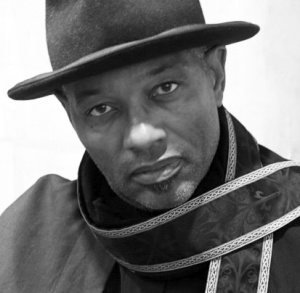
Within two years, an unaffiliated school across Braddock Road — Ascension Academy, on the campus that is now 4401 West Braddock Road 4401 West Braddock Road Middle School (grades 6–8) of St. Stephen's & St. Agnes since the late 1990s, on the West Braddock Road campus that previously housed Ascension Academy — the small independent … — admitted Terry Adkins Terry Adkins b. 1953 · d. 2014 Sculptor, conceptual artist, and musician whose interdisciplinary practice — his "recitals" — built large-scale installations around the lives of Black historical figures. As a … as its first African American student. Adkins, a teenager at the time, would become one of the most-acclaimed American sculptors of his generation; the sculpture-and-performance practice he later called the recital remembered Black historical figures the way a corridor of Episcopal schools eventually remembered itself.
1988–1991 — the merger
[4] Washington Post: Merger Set for St. Stephen's, St. Agnes' (1988) Article The boards of St. Agnes and St. Stephen’s voted in November 1988 to merge — five years of intense discussion among the heads of school, long-tenured staff, alumni, and parents had been required to get to that point. In September 1991, the two schools became one: a single co-educational K–12 institution called St. Stephen’s & St. Agnes School, with Joan Ogilvy-Holden as the first Head of School. The Saint Stephens Road campus became the Upper School for grades 9–12.
The Middle School came together separately. The independent Ascension Academy, on its longstanding campus at 4401 West Braddock Road, did not survive into the late 1990s as an independent institution. SSSAS acquired the property and reconfigured it as the Middle School for grades 6–8 — the campus that today carries the institutional weight of two distinct schools’ histories on the same patch of ground.
The Lower School, on Fontaine Street, picked up grades JK through 5, completing the modern three-campus arrangement. All three sites sit within a 1.5-mile radius — closer to one another than the Russell Road residence had been to its 1957 successor.
What the corridor looks like in 2026
A driver heading north on Quaker Lane from Beverly Hills into Seminary Ridge passes — in roughly this order, depending on detours — the original 1944 residence of St. Stephen’s (now unmarked), the 3737 Seminary Road 3737 Seminary Road Episcopal theological seminary founded in Alexandria in 1823 and relocated to its present hilltop campus in 1827. Occupied by Union forces during the Civil War and used as a … chapel, 1000 Saint Stephens Road 1000 Saint Stephens Road Upper School (grades 9–12) of St. Stephen's & St. Agnes School, occupying the Saint Stephens Road campus opened in January 1957 by St. Stephen's School for Boys. In 1961 the school … on its bend of Saint Stephens Road, the back fields of 1200 North Quaker Lane 1200 North Quaker Lane The first high school in Virginia, founded 1839 by Bishop William Meade of the Episcopal Diocese on a 100-acre campus west of Old Town. First principal William Nelson Pendleton … along Quaker Lane, and — turning west on Braddock — the campus of 4401 West Braddock Road 4401 West Braddock Road Middle School (grades 6–8) of St. Stephen's & St. Agnes since the late 1990s, on the West Braddock Road campus that previously housed Ascension Academy — the small independent … . North of those, on Fontaine Street, the 400 Fontaine Street 400 Fontaine Street Lower School (JK through grade 5) of St. Stephen's & St. Agnes School, on Fontaine Street in Seminary Hill. Originally a campus of St. Agnes School for Girls; rolled into SSSAS at … holds the youngest of the corridor’s roughly 2,500 students.
Five schools, two centuries, one moment in 1961 that mattered.
Sources for this story
- [1] Episcopal High School — Since 1839 Website
- [2] SSSAS School History Website
- [3] Episcopal Diocese of Virginia: Church Schools Celebrate 100 Years Article
- [4] Washington Post: Merger Set for St. Stephen's, St. Agnes' (1988) Article
- [5] City of Alexandria — Lloyd House History Website
- [6] Wikipedia, Episcopal High School (Alexandria, Virginia) Website
- [7] Wikipedia, St. Stephen's & St. Agnes School Website
The story will be expanded as additional records emerge — particularly on the Lloyd House → St. Agnes period (1924–1932) and the Lewis and Adkins integrations (1961, mid-1960s), neither of which is exhaustively documented in publicly available secondary sources. If you have records, photographs, or first-person memory of any of these chapters, please contribute a correction.
On the ground
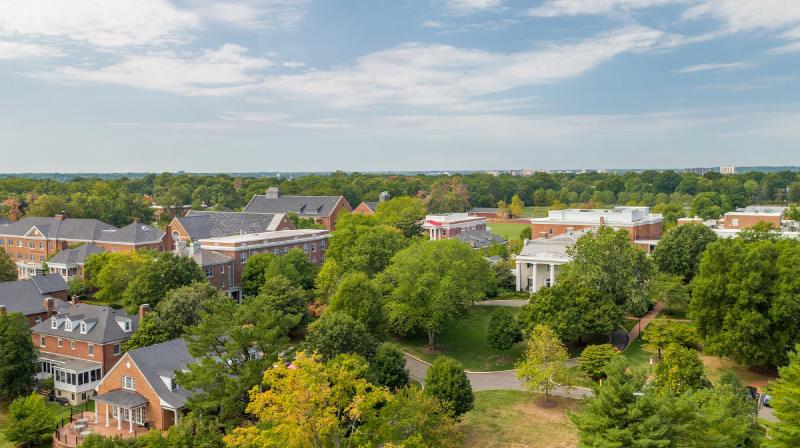
Episcopal High School's 100-acre campus from above, September 2019 — Hoxton House (white columns, right) anchors the south end; the Collegiate Gothic academic buildings ring the central quad. Aerial view of Episcopal High School, by Penguino2020 / Wikimedia Commons, CC BY-SA 4.0 (2019) 1200 North Quaker Lane
The first high school in Virginia, founded 1839 by Bishop William Meade of the Episcopal Diocese on a 100-acre campus west of Old Town. …
![Old Loyd [i.e. Lloyd] House, Alexandria, Va.](/images/gtdju7ejdnwoq7p/old_loyd_i_e_lloyd_house_alexandria_va_2rutnb54Yg._hu_952f28a739427277.jpg)
Old Loyd [i.e. Lloyd] House, Alexandria, Va. · Library of Congress, Prints & Photographs Division · http://www.loc.gov/item/2016803285/ 220 North Washington Street
Late-Georgian 1797 townhouse at the corner of North Washington and Queen built by merchant John Wise. Charles Lee, U.S. Attorney General and …
1000 Saint Stephens Road 1000 Saint Stephens Road
Upper School (grades 9–12) of St. Stephen's & St. Agnes School, occupying the Saint Stephens Road campus opened in January 1957 by St. …
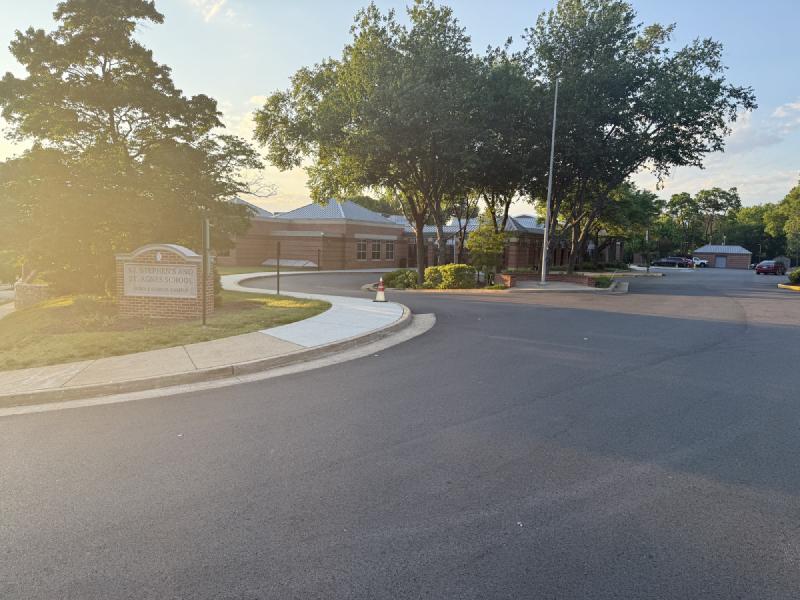
St. Stephen's and St. Agnes Middle School Campus on West Braddock Road at sunrise — the entrance sign and the brick academic buildings beyond, back-lit by golden-hour light. © KingSt.com, 2024 4401 West Braddock Road
Middle School (grades 6–8) of St. Stephen's & St. Agnes since the late 1990s, on the West Braddock Road campus that previously housed …
400 Fontaine Street 400 Fontaine Street
Lower School (JK through grade 5) of St. Stephen's & St. Agnes School, on Fontaine Street in Seminary Hill. Originally a campus of St. Agnes …
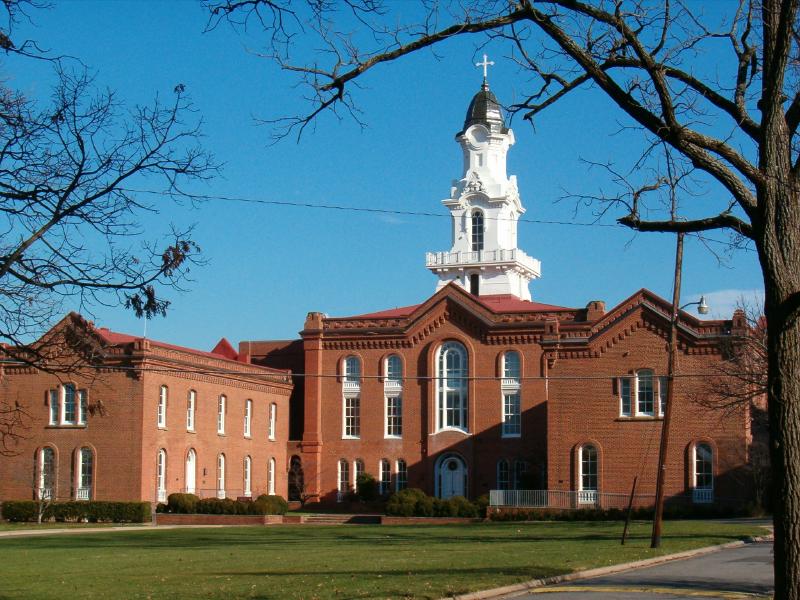
John W. Cross · via Wikimedia Commons · CC BY 2.5 3737 Seminary Road
Episcopal theological seminary founded in Alexandria in 1823 and relocated to its present hilltop campus in 1827. Occupied by Union forces …
Dramatis personae
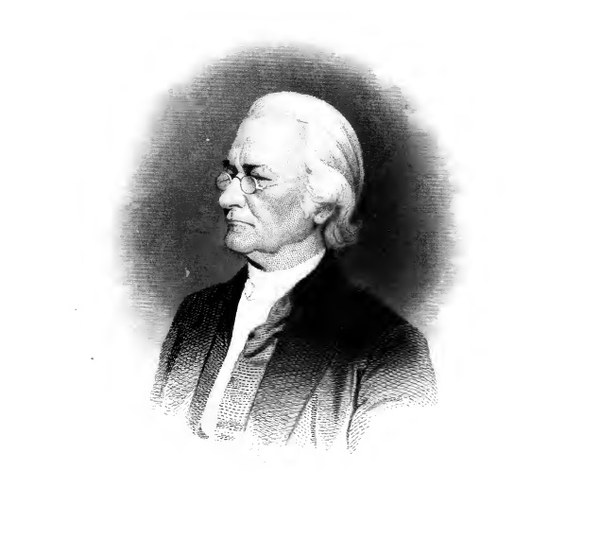
William Meade
b. 1789 · d. 1862
Second Bishop of Virginia (consecrated 1841; assistant bishop 1829–1841) and the founder of Episcopal High School in Alexandria in 1839 — the first high school in Virginia. A …
William Nelson Pendleton
b. 1809 · d. 1883
West Point–trained Episcopal priest who served as the first principal of Episcopal High School in Alexandria from its 1839 opening through 1844, then later as Robert E. Lee's chief …
The Rev. Edward Tate
Episcopal priest who founded St. Stephen's School for Boys at a single residence on Russell Road in Alexandria in 1944. The school was admitted that same year to the Church Schools …
Lloyd "Tony" Lewis
First Black student admitted to any of the Episcopal Church Schools of the Diocese of Virginia, entering St. Stephen's School for Boys in Alexandria in September 1961 — four years …
Terry Adkins
b. 1953 · d. 2014
Sculptor, conceptual artist, and musician whose interdisciplinary practice — his "recitals" — built large-scale installations around the lives of Black historical figures. As a …
Sources
- 1.
Episcopal High School, "Since 1839: A Brief History of EHS," episcopalhighschool.org, accessed 2026.
Website https://www.episcopalhighschool.org/about-us/since-1839-a-brief-history-of-ehs →
- 2.
St. Stephen's & St. Agnes School, "School History," sssas.org, accessed 2026.
- 3.
Episcopal Diocese of Virginia, "Church Schools Celebrate 100 Years +," episcopalvirginia.org.
Article https://episcopalvirginia.org/stories/schools-100-years/ →
- 4.
Washington Post, "Merger Set for St. Stephen's, St. Agnes' Schools in Virginia," November 30, 1988.
- 5.
City of Alexandria, "Lloyd House History," alexandriava.gov, accessed 2026.
Website https://www.alexandriava.gov/historic-sites/lloyd-house-history →
- 6.
Wikipedia, "Episcopal High School (Alexandria, Virginia)," accessed 2026.
Website https://en.wikipedia.org/wiki/Episcopal_High_School_(Alexandria,_Virginia) →
- 7.
Wikipedia, "St. Stephen's & St. Agnes School," accessed 2026.
Website https://en.wikipedia.org/wiki/St._Stephen's_%26_St._Agnes_School →